70% of AI adoption in private equity is people and change, not technology.
Orphan pilots across portfolio companies waste budget without ownership.
Map tacit knowledge from deal teams before deploying AI agents.
Generative AI tools without proprietary data sources create zero competitive advantage.
Structure vendor contracts with benchmarks, value creation targets, and exit ramps.
Get 1% smarter about AI in financial services every week.
Receive weekly micro lessons on agentic AI, our company updates, and tips from our team right in your inbox. Unsubscribe anytime.
Thank you! Your submission has been received!
Oops! Something went wrong while submitting the form.
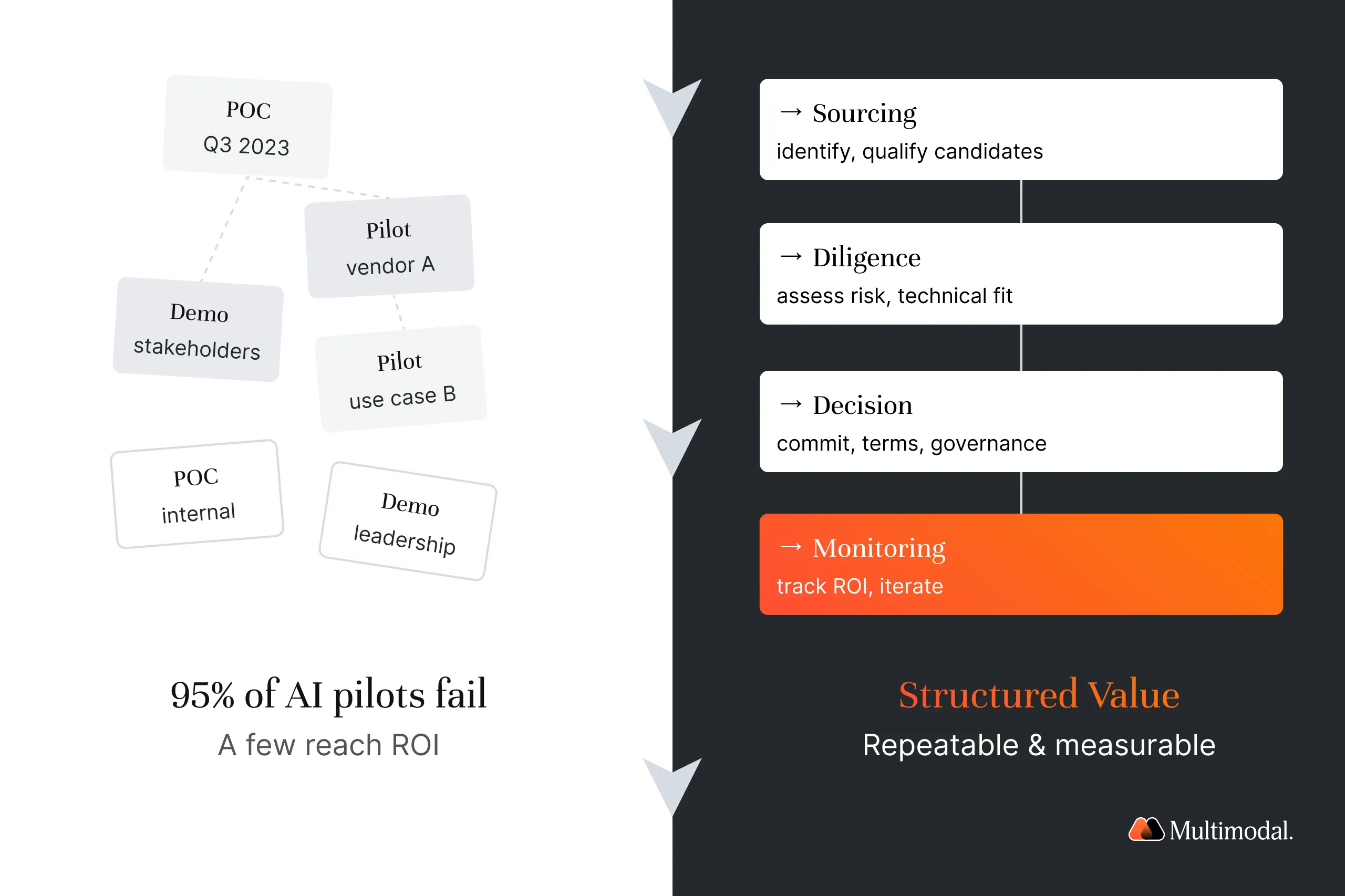
Most private equity firms have experimented with AI by now. Very few have made it work. In 2023 and 2024, roughly 90% of AI activity inside private equity was experimentation. Pilots launched. Demos got applauded. Budgets got approved. Then nothing happened.
According to MIT's Project NANDA, 95% of generative AI pilots fail to reach production. Only 5% of custom enterprise AI tools deliver measurable P&L impact. For an industry built on returns, that hit rate is unacceptable.
So what separates the private equity firms generating real value creation from AI agents from the ones still burning budget on proof-of-concept projects?
We recently hosted a conversation with two practitioners living this problem daily: R.C. Willenbrock, leader of RCVC, an AI consultancy with an investment arm, and Brent Alvord, Managing Director and Head of Research at Sweetwater Private Equity. Their insights surfaced hard truths about deploying AI in private equity operations that most AI solutions vendors would rather not say out loud.
Why Private Equity Firms Stall on AI Adoption: The 10/20/70 Rule
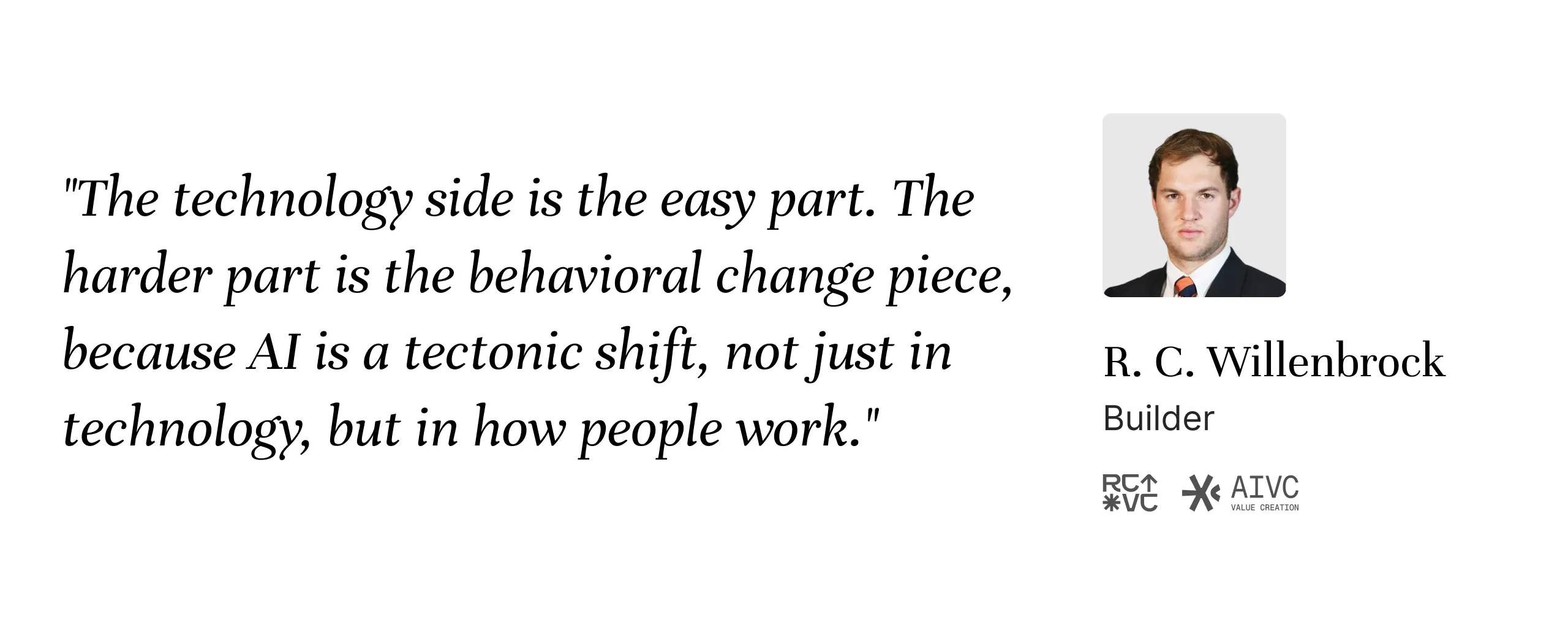
BCG's 10/20/70 rule reframes how every operating partner should think about deploying AI agents across portfolio companies. Only 10% of a successful AI transformation is about the algorithms and AI technologies. Twenty percent is about data and processes. The remaining 70% is about people and organizational change.
Most PE firms invert this completely. Private equity teams spend almost all their energy evaluating generative AI tools, running vendor demos, and comparing large language models. The harder work of reshaping how deal teams, investment teams, and management teams actually operate goes untouched.
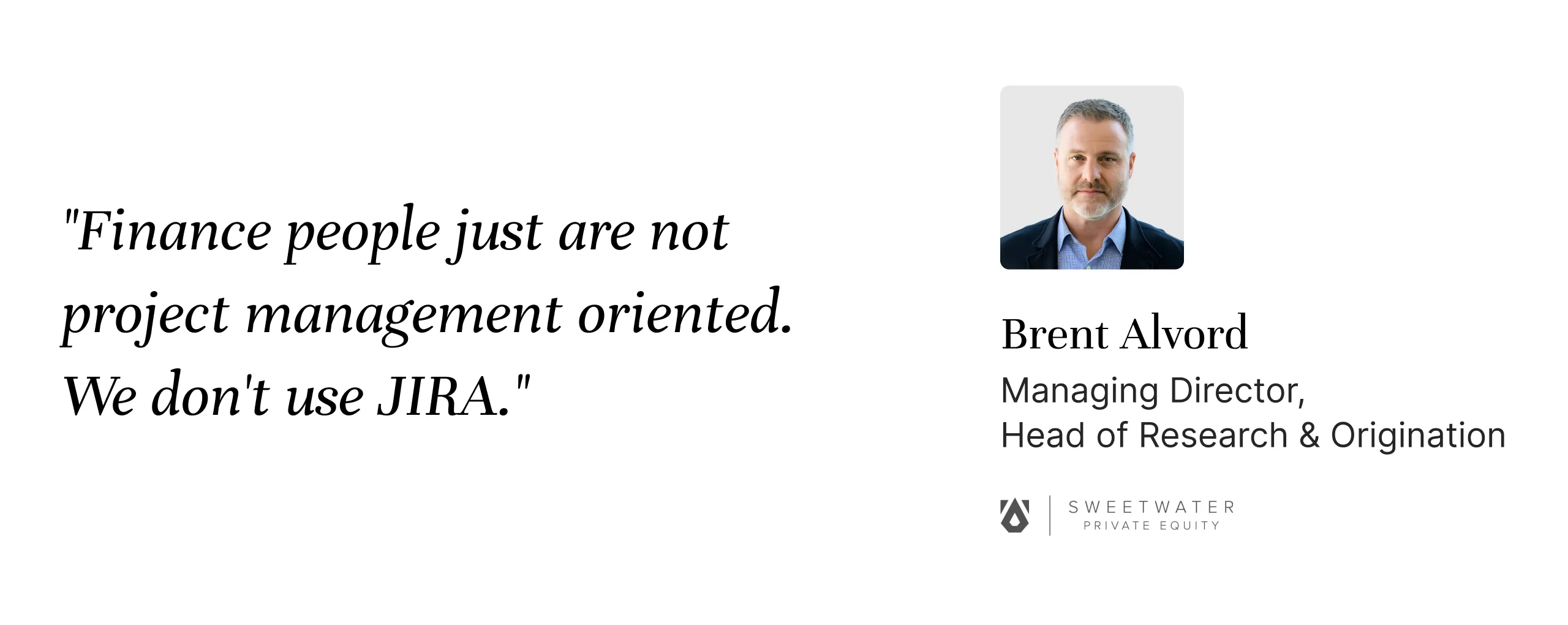
This is not a problem unique to private equity. But it is worse in private equity operations than in most industries. Finance professionals are not product people. They do not document workflows in project management systems. They manage work through email inboxes and meetings. Their internal processes remain largely undocumented.
That means the foundational raw material that AI agents need to function, documented processes, structured data sources, and clearly scoped routine tasks, simply does not exist in most private equity firms. Without it, even the best AI models and generative AI tools produce mediocre results. The key difference between PE firms that see productivity gains from AI and those that do not often comes down to this foundational work.
Download Full Report
See how private equity firms are applying agentic AI across sourcing, diligence, portfolio operations, and value creation.
How Orphan Pilots Undermine AI Deployment Across Portfolio Companies
Willenbrock uses an analogy that is hard to forget. Think of a Michelin-star kitchen. Each chef owns one dish end to end. Sourcing, preparation, execution, presentation. The feedback loop is fast. If the dish fails, everyone knows who is responsible.
Now imagine the opposite: a garlic chef, a butter chef, a vegetable chef, each running around the kitchen adding their ingredient to every dish. The result is chaos. Nobody can tell whether any single dish is delivering real value.
That second kitchen is how most private equity firms deploy AI today across their portfolio companies.
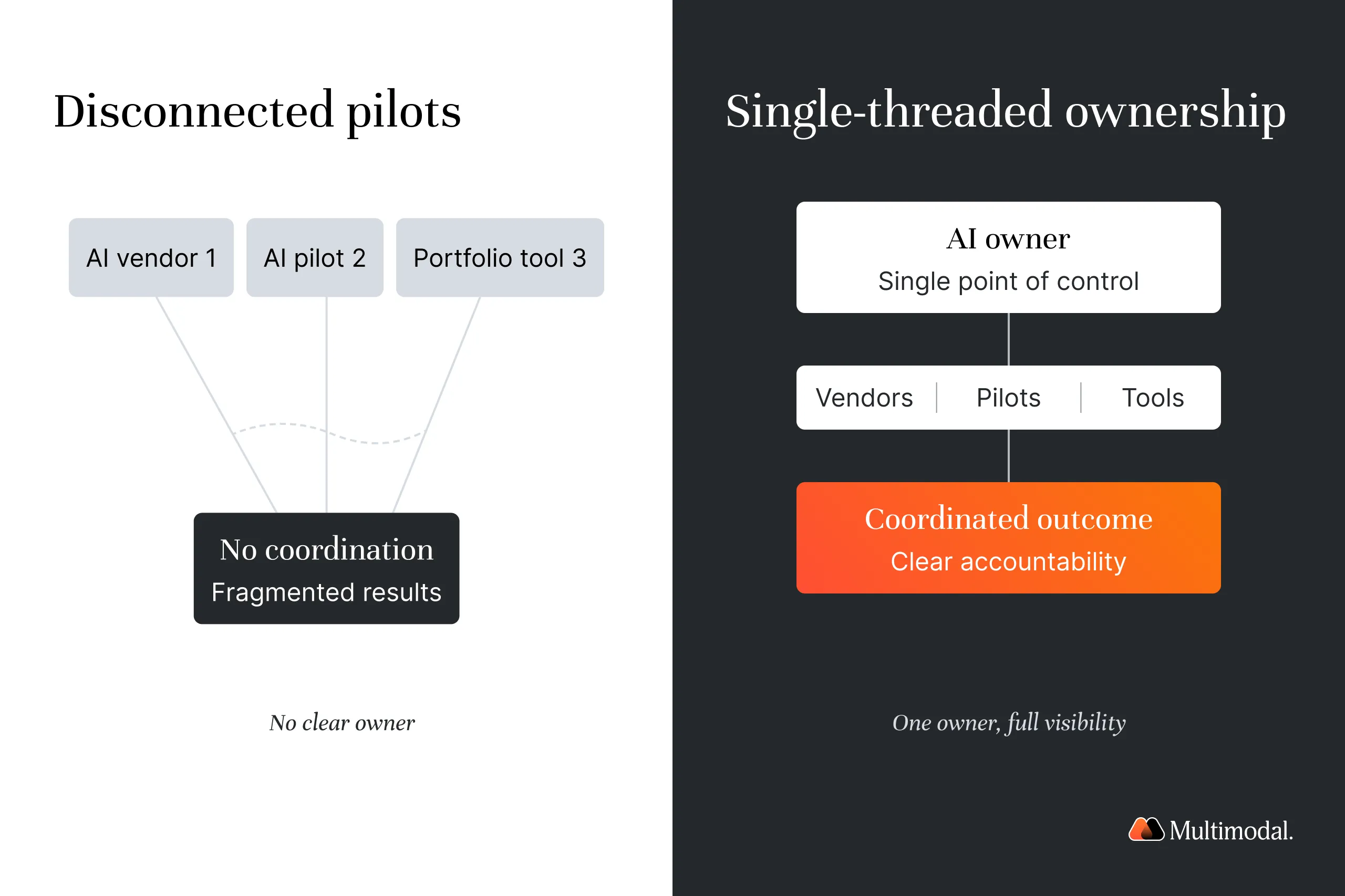
"What ultimately happens is you wind up with this plethora of what we call orphan pilots. Someone in the organization raises their hand, says they have a problem, gets it signed off, brings on a vendor, and then has no holistic vision for how it connects to anything else." — R.C. Willenbrock
The result: fragmented AI solutions scattered across multiple portfolio companies and internal processes. No governance. No feedback loop. No clear success metrics. No portfolio monitoring of what is working and what is not.
Bain's 2025 Global Private Equity Report confirms this pattern at scale. While nearly two-thirds of PE general partners are running generative AI pilots across their portfolio companies, only about 20% have operationalized AI use cases with concrete results.
The fix is not more pilots. PE firms need to treat AI deployment like a product. That means a single-threaded owner who can see the full picture, prioritize across the portfolio, and build an interoperable ecosystem of AI tools rather than a patchwork of disconnected point solutions. This is how private equity firms move from experimentation to operational efficiency.
Surfacing Tacit Knowledge: A Repeatable Model for AI Readiness in Private Equity
One of the most practical insights from the conversation came from Alvord's experience building AI readiness at Sweetwater. Rather than starting with AI technologies, he started with his underwriting team and their existing investment process.
"I ran my whole underwriting team through a 40-minute workshop. I came up with ten different scenarios, and literally my question to everybody was: start writing. What are the first questions you would ask?" — Brent Alvord
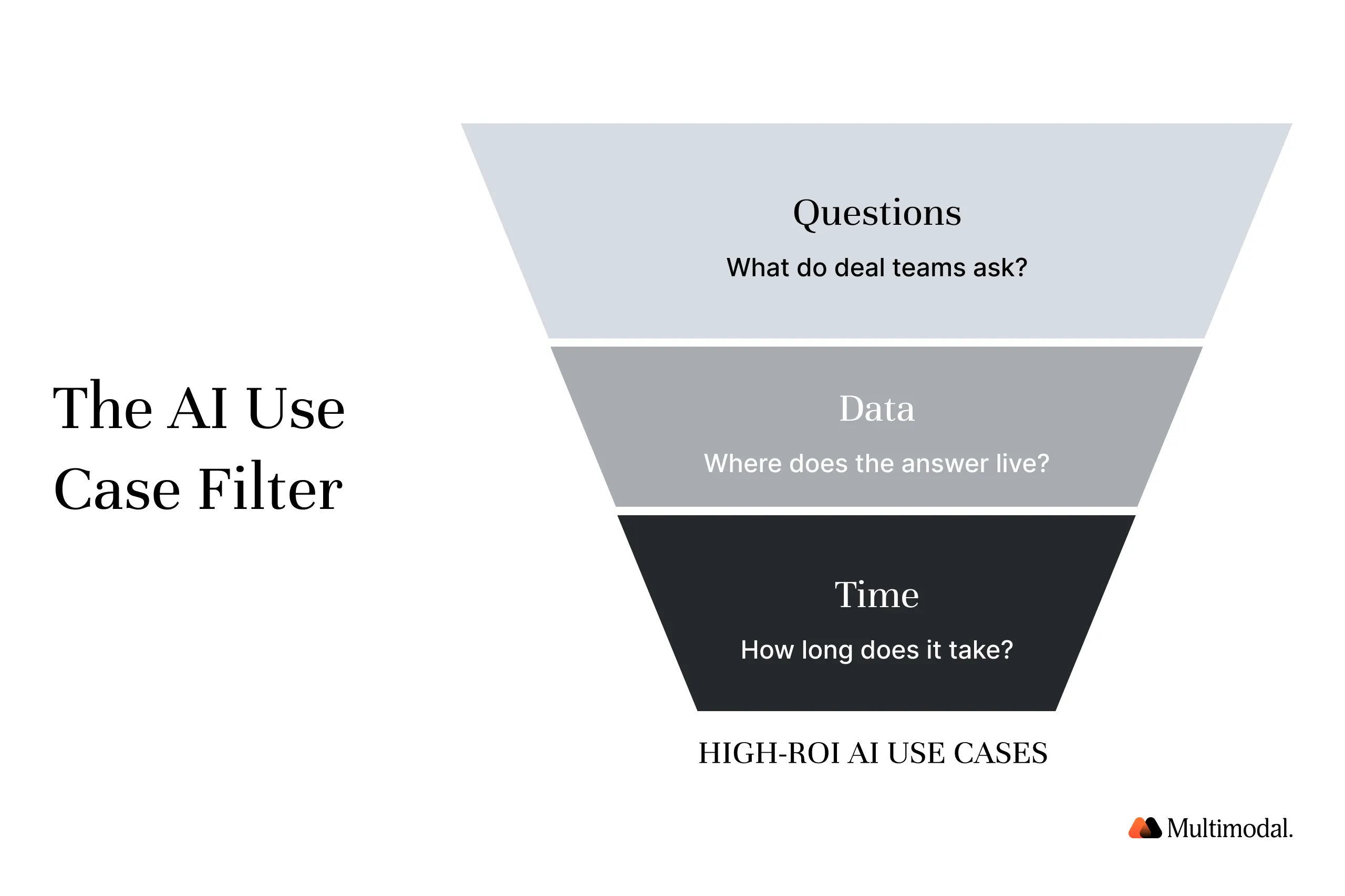
The exercise surfaced roughly 120 questions. After deduplication and a forced-ranking survey, the team distilled those into 15 critical questions. Then came two more rounds of data analysis: Where do you get this data today? What data sources do you use? And how much time does it take?
That three-step process produced a clear prioritization framework for where AI agents could deliver real value creation across the firm's private equity operations:
Identify the highest-value questions that deal teams and investment teams ask repeatedly.
Map the data sources, including financial reports, financial statements, data rooms, market data, and historical data, where answers live today.
Calculate the time cost to identify potential risks, spot market trends, and make informed investment decisions using current manual methods.
This approach also revealed how much undocumented, tacit knowledge lives inside experienced professionals and never makes it into any system. Operating partners, senior underwriters, and deal teams carry decades of pattern recognition in their heads. That institutional knowledge is what separates good due diligence from great due diligence.
"There is so much tacit knowledge, so much judgment built into this business. It is very difficult to build an instruction manual around it, but that is the essential work that has to be done." — Brent Alvord
This is the kind of deep product work that private equity teams need to do before any AI model, generative AI tool, or vendor enters the picture. Without it, PE firms are deploying AI against incomplete maps. That is why so many AI solutions fail to deliver the productivity gains and efficiency gains that private equity firms expect.
Buy vs. Build: Deploying AI With Clear Benchmarks and Exit Ramps
The conversation closed on one of the hardest decisions in private equity operations today: whether to buy, build, or partner for AI capabilities. Both panelists were blunt about the vendor landscape and the high cost of getting it wrong.
"Vendors, in my opinion, are almost preying on private equity firms." — R.C. Willenbrock
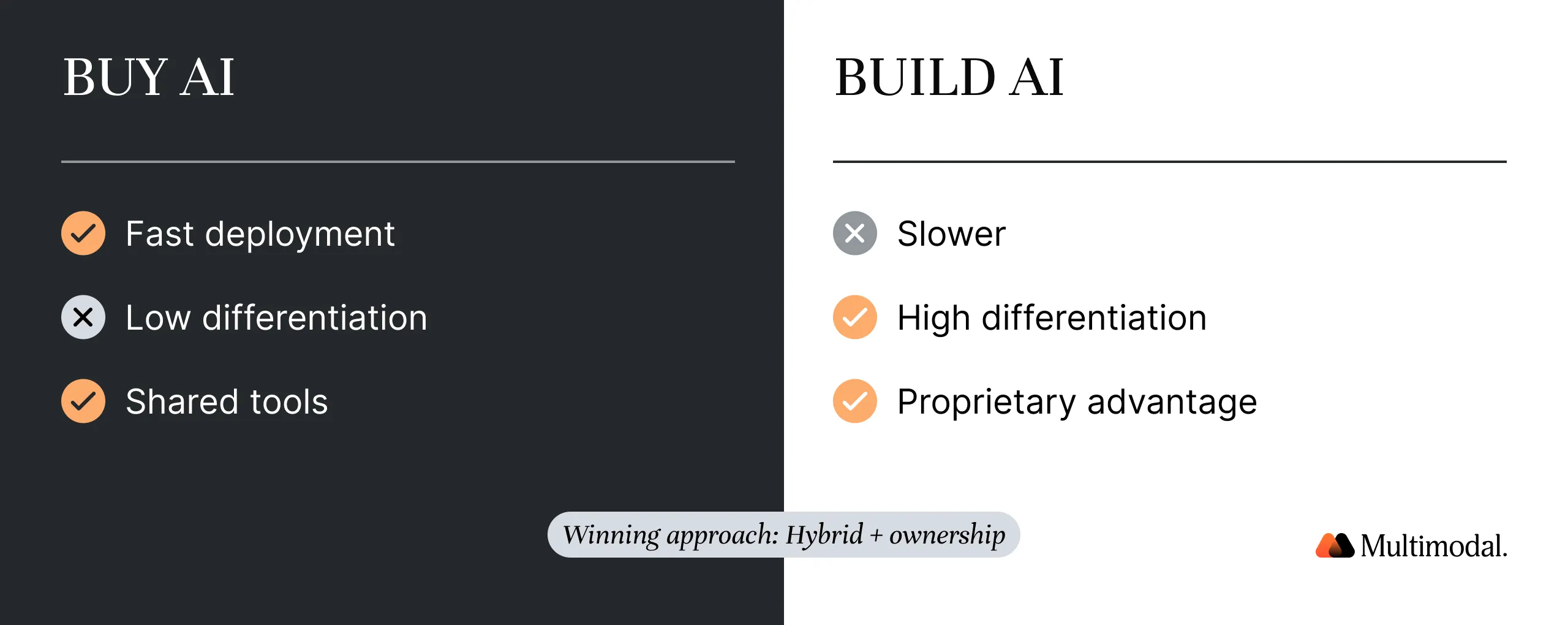
Willenbrock pointed to the number of AI solutions that promise to ingest all of a firm's proprietary data sources and deliver strategic insights through a polished interface, but offer no competitive advantage or differentiation. If every PE firm buys the same off-the-shelf generative AI tools, nobody gains an edge. The same AI tools trained on the same market data produce the same outputs for everyone.
Alvord echoed the concern from the buy side: "I find vendors for the most part promise the world. Most of what they talk about just really is not feasible, to be totally honest."
Their practical advice for PE firms navigating the AI deployment landscape:
Structure contracts with clear benchmarks. If you hire consultants or vendors, build in measurable deliverables and exit ramps. Several private equity firms have spent millions on sprawling AI projects that were discoverable as failures along the way but had no off-switch. Clear success metrics and risk assessments upfront prevent this.
Build for competitive advantage, not convenience. Buying the same generative AI tools as every other fund means competing on a level playing field. Building an interoperable ecosystem of best-in-class AI tools, configured to your firm's differentiated workflows and business models, creates long-term competitive advantage. Private equity firms that invest in their own data infrastructure, including financial data, historical fundraising data, and proprietary data sources, compound that advantage over time.
Maintain internal product-oriented ownership. A head of AI alone will not close the execution gap. That person needs to be a shepherd of third-party partners. They function as the internal operating partner for AI, managing software development timelines, checking portfolio performance against benchmarks, and ensuring AI deployment actually reaches production across the portfolio.
"If you get one more good deal, it pays for everything." — R.C. Willenbrock
The investment in data infrastructure and AI systems may represent a high cost upfront. But the returns, measured in faster due diligence, better deal sourcing, stronger portfolio monitoring, and smarter data-driven decisions, compound over time. For private equity firms in private markets, where even small improvements in the investment process translate to outsized returns for limited partners, the math works.
Frequently Asked Questions (FAQs)
What is the 10/20/70 rule for AI in private equity?
BCG's 10/20/70 rule states that successful AI transformations allocate 10% of effort to algorithms and AI technologies, 20% to data and processes, and 70% to people and organizational change. Most private equity firms invert this and focus almost entirely on technology, which is why AI adoption stalls across portfolio companies.
Why do most AI pilots fail in private equity firms?
Most AI pilots in private equity become orphan pilots, launched without holistic ownership, clear governance, or connection to the firm's broader operating model. MIT's Project NANDA found that 95% of generative AI pilots fail to reach production. The root cause is typically a people and process gap, not a gap in AI technologies.
How should PE firms prioritize AI use cases across portfolio companies?
Start with the human side. Identify the biggest pain points and time sinks across deal teams, underwriting, and fund operations. Map the data sources and time costs for each workflow. Prioritize based on where adoption is most likely and where productivity gains are measurable, not where theoretical value is highest.
This post covers the highlights. The full conversation between R.C. Willenbrock and Brent Alvord goes much deeper into what is actually working in PE fund operations today. Watch the full recording to go deeper.
Should private equity firms buy or build AI tools?
There is no single answer. Off-the-shelf generative AI tools are faster to deploy but offer no competitive advantage. Building proprietary data infrastructure around your own financial data, historical data, and internal processes is more expensive upfront but creates a durable edge. Most private equity firms will need a hybrid approach with strong internal product ownership to manage external partners and AI solutions vendors.
What is an orphan pilot in AI deployment?
An orphan pilot is an AI project launched in isolation, without a holistic strategy, clear ownership, or a feedback loop. It typically starts when one portfolio company or team identifies a problem, brings on a vendor, and builds a point solution that cannot be measured, scaled, or integrated into the firm's broader AI systems and digital transformation strategy.
How can operating partners drive AI adoption in private equity?
Operating partners play a critical role in AI adoption by connecting AI deployment to value creation goals across portfolio companies. They help map existing workflows, identify high-ROI use cases for AI agents, and ensure that management teams and investment teams have the support they need to move from pilots to production. Without operating partner involvement, AI initiatives tend to stall in experimentation.
What role does data security play in deploying AI in private equity?
Data security is central to any AI deployment in private equity. PE firms handle sensitive financial reports, legal contracts, and proprietary data sources from limited partners, potential investors, and portfolio companies. Deploying AI agents within a firm's own VPC or on-premises environment helps maintain data security and regulatory compliance. This is a key difference between enterprise-grade AI solutions and generic generative AI tools.

.svg)
.svg)

.avif)
.png)

.png)
.webp)