Most AI maturity models measure technology and data first, and people last.
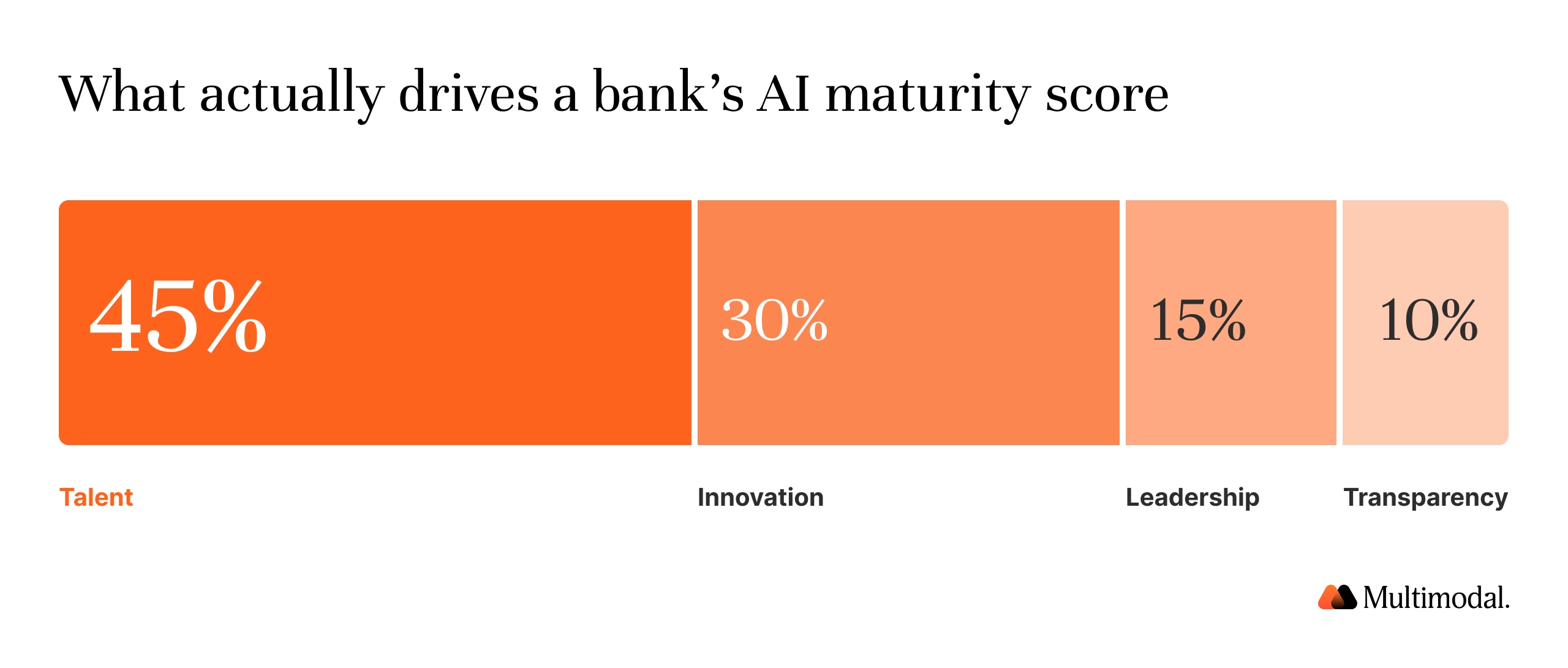
Evident's index of 50 large banks weights AI talent higher than any other pillar.
Only 16% of credit unions report a comprehensive AI roadmap with governance and metrics.
Small credit unions rank talent shortages as their single biggest strategic constraint.
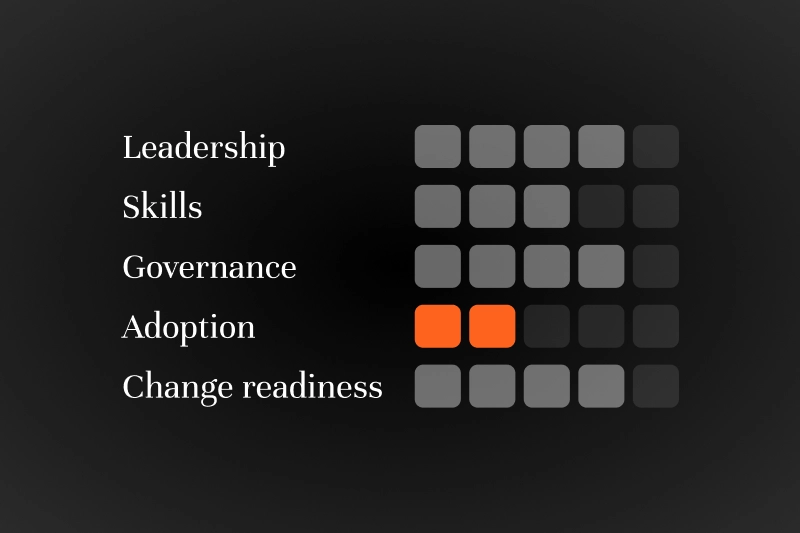
Score each talent dimension on its own. Your lowest score sets your real stage.
Get 1% smarter about AI in financial services every week.
Receive weekly micro lessons on agentic AI, our company updates, and tips from our team right in your inbox. Unsubscribe anytime.
Thank you! Your submission has been received!
Oops! Something went wrong while submitting the form.
An AI maturity model is a staged framework that shows how far an organization has progressed from experimenting with artificial intelligence to running on it, and what must be true of that organization at each step. Most published models score an institution's AI capability by counting AI tools, data infrastructure, and governance structures.
This one measures the people: leadership literacy, staff skills, defined roles, and the learning system that keeps all three current. AI maturity models like this one help an organization assess its current AI capabilities and provide a roadmap for advancing them, turning isolated pilots into systemic business change rather than one-off experiments.
AI adoption at credit unions has outrun AI maturity. Two-thirds of credit unions are actively implementing AI in targeted areas, and 59% have deployed generative AI somewhere in the business, but only 16% report a comprehensive AI roadmap spanning multiple departments with governance frameworks and measurable business impact.
Nationally, 88% of organizations now use AI in at least one business function, up from 78% a year earlier, and the largest banks are closing their own maturity gap by hiring: banks tracked by the Evident AI Index have pushed AI headcount past 90,000 people. Credit unions cannot out-hire that gap. Their AI capability has to grow from the staff already on payroll.
This guide lays out five stages of AI maturity, the four talent dimensions that define each one, how to score your own credit union, and the specific move that gets you to the next stage.
What Is an AI Maturity Model?
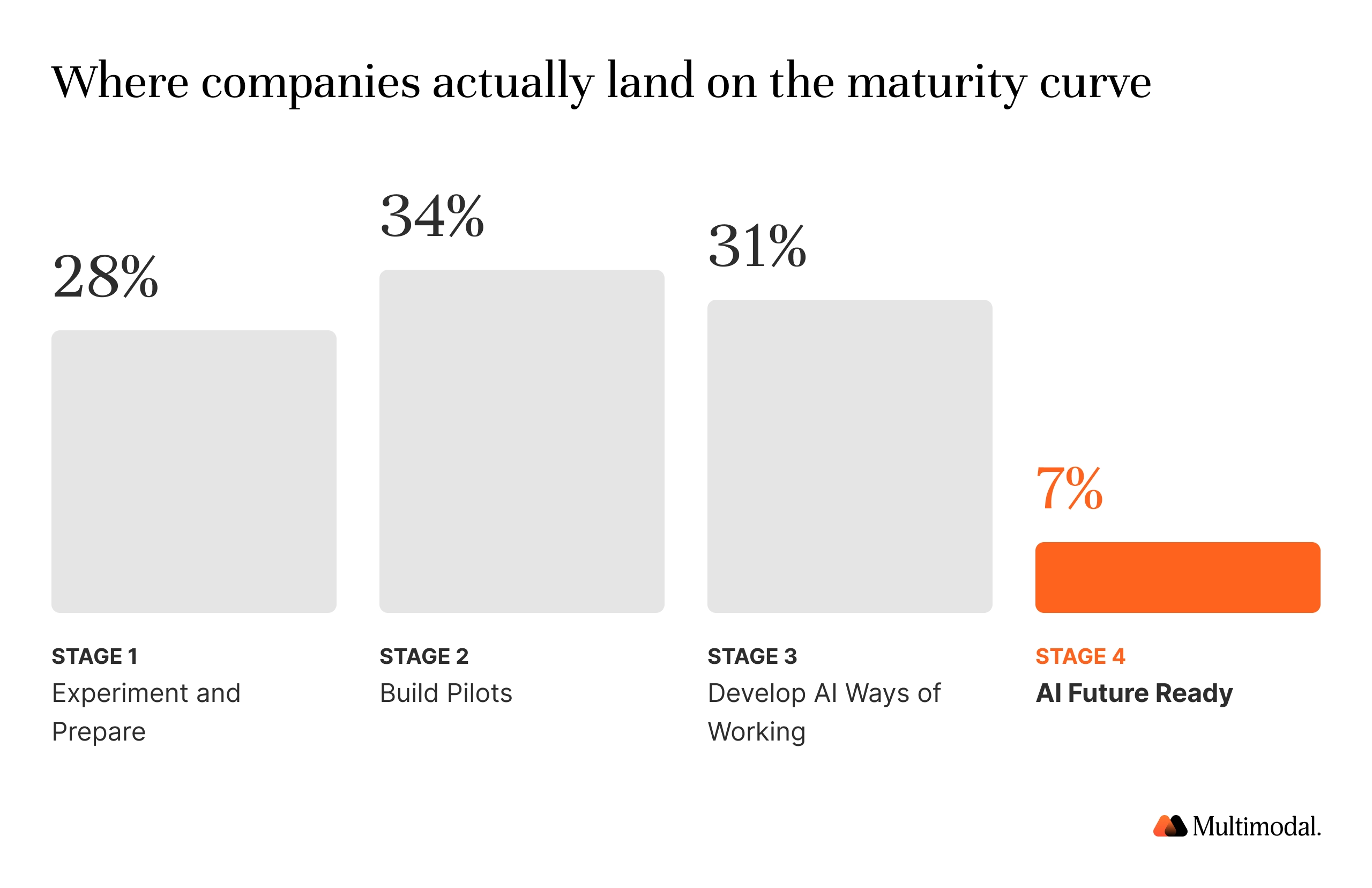
An AI maturity model breaks an organization's AI journey into stages and defines which capabilities must be in place at each stage before the organization can call itself further along. MIT's Center for Information Systems Research built a rigorous cross-industry version with four stages: Experiment and Prepare, Build Pilots and Capabilities, Develop AI Ways of Working, and Become AI Future Ready. Its first stage centers on workforce education and policy, not tools.
In MIT CISR's 2022 survey of 721 companies, 28% of firms were in the first stage, 34% in the second, 31% in the third, and just 7% reached the final stage, where financial performance was well above the industry average. That data is cross-industry and three years old, a general signal rather than a credit union number.
Published models typically define four to seven stages; this one uses five, organized around people rather than tools. Most also include the machine learning models already embedded in underwriting and fraud detection tools, not only the newer generative and agentic systems this guide focuses on.
The credit union-specific read is less advanced. Wipfli's 2026 survey of 100 credit union executives found that two-thirds were actively implementing AI in targeted areas, but only 16% had a comprehensive roadmap spanning multiple departments and demonstrating measurable business impact.
Maturity also varies sharply by size: 29% of large credit unions report the highest maturity level, against just 3% of mid-sized ones, and about a quarter of small credit unions are still in the research phase. That gap between broad adoption and real maturity, on the people side of the ledger, is exactly what this framework is built to close.
Why Is Talent the Pillar Credit Unions Cannot Buy?
At the institutions furthest along, AI maturity is a talent story before a technology one, and credit unions cannot solve it the way the biggest banks do. Organizational culture is as critical to successful AI implementation as the technology itself, and includes workforce skill levels and leadership buy-in in equal measure.
MIT CISR’s own data backs this: companies further along the maturity curve report better decision-making and a lasting competitive advantage, not just a faster technology stack. The Evident AI Index, which scores 50 of the world's largest banks, weights its four pillars unevenly: Talent at 45%, Innovation at 30%, Leadership at 15%, and Transparency at 10%. Talent carries more weight than the other three combined.
AI headcount at those 50 banks grew by more than 25% in a single year, to over 90,000 people, and the banks with the largest AI teams rolled out nearly twice as many AI use cases as their peers. Evident's companion Talent Report adds the training half of the picture: 37 of the 50 banks, or 74%, provide AI-specific training to employees, and roughly 1 in every 50 bank employees now works in an AI or data-related role.
Credit unions report the mirror image of that investment. In Wipfli's 2026 survey, small credit unions ranked talent shortages as their single biggest constraint on strategic priorities for the year, ahead of the economy, deposit growth, and interest rate pressure. Large credit unions, when asked about barriers to digital transformation, most often cited a lack of talent or technical expertise. Neither can match a global bank's hiring budget, so their AI capability has to come from developing the staff they already have.
The talent that needs developing is also a moving target. The World Economic Forum's Future of Jobs Report 2025 found that nearly 40% of core job skills are expected to change by 2030, and 63% of employers cite the skills gap as their biggest barrier to transformation, even though 77% plan to prioritize upskilling. Microsoft and LinkedIn's 2024 Work Trend Index found that only 39% of employees who use AI had actually been trained on it by their employer. Ambition to upskill is not the same as an existing training program.
A credit union's route to AI maturity runs through the people it already employs. That is why the model below scores the organization on them. Adopting AI technologies touches more than a licensing decision. It reshapes business processes, automates certain tasks, and surfaces valuable insights that used to take a specialist to find, but only when a credit union approaches AI use and AI activity in a structured way, department by department, instead of ad hoc.
The Five Stages of a Talent-First AI Maturity Model
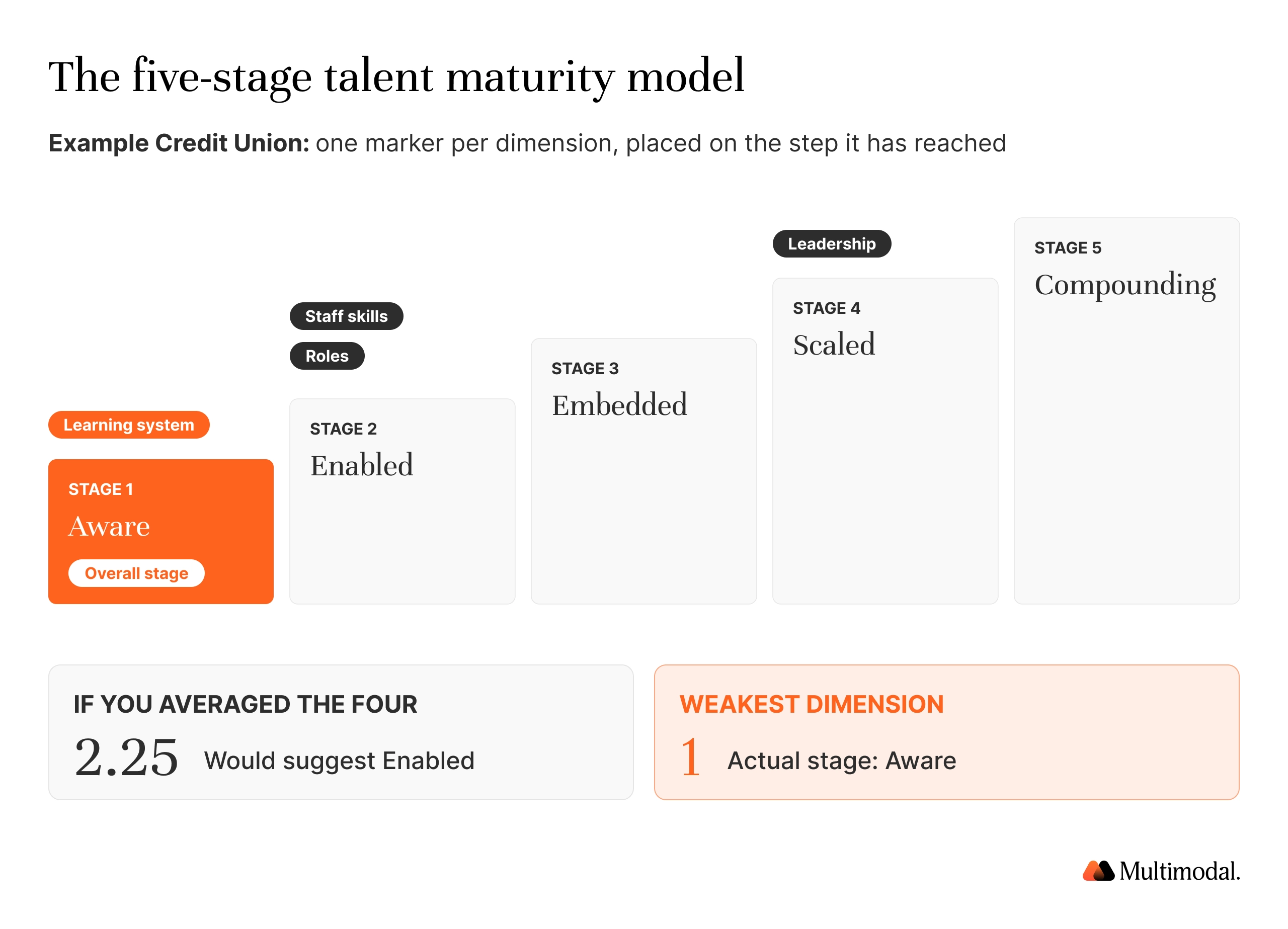
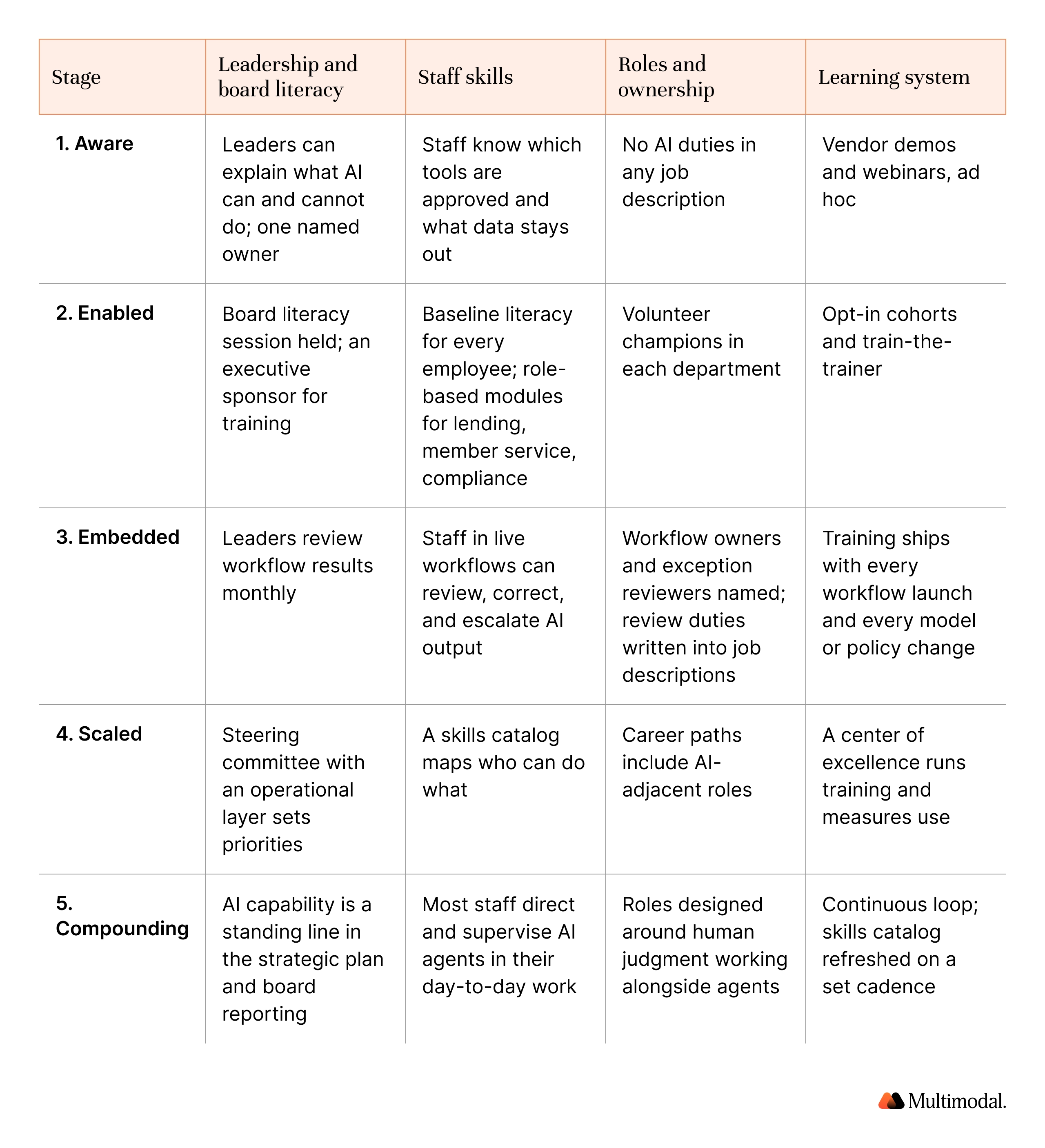
This is Multimodal's own framework, built from four talent dimensions rather than from tool counts or data pipelines. Score your credit union on each dimension separately using the table below.
Most credit unions stall on the way into the third stage, Embedded, because it is the first one that demands a named owner and a live workflow rather than training alone. Reaching the final stage, Compounding, is rare everywhere: in MIT CISR's cross-industry data, only 7% of firms got there.
How Do You Score Your Credit Union's AI Maturity?
Rate each of the four dimensions in the table, from 1 to 5, against what is actually true today, not what the strategic plan says should be true. Your credit union's real stage is your lowest score, not your average and not your highest score. The gap between your highest and lowest dimension is your friction, and it points directly at your next move.
For example, a credit union that bought Stage 4 software, trained staff to Stage 2, and defined zero AI-specific roles is not a Stage 4 organization with a training gap. It is a Stage 1 organization with expensive software, because the lowest dimension caps the whole score.
"An organization isn't just one homogeneous group. Your maturity for data and AI is going to be different in different areas, whether it's your governance, whether it's your strategy, whether it's your people, your policies, your procedures... How do you synchronize all that so that you don't have friction? Because if one area is too mature and it's dragging the other areas, it's going to cause friction." — Adrian Rodriguez, Former SVP of Data and Innovation, American Heritage Credit Union
What Moves a Credit Union From One Stage to the Next?
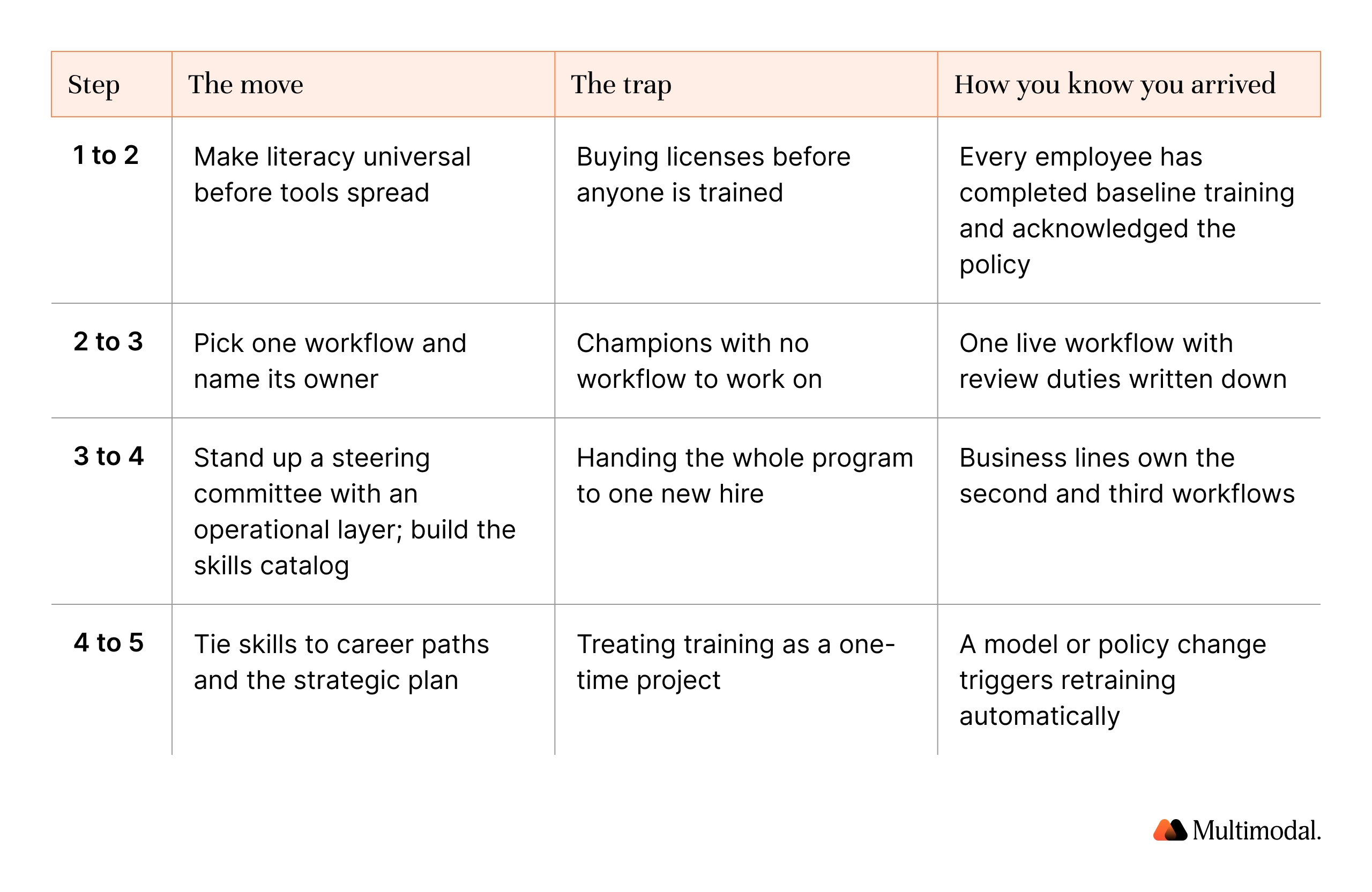
The first move matters most: licensing an AI tool before staff has baseline literacy is the exact trap the Microsoft and LinkedIn data above points to. The move from the second stage to the third is where volunteer enthusiasm turns into real capability, or fades: champions need one live workflow, with an owner and written review duties, not a mandate to "explore AI." The fourth-stage move changes the structure itself to a steering committee with an operational layer beneath it, so the program does not depend on a single hire.
"The direction that we started in is really three pillars for AI specifically. Governance, right? We need to create really safe guardrails for people to play in... Education. So you [have] people all over your organization on the spectrum of AI, right? Like I'm really comfortable or I'm scared to death or I don't know anything about it. And then use case driven. So enablement." — Courtney Rowan, SVP and Chief Digital and Transformation Officer, Citadel Credit Union
Where Does Talent Sit Next to Governance and Data?
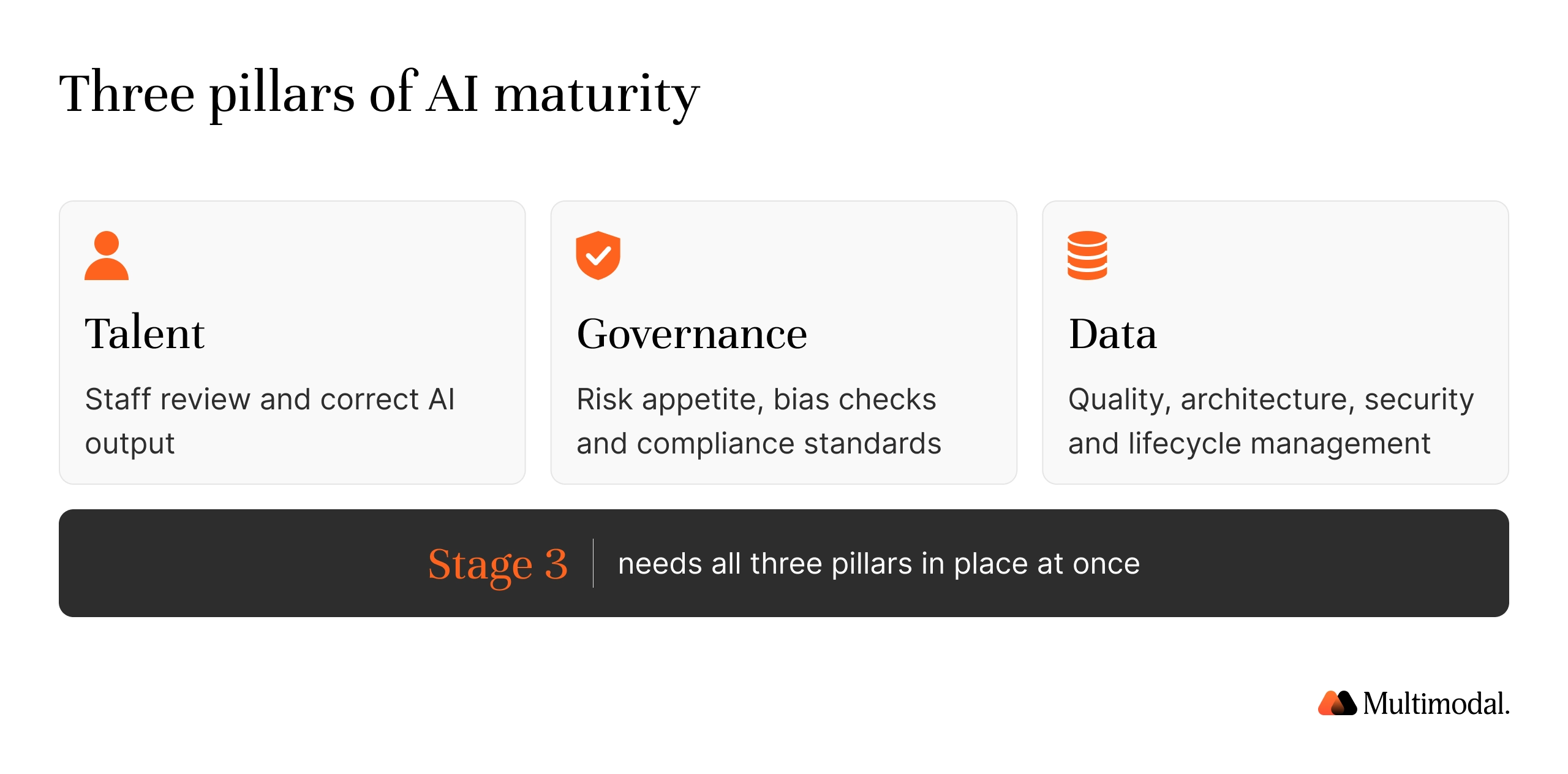
Talent is one pillar of AI maturity, not the whole model. A credit union cannot reach the third stage, where staff review and correct AI output as a job duty, without a governance structure defining what to escalate regarding member data privacy and fair lending compliance, and without data clean enough to trust.
Filene's research frames AI readiness the same way this model does: a leadership and culture issue first, not a technology purchase. Data readiness itself has four parts: quality, architecture, security, and lifecycle management the pieces that together make up disciplined data management, and none of them are optional once staff starts reviewing AI output as a job duty.
Governance and ethics work together here too: clear ethical guidelines, a defined risk appetite, model bias checks, documented security risks, risk management policies, and clear compliance standards are what turn a compliance requirement into a real governance structure, not just a policy binder.
Our AI-ready data post covers the data governance and data quality side.
Most organizations already have the binder: 75% report having established AI usage policies, but a policy is not the governance structure a credit union needs to reach the third stage. Establishing a unified AI strategy, rather than a policy per department, aligns AI initiatives with the credit union’s actual business objectives.
What Does This Look Like in Practice?
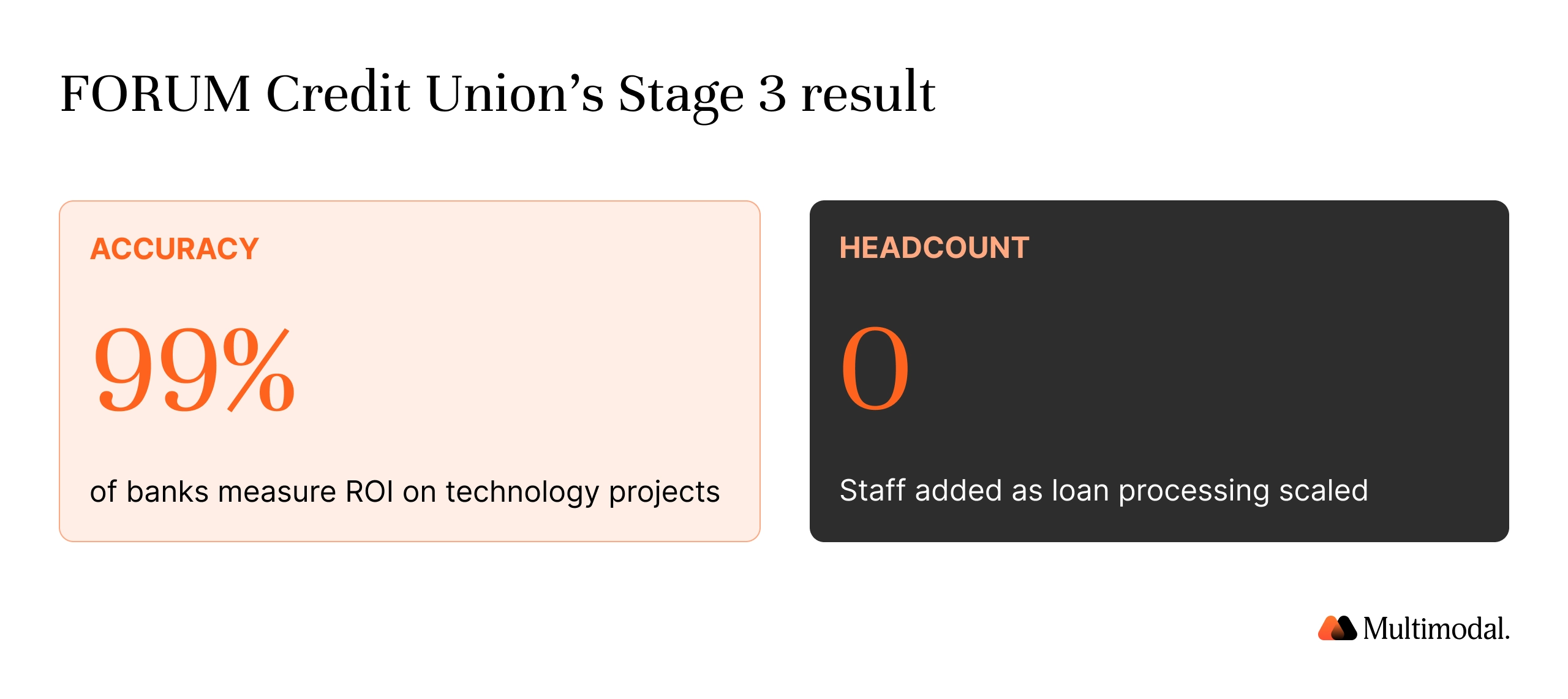
FORUM Credit Union's lending team is a Stage 3 story in this framework. Running loan file processing through AgentFlow, FORUM reached 99% document classification accuracy across 62 document packages, well past its own 90% target, and has scaled loan processing without adding headcount. The technology did not replace the reviewers. It gave them a workflow with review duties clear enough to own, the Stage 3 marker above.
The same pattern holds for credit unions and other financial institutions alike: operational efficiency and cost savings show up first, and the member or customer experience improves once staff spend their time making judgment calls rather than on paperwork.
Your First 90 Days
Score (weeks 1 to 2). Rate all four dimensions against the table above, name one owner, and share your lowest score with the executive team.
Enable (weeks 3 to 8). Run baseline AI literacy training for every employee, hold one board session, and recruit an opt-in champion cohort from every department.
Embed (weeks 9 to 13). Launch one workflow with a named owner and written review duties, then re-score and report the gap to the board as a people number. Treat each cycle as a risk assessment as much as a training plan: address the specific challenges your lowest dimension creates, apply real change management discipline, and measure progress the same way every time.
Maturity Lives in the Job Descriptions
Technology is the part of AI maturity a credit union can buy. The talent dimensions, leadership literacy, staff skills, defined roles, and a real learning system must be built stage by stage, and your lowest-scoring dimension sets the pace, no matter how advanced your tools are. That is why AI maturity is important for credit unions specifically: technology is the part any competitor can buy.
The potential benefits compound when a credit union treats this as continuous improvement rather than a one-time project. A structured approach is what enables a credit union to support innovation as new technologies emerge, turning talent into measurable business value.
Send us one workflow and the team that runs it today. We will run it through AgentFlow and show you which steps move to the agent, which stay with your people, and what your reviewers would see on every file.
Find Out Your Real AI Maturity Stage
Most scorecards measure your tools, not your people. Book a 30-minute session, and we'll score your real talent stage together.
An AI maturity model is a staged framework that measures how far an organization has progressed from experimenting with AI to running core operations on it. Most models assess technology and data readiness; this one instead scores credit unions on four talent dimensions: leadership literacy, staff skills, defined roles, and training.
What are the stages of AI maturity for a credit union?
This framework defines five stages: Aware, Enabled, Embedded, Scaled, and Compounding. Each stage sets a bar for leadership literacy, staff skills, roles and ownership, and the learning system; a credit union's overall stage is determined by its lowest-scoring dimension, not its average.
Why does workforce readiness matter for AI maturity?
Workforce readiness matters because AI tools cannot compensate for staff who have not been trained to use, review, or correct them. The Evident AI Index weights talent as the single largest factor in bank AI maturity, at 45% of its total score, ahead of innovation, leadership, and transparency combined.
How do you measure AI workforce readiness at a credit union?
Score leadership literacy, staff skills, roles and ownership, and your learning system on a 1 to 5 scale against a defined stage table. Your credit union’s real AI maturity level is its lowest score across those four dimensions, since one unready area limits what the rest of the organization can do with AI.
What AI training should credit union staff get first?
Start with baseline AI literacy for every employee: what the tools can and cannot do, and which data stays out of them. Add role-based modules for lending, member service, and compliance staff next, before licensing tools for a live workflow. Training after deployment is the most common mistake.
Does a credit union need to hire a head of AI?
Not necessarily. This framework's second stage relies on volunteer champions and an executive sponsor rather than a single new hire. A named owner matters more than a title. Many credit unions build real AI capability by developing champions already on staff before considering a dedicated role.
How does AI maturity relate to AI governance?
AI maturity and AI governance advance together. A credit union cannot reach the stage where staff review and correct AI output as a job duty without a governance structure defining what to escalate.

.svg)
.svg)

.avif)
.png)

.png)