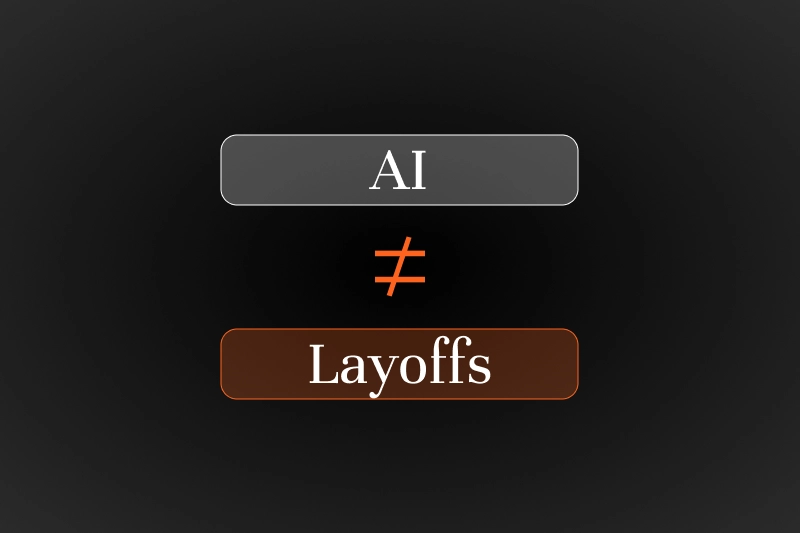
We Are Not Amazon: AI Without Layoffs at Credit Unions
Credit unions can adopt AI without cutting staff. Get a five-move redeployment playbook, real adoption data, and change management lessons from CU leaders.
Credit union AI pays through avoided hiring, never removing people.
80% of FI executives expect AI augmentation; none cite layoffs.
Baseline minutes per file, never FTE count, to prove AI value.
FORUM processed 70% more loans with the same lending staff.
A written no-layoffs commitment is your strongest lever for adoption.
Get 1% smarter about AI in financial services every week.
Receive weekly micro lessons on agentic AI, our company updates, and tips from our team right in your inbox. Unsubscribe anytime.
Thank you! Your submission has been received!
Oops! Something went wrong while submitting the form.
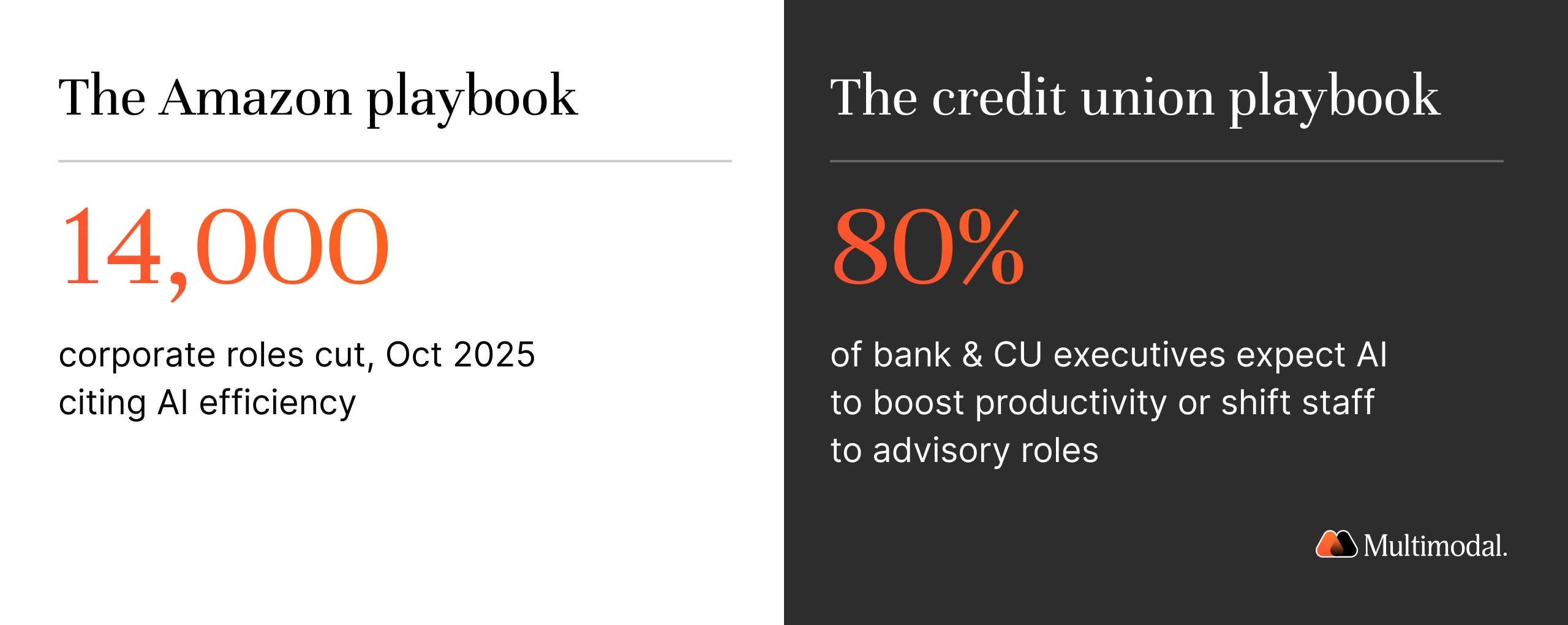
Credit unions do not have to choose between adopting AI and keeping their people. The credit union model for AI change management runs on redeployment: automation absorbs the impact of loan growth, merger volume, and rising member demand. At the same time, the same team moves up to higher-value work. Amazon tied roughly 14,000 corporate job cuts to AI-driven efficiency in October 2025; every credit union employee read that headline.
This guide explains why that playbook fails to transfer to a member-owned cooperative. What follows is the AI change management credit union leaders keep asking us for: a five-move plan for AI implementation without layoffs.
Why Does Every Credit Union AI Conversation Start With Layoffs?
"We're not Amazon, we're not going to lay people off."
A credit union executive said that to us on a sales call, and some version of it surfaces in most AI conversations we have across the financial services sector. It is the most common emotional objection we hear, and it deserves a serious answer rather than a slide.
The fear has a specific address. On October 28, 2025, Amazon confirmed it was cutting roughly 14,000 corporate roles, with further reductions expected into 2026. Months earlier, CEO Andy Jassy had told employees he expected the company's total corporate workforce to shrink over time due to efficiency gains from AI. The banking headlines echo the same theme: a Bloomberg Intelligence survey projected that global banks could cut as many as 200,000 jobs over the next three to five years as artificial intelligence erodes certain roles.
So when frontline staff at credit unions hear leadership discuss implementing AI, they import that narrative wholesale. The fear is rational. It just belongs to a different business model.
The question this post answers: does the big-tech playbook actually apply to a 200-person cooperative that exists to serve its members? The evidence and the structure of the institution itself say no.
What Does the Data Say About AI and Credit Union Jobs?
Three findings frame the real picture: executive intent points to augmentation, AI adoption is still in its early stages, and employee fear is the bottleneck.
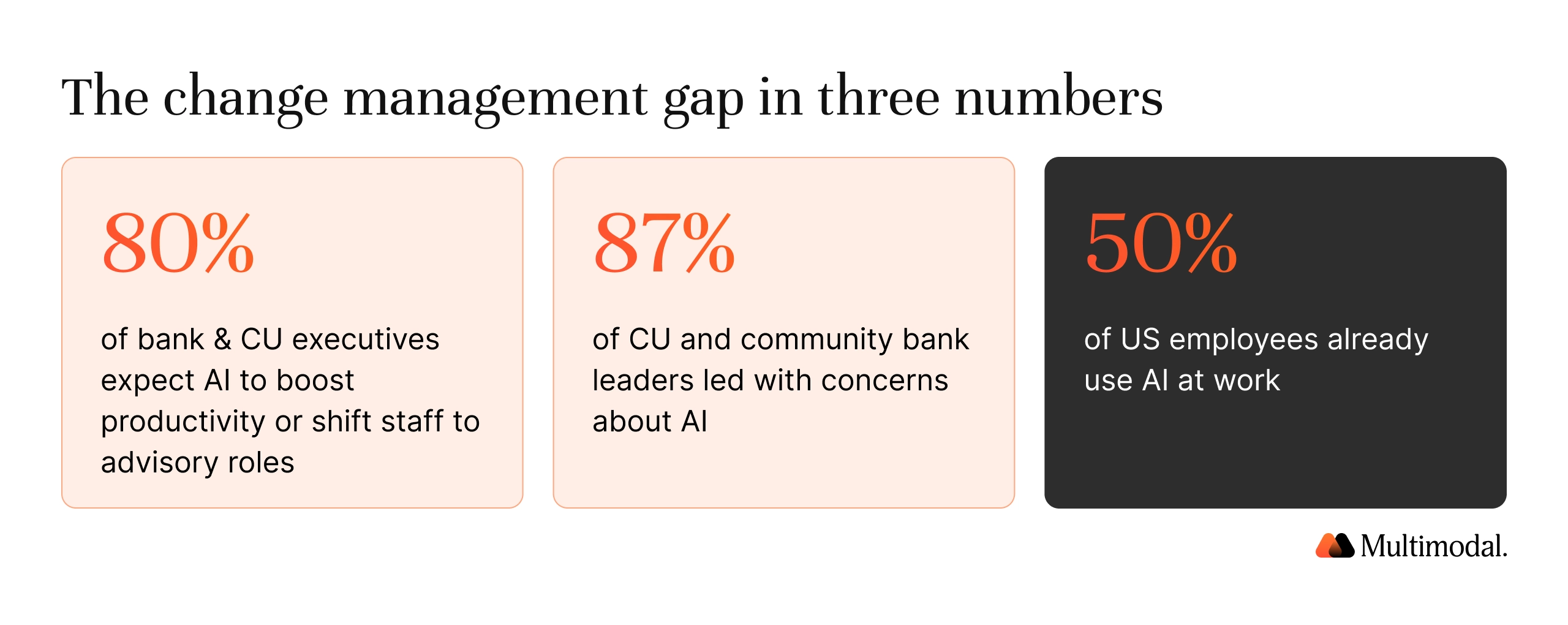
Start with intent. In the 2026 State of Artificial Intelligence survey of 51 banks and 53 credit unions, 80% of executives said they expect AI to increase productivity, automate portions of work, or shift bankers into advisory roles, and 58% named employee productivity and satisfaction as a goal of their AI initiatives. Headcount reduction did not appear among the stated goals. The same survey found only 6% of institutions use AI tools in customer-facing interactions and just 2% have scaled AI across multiple functions. Most institutions are still inside the early window where a deliberate AI strategy is a genuine advantage rather than table stakes.
Now the fear side. When 30 credit union and community bank leaders at institutions between $250 million and $8 billion in assets were asked about AI in May 2026, 87% led with concerns rather than opportunities, even while rating AI's importance an average of 8 out of 10. The sample is small, so treat it as directional, but it matches what we hear on calls every week: leaders believe in the technology and worry about their teams. Closing that gap between important and trusted is exactly what an AI change management credit union program exists to do.
Meanwhile, employees are ahead of the policy manual. Gallup found that 50% of US employees already use AI at work, up 10 percentage points in under a year. Your team is already experimenting with generative AI. The open question is whether leadership gives that energy a plan.
And the adoption paradox still holds. 59% of credit unions have deployed generative AI, ahead of banks at 49%, yet fewer than 5% of credit union leaders describe their organization as fully adopted. Deploying AI without a people plan is how pilots stall, and AI roadmaps that never name a first workflow or a redeployment destination stall fastest.
Why Credit Unions Are Structurally Built for AI Without Layoffs
The Amazon comparison fails on structure before it ever gets to sentiment. Four differences matter.
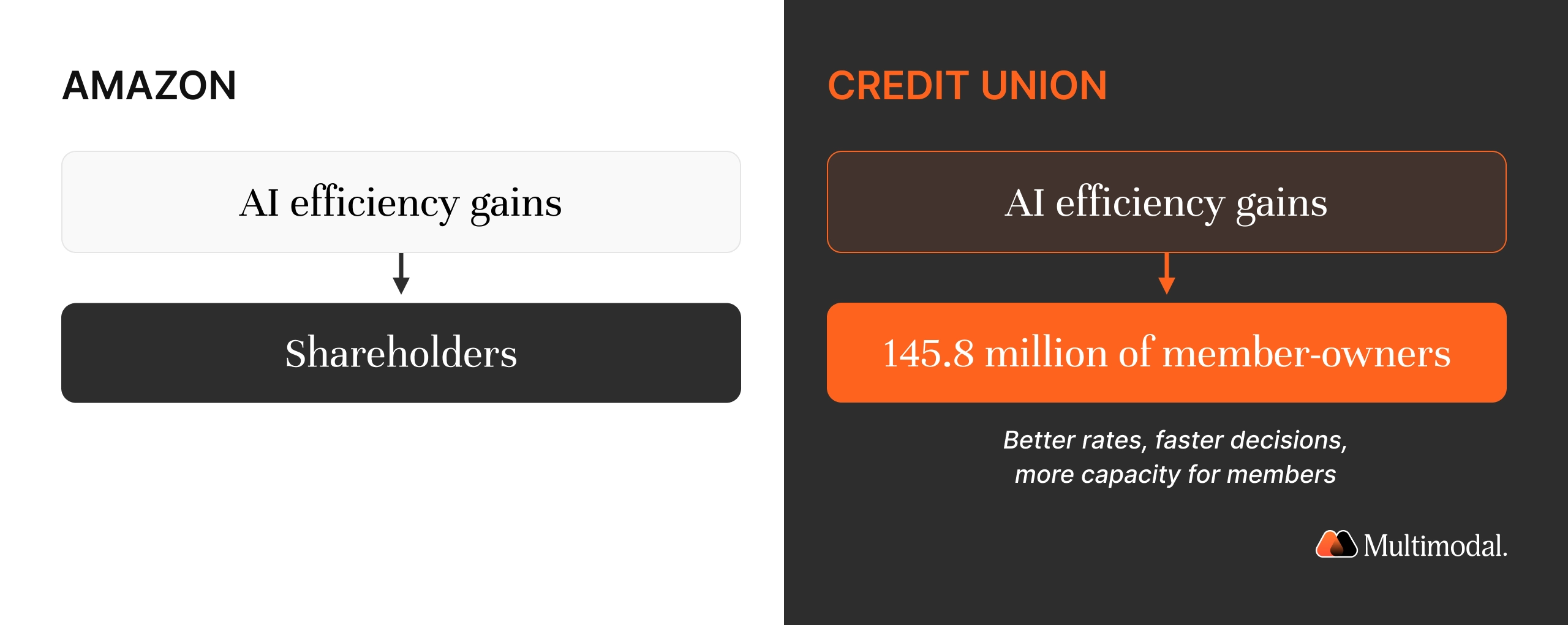
Ownership. Amazon's efficiency gains flow to shareholders. A credit union is a not-for-profit cooperative owned by the people it serves: 145.8 million members across 4,250 federally insured institutions holding $2.48 trillion in assets. When AI technology removes cost from operations, the savings have somewhere else to go: better rates, faster decisions, and more capacity for member relationships.
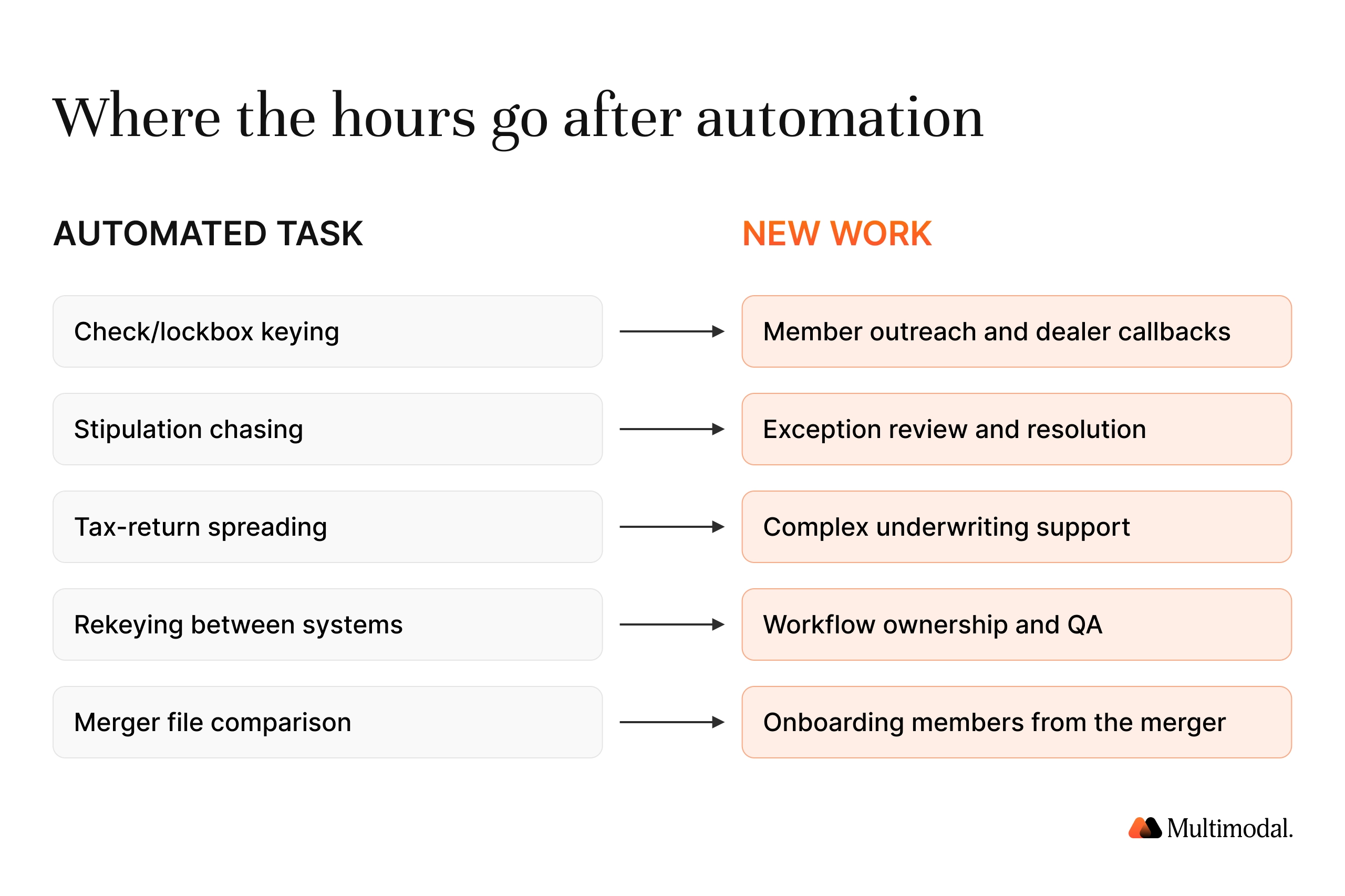
Starting point. Most credit unions already run lean back offices. The pain list we hear from financial institutions is a list of overload: check and lockbox keying that runs 300 to 1,000 items a day, stipulation clearing, tax-return spreading, merger file comparison, and manual review of bank statements and pay stubs. There is no bloated middle layer to cut. There is a queue that never empties.
Labor math. The staffing problem at most credit unions is capacity during growth and merger events, turnover and burnout in data entry and data processing roles, and requisitions that sit unfilled for months. AI systems that absorb volume growth pay for themselves through the hiring you avoid, never through the people you remove. One credit union finance leader told us on a call that automation would pay for itself by eliminating the positions they would no longer need to post, while every current employee would stay.
Differentiation. Service is the only battlefield where a credit union consistently beats a megabank, and service is people. Cutting the people to fund the AI would trade a durable advantage for a temporary expense line.
Jed Meyer, CEO of St. Cloud Financial Credit Union, put the operating philosophy plainly on our podcast:
"I don't see that as an opportunity where we're going to want to replace the human connection. But if I can get the machine to do the work so the human can focus on the interaction, that's how I look at technology… getting the humans out of the mistake business and getting them into the building of people business, and letting technology do the work in between, is really how I see us going. And I see that same thing in AI… how do we ultimately keep building on an extension of the employee versus the replacement?" — Jed Meyer, CEO, St. Cloud Financial Credit Union, Main Street AI podcast
The machine does the data processing. The people do the members. That division of labor is the entire argument.
The Redeployment Playbook: 5 Moves for AI Without Layoffs
Commitments need mechanics. These five practical steps, run in order, turn a no-layoffs promise into an operating plan your team can verify.
1. Say It Out Loud Before the First Demo
If the commitment is no layoffs, put it in writing to staff before you evaluate a single vendor. Silence breeds the resistance that the 87% concern figure measures, and transparent communication is the cheapest risk management you will ever buy.
Modern AI tools can even support the change itself. Predictive analytics can flag where adoption is likely to stall; natural language tools can draft internal FAQs and member-facing notifications; and adoption can be tracked through concrete indicators such as system usage and training completion rather than hallway sentiment. Those signals give leaders valuable insights into where the rollout needs attention next and help them make informed decisions rather than guesses.
2. Automate the Work Nobody Was Hired to Do
Start where the queue is: document intake, data entry, stipulation chasing, ACH exception review, and verifying income across bank statements and transaction history. These routine tasks are why processing teams burn out, and nobody joined a credit union to rekey the same loan file into three systems.
Frontline staff experience automation of this work as relief, and adoption follows relief. This is also where measurable results come fastest, because document-heavy workflows produce clean before-and-after numbers.
3. Baseline Capacity, Never Headcount
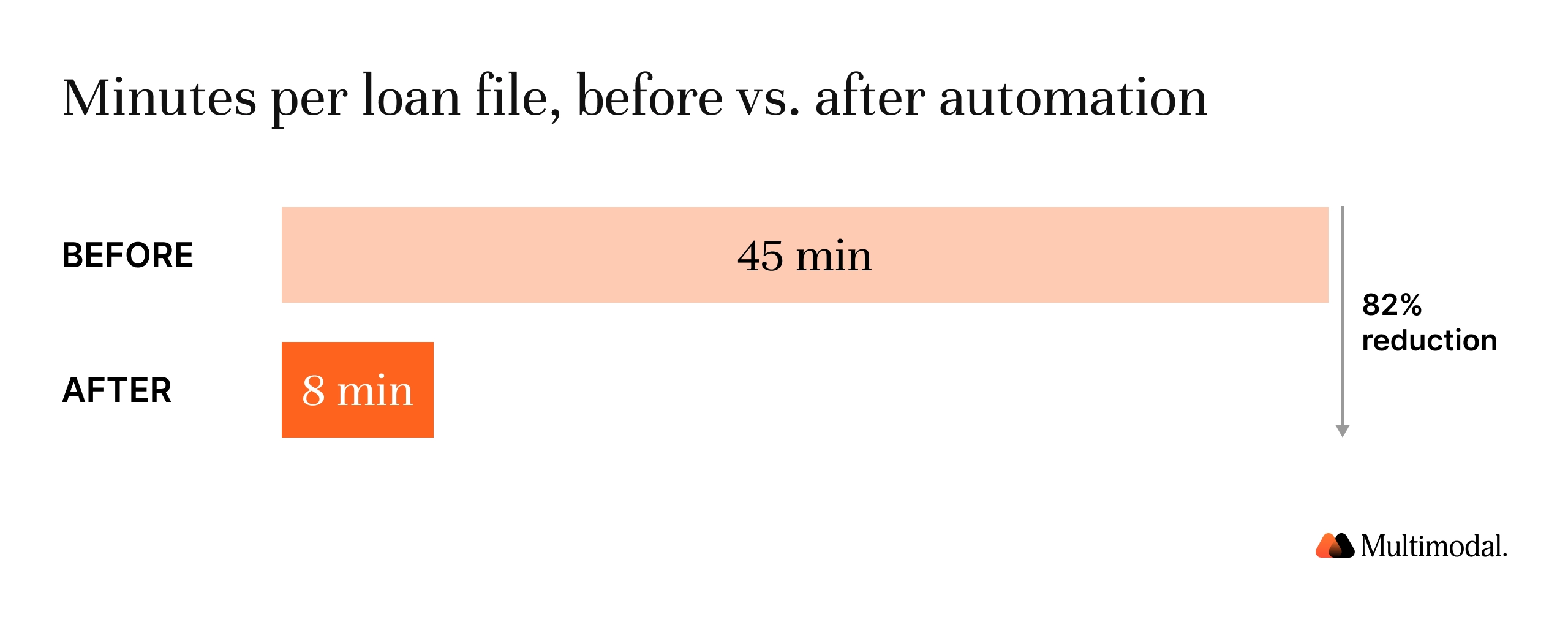
The before-and-after metric is minutes per file and files per employee-day. Across our own deployments, loan file processing time dropped from roughly 45 minutes to 8 minutes per file. That is the number that proves the case to the board and to the team at the same time.
What gets measured signals what gets managed. If the board deck tracks FTE reduction, employees will read the real plan no matter what the town hall script says. If it tracks capacity, member satisfaction, and turnaround time, the no-layoffs commitment becomes visible in the numbers everyone sees.
4. Redeploy the Saved Hours to Member Work
Name the destination in advance: dealer callbacks, member outreach, exception resolution, fraud review, cross-training. Redeployment only reads as real when the new work is named before the automation arrives.
This is where member experience compounds. Member interactions get the time that used to go into rekeying, follow-ups happen the same day, and personalized member engagement stops being an aspiration on a strategy slide. The same systems surface actionable insights that point staff toward the members who need the most attention, and post-implementation feedback analysis shows whether member satisfaction is actually improving. The freed hours land where a cooperative wants them: serving members.
5. Upskill People Into the AI-Adjacent Roles
Human-in-the-loop review, confidence-threshold exception handling, and workflow ownership are new rungs for career development. The people who keyed the documents are the best qualified to supervise the AI systems doing it now, because they know what a bad file looks like.
Fraud detection shows why these roles matter. Machine learning models strengthen fraud detection by analyzing large volumes of transaction data quickly, but poorly tuned AI systems can raise false positives, and a false positive at a credit union means a member loses access to their own money. The analysts who know the membership are the ones who resolve those cases well. The same logic applies to deepfake-enabled fraud schemes, which are exactly the kind of threat that requires trained people paired with new tools.
Employee training itself gets easier with AI in the stack: adaptive learning paths adjust to each person's role and performance, generative AI assistants answer procedural questions instantly, and knowledge gaps surface before they become errors. AI training is as much a retention tool as a rollout requirement.
Amy Stevens, SVP of Member Experience at GreenState Credit Union, described the destination on our podcast:
"How are we then skilling up our folks so that they are using their superpowers? They've got empathy, they've got listening, they've got understanding. [They] can help with more complex transactions for our members. That's where we're going to be using our people… AI is just another technology that augments what we do." — Amy Stevens, SVP of Member Experience, GreenState Credit Union, Main Street AI podcast
What Does AI Without Layoffs Look Like in Practice?
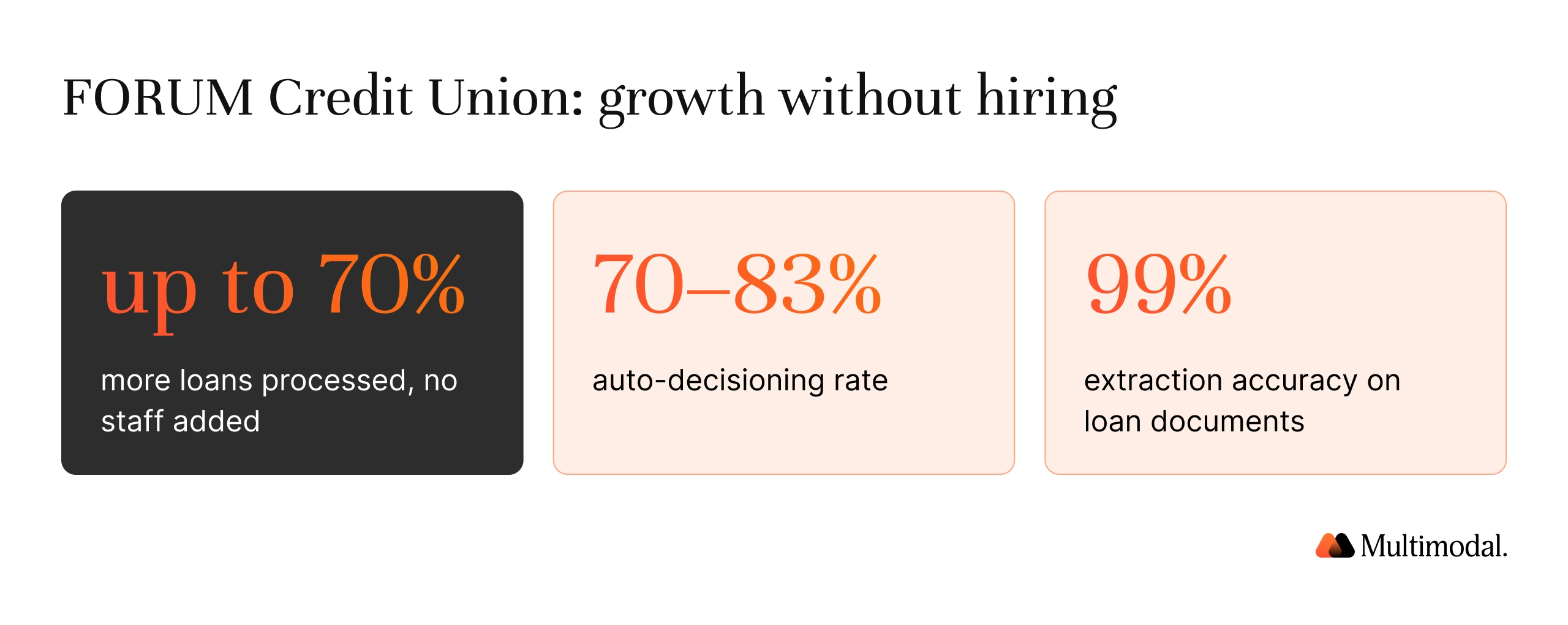
FORUM Credit Union processes up to 70% more loans without adding staff, with auto-decisioning rates of 70 to 83% and 99% extraction accuracy on loan documents. Andy Mattingly, FORUM's Chief Operating Officer, summarized the outcome in that report: "The real payoff is doing more with the same number of people."
The pattern repeats across our first-party data. Our 2026 Field Report draws on 445 prospect conversations across 144 financial institutions, including 70 credit unions, and the consistent theme is capacity absorption. Institutions leverage AI to handle the volume they could not hire their way through; they improve operational efficiency in the workflows that hurt most, and the gains fund member-facing work rather than severance packages.
AgentFlow sits in exactly that layer: it ingests the documents, extracts and validates the member data, applies policy rules, and routes exceptions to the humans who should see them, before and after credit decisioning. The people stay in the decision-making processes where judgment matters.
How Do You Bring the Team Along?
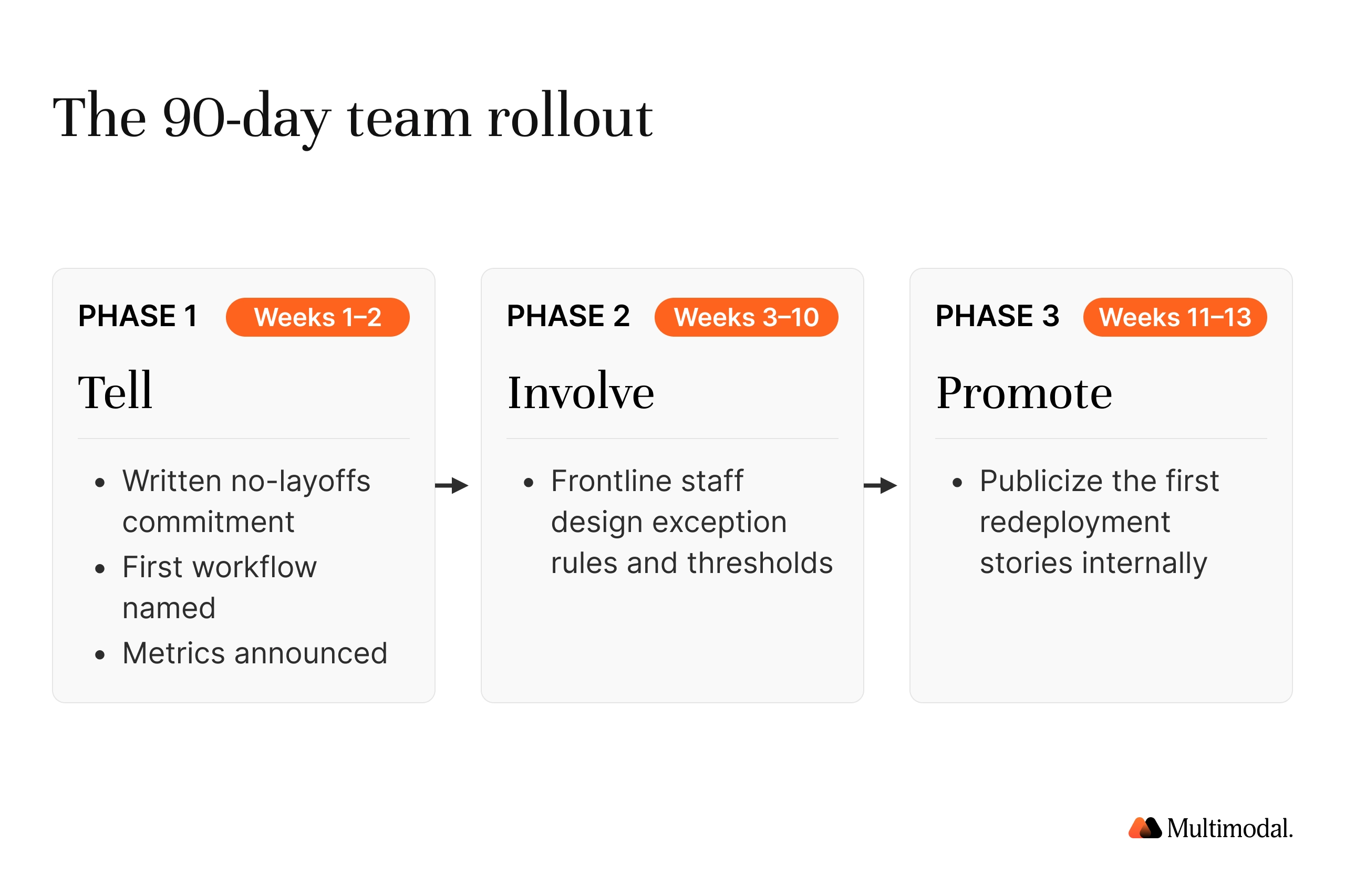
Change management for AI implementation at a credit union runs in three phases over roughly 90 days.
Phase 1: Tell (weeks 1-2). Publish the written no-layoffs commitment, the reason for the change, the named first workflow, and exactly what will be measured. Employees make informed decisions about new technology the same way boards do: with clear scope and honest numbers.
Phase 2: Involve (weeks 3-10). Frontline processors help design the exception rules and confidence thresholds. They know where the process actually breaks down, and empowered employees who shaped the rollout later defend it. Collaboration patterns will also reveal your natural champions; every successful rollout we have seen had two or three of them.
Phase 3: Promote (weeks 11-13). Publicize the first redeployment stories internally. The processor who became the exception-review lead is worth ten memos, and the story gives every other employee a picture of their own future needs and path.
Governance belongs in the same conversation, because your examiners will put it there anyway. Fair lending obligations apply to AI model outcomes just as they apply to human decisions, and regulators expect documented model risk management for any AI capability that touches lending. Discriminatory outcomes are a real risk when models go unmanaged, which is why AI governance policies, risk assessment, and ongoing monitoring need owners from day one. Credit unions do not have to build this scaffolding from scratch: NIST publishes an AI risk management framework, COSO has released a framework for managing AI-related risks, and CISA offers AI data security guidance that applies directly to member data and who has access to it. Here is the compliance dividend of the no-layoffs approach: human-in-the-loop staffing is itself a governance control, and the same people you kept are your audit trail.
Balancing innovation with accountability is not a constraint on the rollout. It is what makes the rollout survivable at exam time.
Frequently Asked Questions (FAQs)
Will AI cause layoffs at credit unions?
Current evidence points the other way. In a 2026 survey of 104 banks and credit unions, 80% of executives expected AI to raise productivity or shift staff into advisory roles, and none listed headcount reduction as a goal. Credit unions adopt AI to absorb growing volumes, reducing future hiring pressure rather than affecting current staff.
What is AI change management for a credit union?
An AI change management plan for a credit union brings people, processes, and communication together through AI implementation: a written staff commitment, a named first workflow, capacity baselines, redeployment destinations, and employee training. Done well, it closes the gap between deploying AI and actually changing how work gets done.
How do credit unions adopt AI without cutting staff?
They automate high-volume document work such as data entry, income verification, and stipulation clearing, then redeploy the time saved to member-facing work. Success is measured in minutes per file and member satisfaction, rather than headcount, so operational efficiency translates into capacity rather than cuts.
Which credit union jobs change most with AI?
Processing and back-office roles change most: routine tasks like document intake and rekeying shift to AI systems, while people move into exception handling, quality review, fraud review, and workflow ownership. Member-facing roles change least and gain the most time for member relationships.
How should leadership talk to employees about AI?
Commitment first, workflow second, metrics third. Put the no-layoffs commitment in writing before vendor demos, name the first workflow and what will be measured, and keep communication transparent throughout. Silence is the main driver of resistance; specifics are the antidote.
What should a credit union automate first?
One internal, high-volume, document-heavy workflow you can baseline today, such as loan document intake or stipulation clearing. Internal workflows carry no member-facing risk while the team learns, and they produce the clean before-and-after numbers a board wants to see.
The Credit Union Advantage Is the People You Keep
Amazon's efficiency flows to shareholders. A credit union's efficiency flows back to members through the people who serve them every day. The institutions that stay ahead over the next five years will run AI on the loan file and humans on the relationship, and they will treat their staff as the reason the technology works rather than the cost it eliminates.
"We are not Amazon" started as an objection on a sales call. Run the playbook above to make it your AI strategy.
Bring us one week of your document queue. We will run it through AgentFlow and hand you the numbers your staff meeting needs: minutes per file before and after, and the hours freed for member work. No layoff math anywhere in the model.
See Your Own Before-and-After Numbers
Bring us one week of your document queue. We will run it through AgentFlow and hand you the numbers your next staff meeting needs: minutes per file before and after, and the hours freed for member work. No layoff math anywhere in the model, because the plan is capacity, never cuts.

.svg)
.svg)

.avif)
.png)

.png)