Where Do We Even Start? The First Workflow a Credit Union Should Automate
Most credit union AI pilots stall before impact. Use this five-filter test to pick your first AI workflow, with data and lessons from credit union leaders.
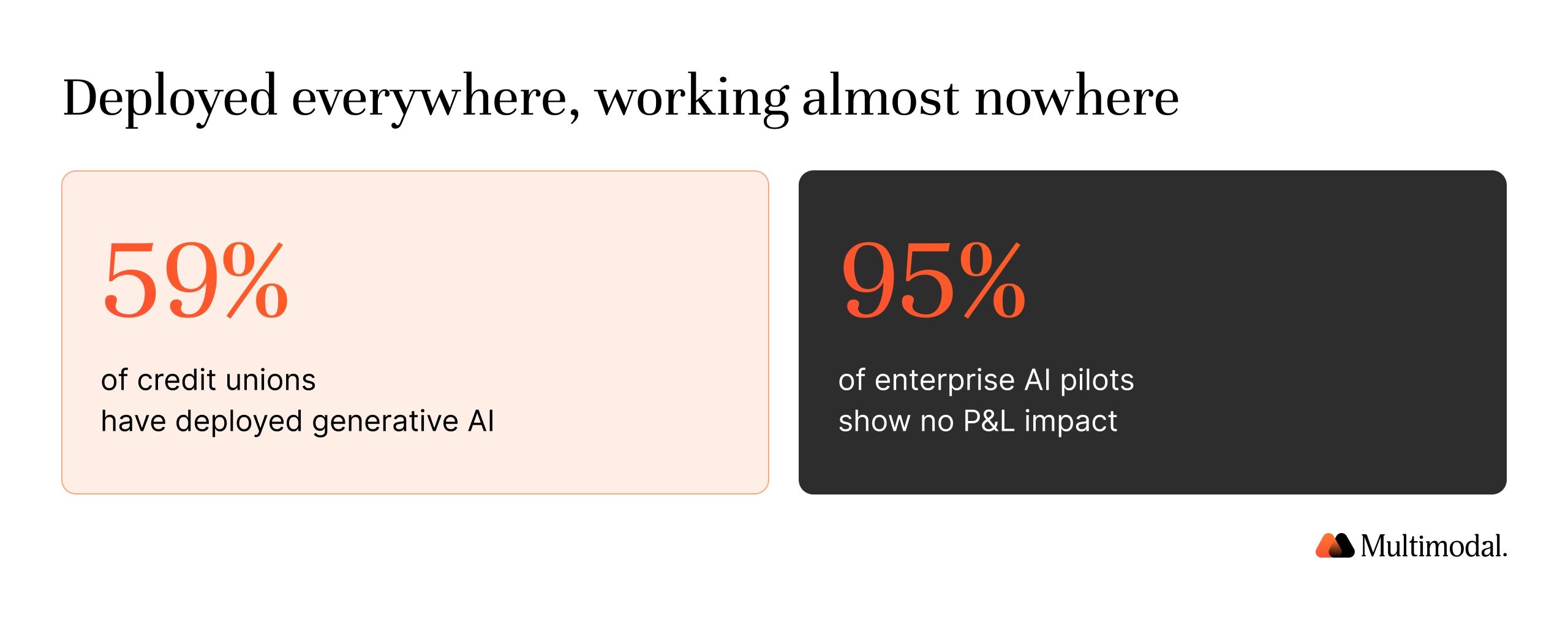
59% of credit unions deployed generative AI; fewer than 5% fully adopted it.
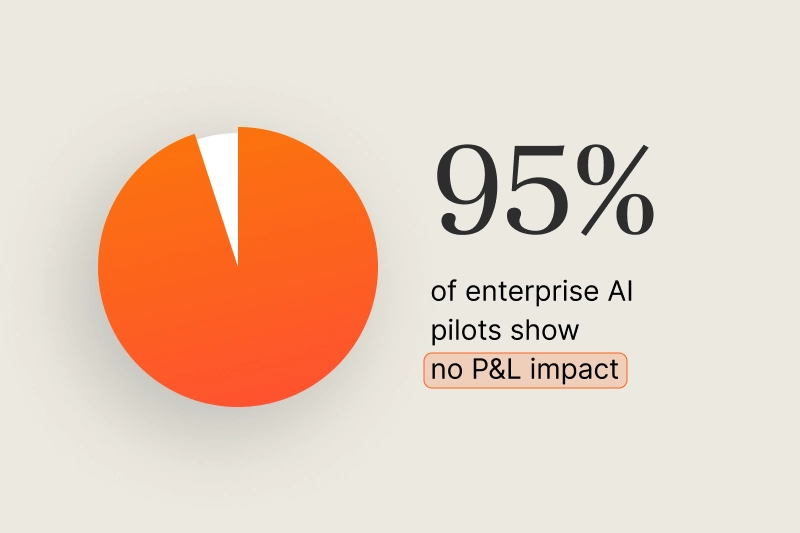
MIT found 95% of pilots show no P&L impact; back office delivers.
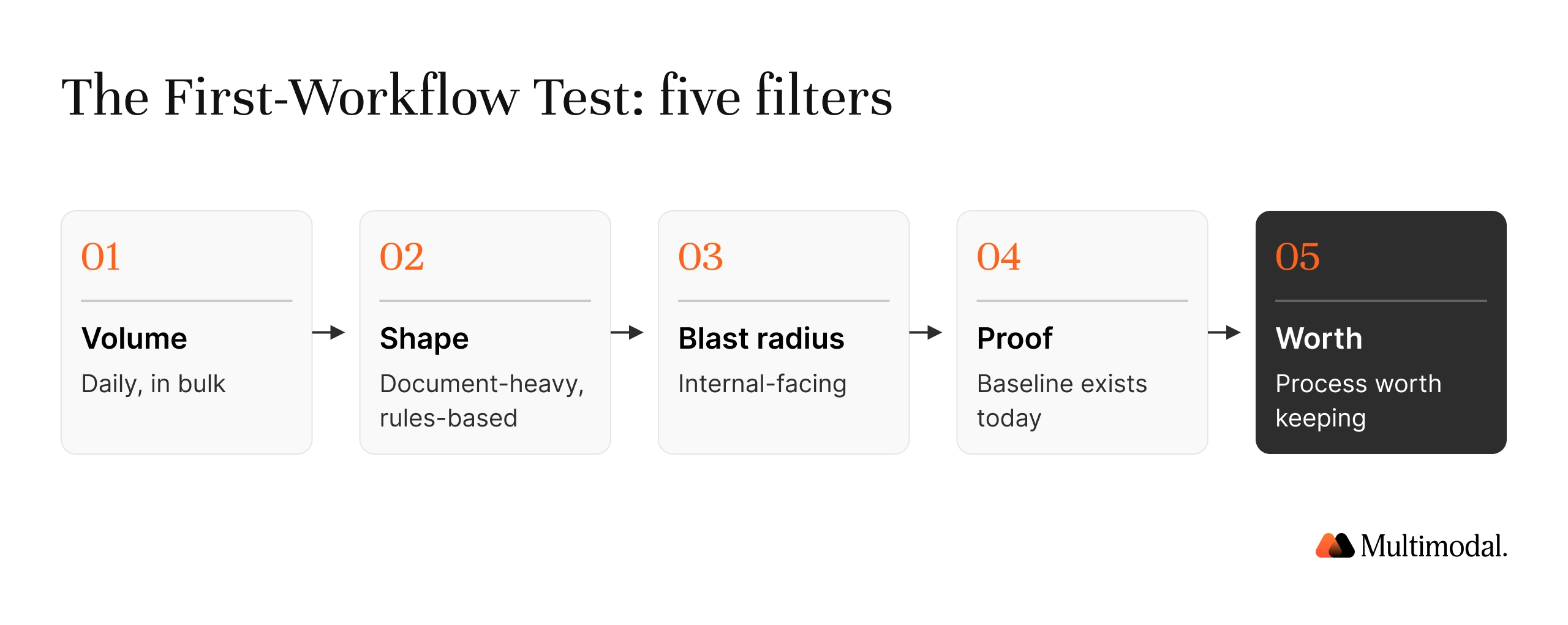
First workflows should be high-volume, document-heavy, internal, measurable, and sound.
Loan-file document intake, starting with stipulation clearing, passes all five filters.
A 90-day human-in-the-loop pilot with a single baseline metric outperforms grand strategies.
Get 1% smarter about AI in financial services every week.
Receive weekly micro lessons on agentic AI, our company updates, and tips from our team right in your inbox. Unsubscribe anytime.
Thank you! Your submission has been received!
Oops! Something went wrong while submitting the form.
The honest answer to every "how to start with AI credit union" search is to pick one internal, high-volume, document-heavy workflow, measure it against a baseline, and prove the result end-to-end before anything member-facing goes live. Most credit unions do the opposite: they launch a visible pilot, skip the baseline, and stall when nobody can show the board what changed. This guide gives credit union leaders the five-filter test we use in our own sales conversations, plus the workflow that passes it most often.
Why Do So Many Credit Union AI Projects Stall Before They Start?
"Where do we even start?" is the question we hear most often from credit union leaders exploring AI adoption. It comes up on discovery calls, at advisory board sessions, and in boardrooms where the pressure to remain competitive collides with the fear of getting AI implementation wrong. It is the same intent behind every "how to start with AI credit union" query: leaders want a first step that improves operational efficiency and survives board scrutiny.
The data explains the anxiety. According to Cornerstone Advisors' What's Going On in Banking 2026 study, 59% of credit unions have already deployed generative AI, ahead of 49% of banks, and more than 80% of financial institutions plan to increase technology spending in 2026. Agentic AI is now a board-level discussion at more than half of institutions. AI has also become the number one planned technology investment among community financial institutions for the first time, cited by 48% of executives.
Deployment, however, has outrun impact. In the Filene Research Institute's survey of 110 credit union leaders, roughly 80% described themselves as in the early stages of their AI journey, and fewer than 5% described their organization as having fully adopted AI. Only about half had a formal AI strategy at all. Zoom out beyond credit unions, and the picture sharpens: MIT's NANDA initiative found that 95% of enterprise generative AI pilots deliver no measurable P&L impact, and Gartner predicts that over 40% of agentic AI projects will be canceled by the end of 2027 due to escalating costs, unclear business value, or inadequate risk controls.
The pattern behind those numbers points to selection more than technology. Many credit unions start implementing AI in the most visible use cases rather than the most measurable ones, and a pilot that cannot prove its value gets cut in the next budget cycle. The choice of first workflow decides whether your AI implementation builds momentum or becomes another stalled experiment.
What Makes a Good First AI Workflow for a Credit Union?
A good first workflow is internal, boring, and countable. That runs against instinct, because most of the industry's attention goes to member-facing AI tools, and watching where other credit unions deploy first reinforces it. As reported by PYMNTS, data from Cornerstone Advisors show that contact centers are the most common generative AI application at 74%, followed by fraud detection at 48% and lending at 46%.
The return data points the other way. The same MIT research that documented the 95% failure rate found that the biggest ROI comes from back-office automation, even though most budgets chase front-office and marketing use cases. It also found that purchased vendor solutions succeed about 67% of the time, while internal builds succeed only about a third as often. For credit union leaders deciding where to spend a first AI budget, both findings matter: buy before you build, and look behind the teller line before you look in front of it.
There is a practical reason internal workflows make better first steps. When your first AI project runs in operations, your employees see the benefit immediately, your members are shielded from any early wobbles, and the win still shows up in the member experience through faster service.
Amy Stevens saw exactly this at GreenState, where quality teams could never manually score enough phone calls to represent all member conversations. Their first win was AI-assisted call scoring and sentiment analysis in quality management: a 13-minute phone call scored in about 30 seconds, feeding coaching plans and employee training decisions with actionable insights the team could never produce manually.
"That was extremely helpful for us to see a quick win that our members would not have noticed, but they would notice based upon an increase in our service that we were providing them. That was a good first win for us." — Amy Stevens, SVP of Member Experience at GreenState Credit Union, on Multimodal's Main Street AI podcast
That is the shape to look for: a quick win that improves member service without putting member interactions at risk on day one.
The First-Workflow Test: 5 Filters That Pick It for You
Run every candidate workflow through these five filters. A workflow that passes all five is a first project you can defend to your board, your examiners, and your employees.
1. Volume: does it happen every day, in bulk?
AI applications earn their keep on repetition and improve efficiency fastest where volume is highest. A task performed 20 times a month cannot generate enough evidence to prove anything in a quarter. Check and lockbox keying at credit unions we talk to runs 300 to 1,000 items per day. That is the kind of volume that turns a pilot into a dataset.
2. Shape: Is it document-heavy and rules-based?
The strongest early use cases involve documents with known rules: pay stubs, tax returns, deposit account statements, titles, insurance proofs. AI enhances loan processing precisely because it speeds up document verification and data extraction, work that follows deterministic rules rather than judgment-heavy decision-making. If a trained processor can document how they make decisions, the workflow qualifies.
3. Blast radius: is it internal-facing?
If the pilot wobbles in week three, who notices? The right answer is a processor with a review queue, never a member. Internal-facing workflows let you maintain human oversight of every output as the system earns trust and your team learns to use AI effectively, and they protect member relationships and member trust along the way. AI should function as a support tool before it becomes a decision-maker anywhere near member data.
4. Proof: can you baseline it today?
Pick the metric before you pick the vendor: minutes per file, files per employee per day, error rate, rework rate. If you cannot measure the process before automation, you cannot prove the after, and an unprovable pilot is an unfundable second phase. This is also what regulators respond to. The National Credit Union Administration does not expect perfection from a pilot; examiners expect documentation, an audit trail, a risk assessment, and evidence that you can show your work.
5. Worth: Is the process sound enough to keep?
One credit union COO put the objection to us bluntly: "We don't want to automate a shitty process." That instinct is correct, and it is the reason this filter exists. Map the workflow first, fix what is genuinely broken, and then automate what remains. Most processes fail this filter for a subtler reason than bad design: they calcified.
A tool or process starts out as the right answer for the moment, but then over time the vendors improve, the business and member needs change, the workarounds pile up, and the original reason for doing something a certain way either changes or disappears completely. But the processes stay because it's been the practice for so long that nobody stops to question it. - Adrian Rodriguez, former SVP of Data and Innovation at American Heritage Credit Union, on Multimodal's Main Street AI podcast
Mapping the process is not a wasted effort, even if it delays the pilot by two weeks. It is the cheapest process improvement your credit union will ever buy, and it hands the AI a workflow worth scaling.
Which Workflow Passes All Five? Start Where the Loan File Slows Down
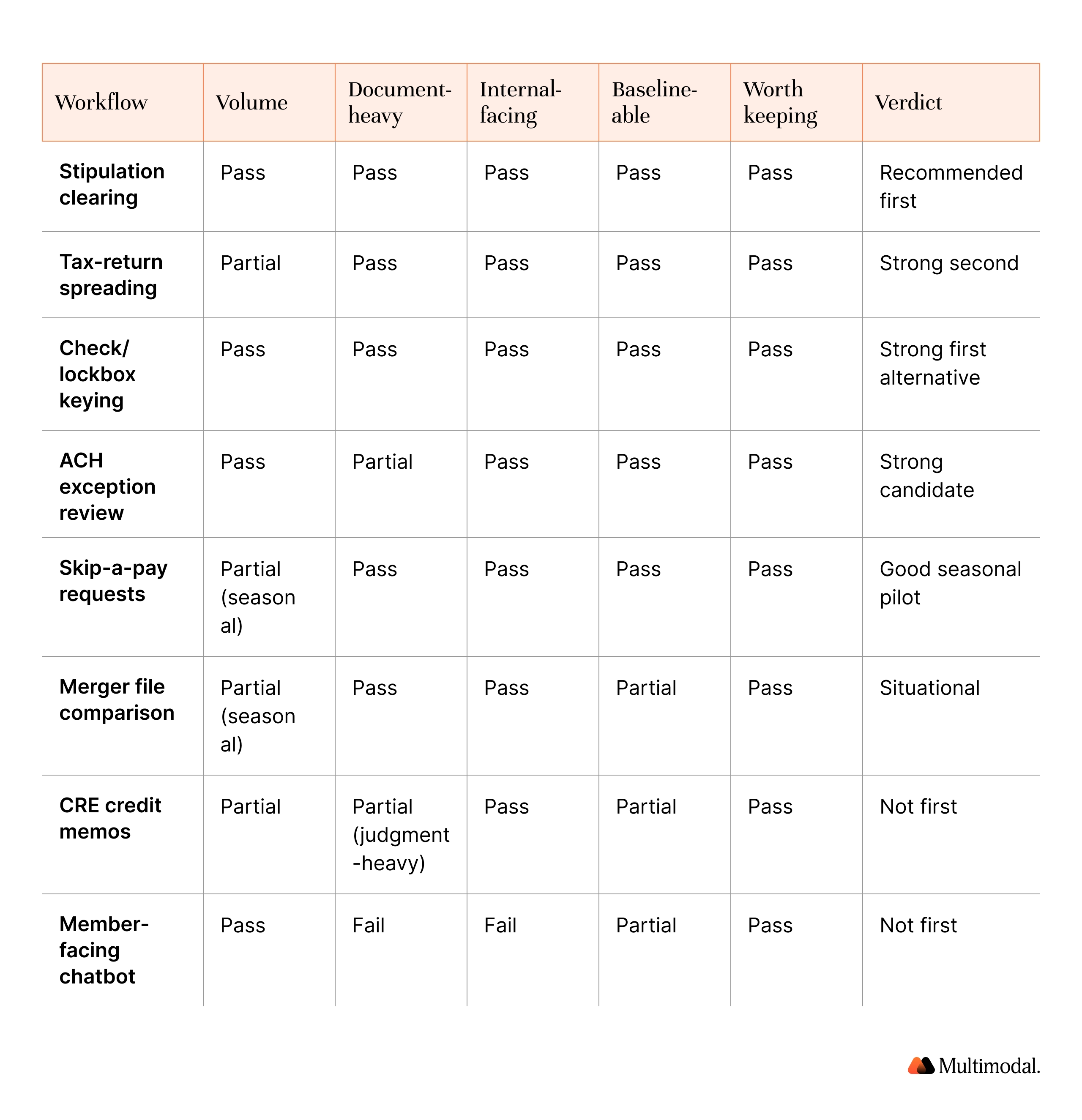
Run the common candidates through the filters and a pattern emerges quickly.
The workflow that most consistently passes all five filters is loan-file document intake, and the sharpest entry point within it is stipulation clearing. Stips arrive daily and in bulk; they are purely document verification against known rules; the work is invisible to members; and every loan origination system timestamps the queue, so the baseline already exists. Nobody defends the manual version of stip clearing as a member-experience asset.
The economics reinforce the choice. The cost to originate a retail mortgage at depository lenders averaged $16,320 per loan in 2025, and origination costs across the financial services industry rose 35%, about $3,000 per loan, in just three years. Much of that cost is due to people pushing paper through loan-processing steps that follow written rules, which makes document intake the cheapest place to streamline operations.
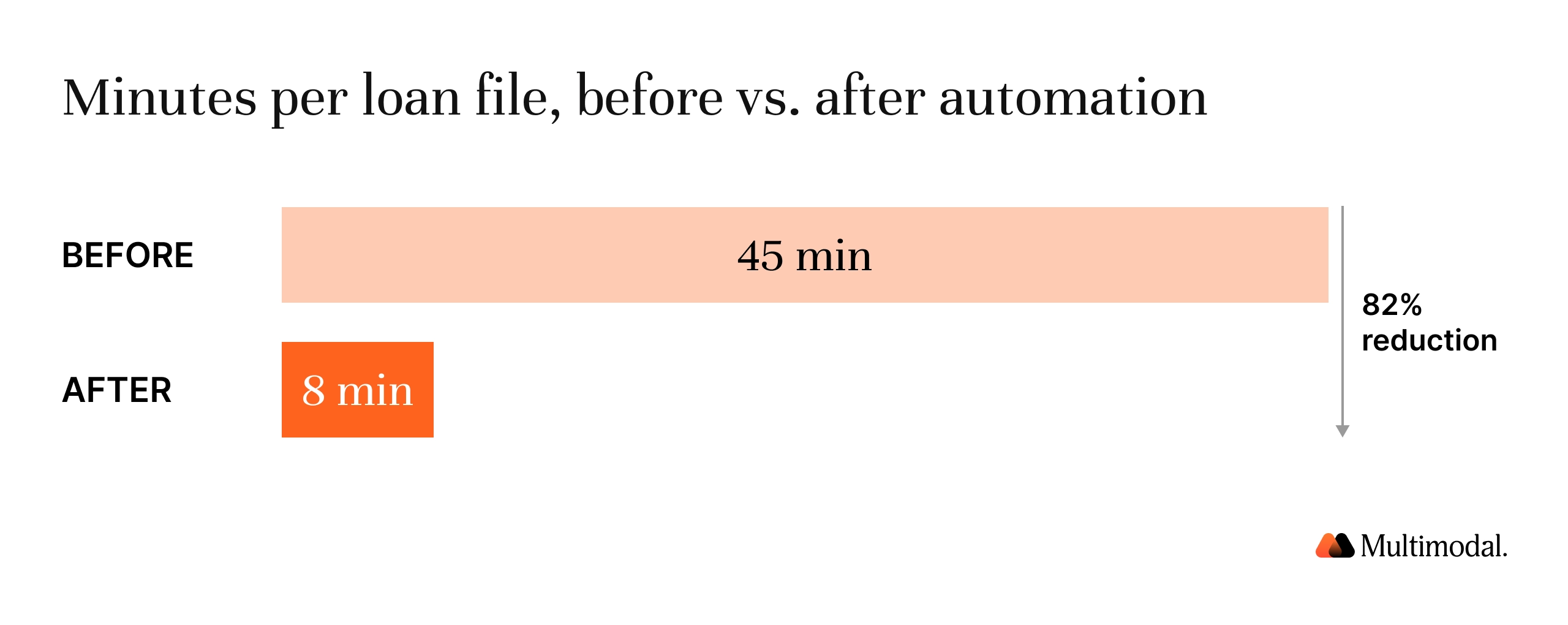
In our own deployments, document-heavy loan file review that took 45 minutes per file drops to roughly 8 minutes with AI agents handling extraction, compliance checks, and routing while a human reviews the output. FORUM Credit Union achieved 99% data extraction accuracy in automated document processing, with human review of exceptions.
Fraud detection deserves a mention because it is often the second most tempting starting point. AI genuinely helps credit unions here: AI-driven machine learning models analyze transaction patterns in real time, identify suspicious activity faster than traditional rule-based systems, and reduce false positives that waste analysts' hours. But most fraud detection AI arrives as an embedded feature in tools you already run from your core or payments vendors. Adopting it is closer to vendor management than to building your credit union's own AI muscle.
Take the embedded wins and still run the five-filter test to pick the first workflow your team owns end-to-end. Member onboarding document checks are a close cousin of loan-file intake and make a strong second workflow once KYC volumes justify it.
What About Starting With a Chatbot?
Chatbots are the default first project across the industry, and the appeal is real: AI chatbots provide 24/7 support for member inquiries, hold natural conversations, deflect routine service requests, and deliver personalized recommendations from a well-maintained knowledge base. Done well, conversational AI lifts member satisfaction. Chatbot and virtual assistant adoption at credit unions more than doubled over three years to 45%, according to PYMNTS, citing data from Cornerstone.
Yet the adoption paradox from the top of this article persists, and part of the reason sits right behind the conversation. A chatbot can tell a member their loan status at any hour. It does not process the loan file used to determine the status. The documents still get keyed, sorted, and verified by hand, so the member gets a faster answer about the same slow process.
There are also reasons a conversational front door is a hard first workflow. Member conversations carry your brand and depend on a personal connection that took years to build; sentiment is unforgiving when an early model gets an answer wrong at the wrong moment. Member-facing AI touches member data in ways that trigger data privacy review, and it fails the blast-radius filter by definition. None of this makes conversational AI a bad investment. It makes it a second- or third-workflow, deployed after your operations team has learned to run, measure, and govern AI agents, where mistakes are cheap.
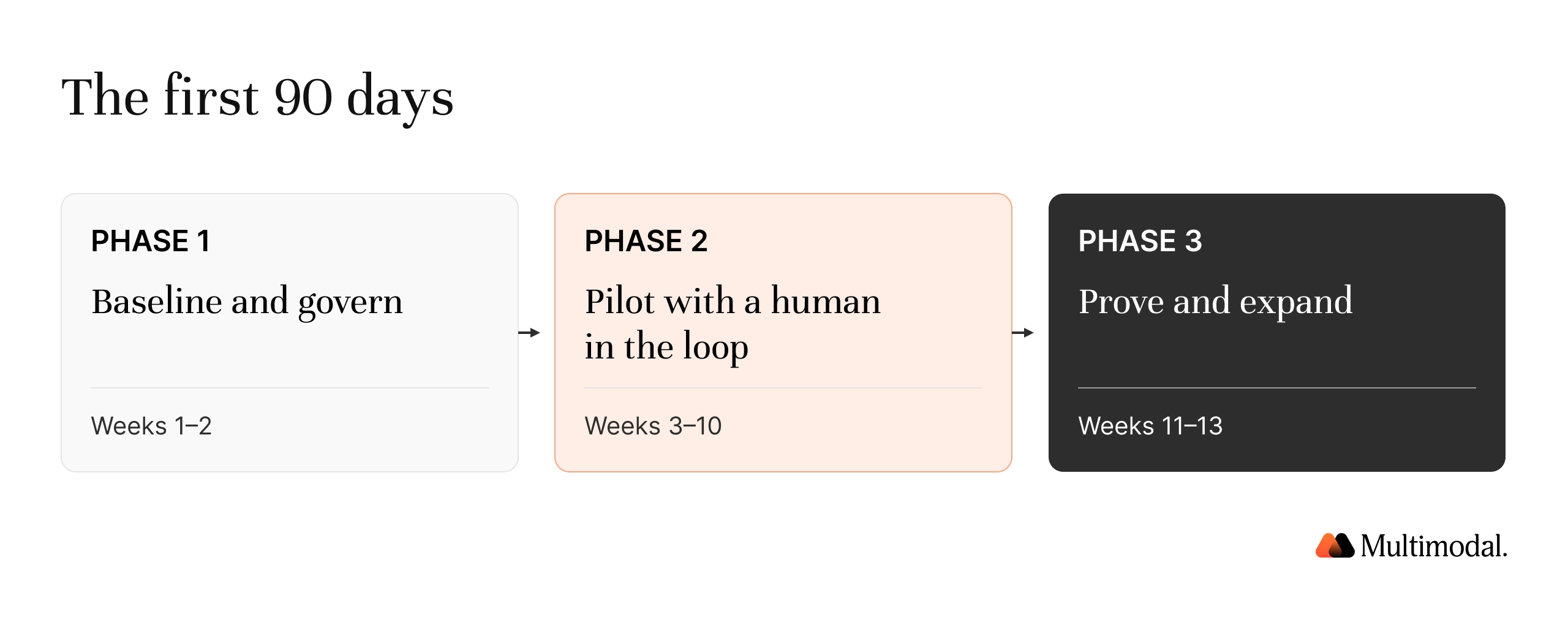
How to Start With AI, Credit Union Style: Your First 90 Days
A first workflow succeeds on structure, and implementing AI well fits in one quarter. The principle throughout: one measurable pilot, not a large-scale deployment.
Phase 1: Baseline and govern (weeks 1 to 2)
Capture the before. Pull 90 days of volume and timestamps from your LOS or imaging system and write down minutes per file, files per FTE-day, and error rate. Map the process on one page and apply Filter 5: fix what is broken before you automate it.
Stand up lightweight governance in parallel, because establishing AI governance before deployment makes the rest of the quarter fast rather than contentious. That means a concise acceptable-use policy, an inventory of every AI tool already in the building, and a governance committee spanning compliance, IT, risk management, and legal.
You do not need to invent the framework: NIST's AI Risk Management Framework covers governance and risk for artificial intelligence systems, CISA publishes guidance on securing data across the AI lifecycle, and COSO has a framework for managing AI-related risks. Written down, that is a working AI strategy your board can approve in a week.
Our NCUA AI guidance breakdown maps these to what examiners actually ask.
Phase 2: Pilot with a human in the loop (weeks 3 to 10)
Run the workflow time-boxed, with human oversight on every file. Set confidence thresholds so the system routes anything uncertain to a reviewer at the right moment, and keep the audit trail: what was extracted, what was flagged, who approved it. That trail is your evidence for regulatory requirements later, including compliance reviews that touch Reg E, Reg Z, and fair lending expectations.
Vendor selection belongs here too, and it deserves rigor. NCUA cannot examine technology vendors directly, so your credit union is responsible for due diligence on any third-party AI provider; our 40-question vendor due diligence questionnaire exists for exactly this step.
Confirm the vendor integrates with your core and LOS rather than creating another swivel-chair system, and confirm the pricing model matches your volume. Train employees on the workflow, appropriate use of AI, data protection, and verification of AI-generated output. Internal buy-in is built in this phase or never: the processors who review the AI's work daily become either your champions or your critics.
Phase 3: Prove and expand (weeks 11 to 13)
Compare against the baseline and put the delta in writing: minutes per file before and after, exception rate, dollars per file. Take that one-page result to the board, because a documented first win lets directors make an informed decision about scale and unlocks the second budget. Then pick workflow number two with the same five filters, at your own pace. Teams that follow this sequence compound: governance, review habits, and vendor relationships all transfer, which is why the second workflow ships in half the time.
Frequently Asked Questions (FAQs)
How should a credit union start with AI?
If you searched "how to start with AI credit union," here is the checklist: one internal, high-volume, document-heavy workflow you can measure, proven through a 90-day human-in-the-loop pilot against a written baseline. Stand up basic governance in parallel: an AI inventory, an acceptable-use policy, and a committee spanning compliance, IT, risk, and legal. Prove the result in writing before expanding to a second workflow.
What is the best first AI use case for a credit union?
For most credit unions, loan-file document intake, and specifically stipulation clearing. It runs daily and at high volume; it verifies documents against known rules; members never see it wobble; and the loan origination system already timestamps the queue, so results are provable. Tax-return spreading, check and lockbox keying, and ACH exception review are strong alternatives that pass the same filters.
Should a credit union start with member-facing or back-office AI?
Back office. MIT's 2025 research found the largest ROI from generative AI in back-office automation, even though most budgets go to front-office use cases. Internal workflows also carry a smaller blast radius: an early error reaches a reviewer's queue instead of a member conversation, which protects member trust while your team builds skill.
How long should a first AI pilot take?
About 90 days: two weeks to baseline the process and stand up governance, eight weeks of time-boxed piloting with human review on every file, and two to three weeks to document results against the baseline and present them to the board. Open-ended pilots are the ones that stall; a time box forces a provable answer.
Do we need to clean all our data before starting?
Not for a document workflow. Stips, pay stubs, and tax returns arrive as fresh documents with each loan file, so the pilot does not depend on years of warehouse cleanup. Ensure quality of the specific inputs the workflow touches, including current procedures and up-to-date checklists, and audit your data infrastructure as you scale into analytics-heavy AI technologies such as credit scoring or personalized member engagement.
What if the process we want to automate is broken?
Then the objection "we don't want to automate a bad process" is doing its job. Map the workflow first, remove the steps that exist only as workarounds, and automate what remains. Process mapping typically takes days, and it both improves the manual process immediately and hands the AI a workflow worth scaling.
Ready to Pick Your First Workflow?
We will run the five-filter test on your workflows and show you what a 90-day pilot looks like on your own loan files.
Your First Workflow Decides Whether There Is a Second
The first workflow a credit union automates is a credibility engine. Done right, it gives the board a documented return, gives examiners an audit trail, and gives employees proof that AI removes the keying and sorting, not the people. Pick it with the five filters, prove it against a baseline, and the second workflow funds itself. That is how to start with AI, credit union style. The credit unions pulling ahead in 2026 are the ones that treated AI adoption as a sequence of provable workflows, while others let the hype pick their pilots.
Send us one week of your stip queue or document intake volume. We will run sample files through AgentFlow and show you the before-and-after minutes per file in writing, so your board can see the math before you sign anything.

.svg)
.svg)

.avif)
.png)

.png)