How Credit Unions Should Price AI: Fixed vs Usage vs Per-File
Compare fixed, usage-based, and per-file AI pricing models for credit unions, where each one breaks down, and the 7 questions that make any vendor show the math.
Fixed pricing buys predictability; usage-based scales with activity; per-file tracks work delivered.
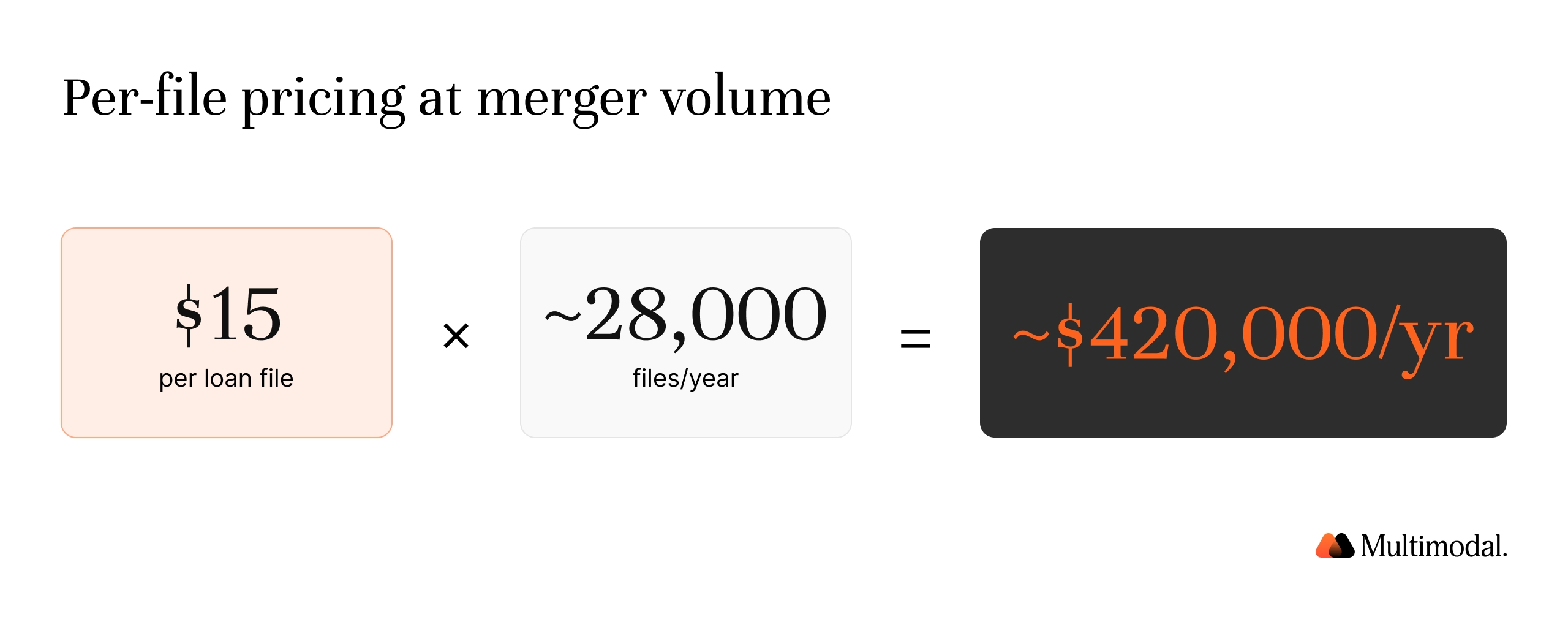
At $15 per loan file, one merger penciled out at nearly $420,000 per year.
Support, integration, governance, and audit overheads apply to every AI pricing model.
Adjacent AI products publish per-resolution prices; most credit union vendors publish nothing.
Seven pricing questions force any vendor to show math against your volume.
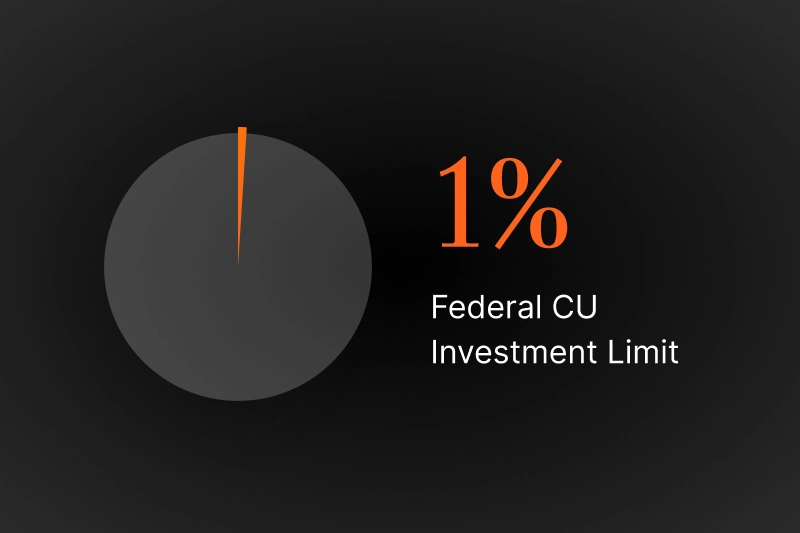
Get 1% smarter about AI in financial services every week.
Receive weekly micro lessons on agentic AI, our company updates, and tips from our team right in your inbox. Unsubscribe anytime.
Thank you! Your submission has been received!
Oops! Something went wrong while submitting the form.
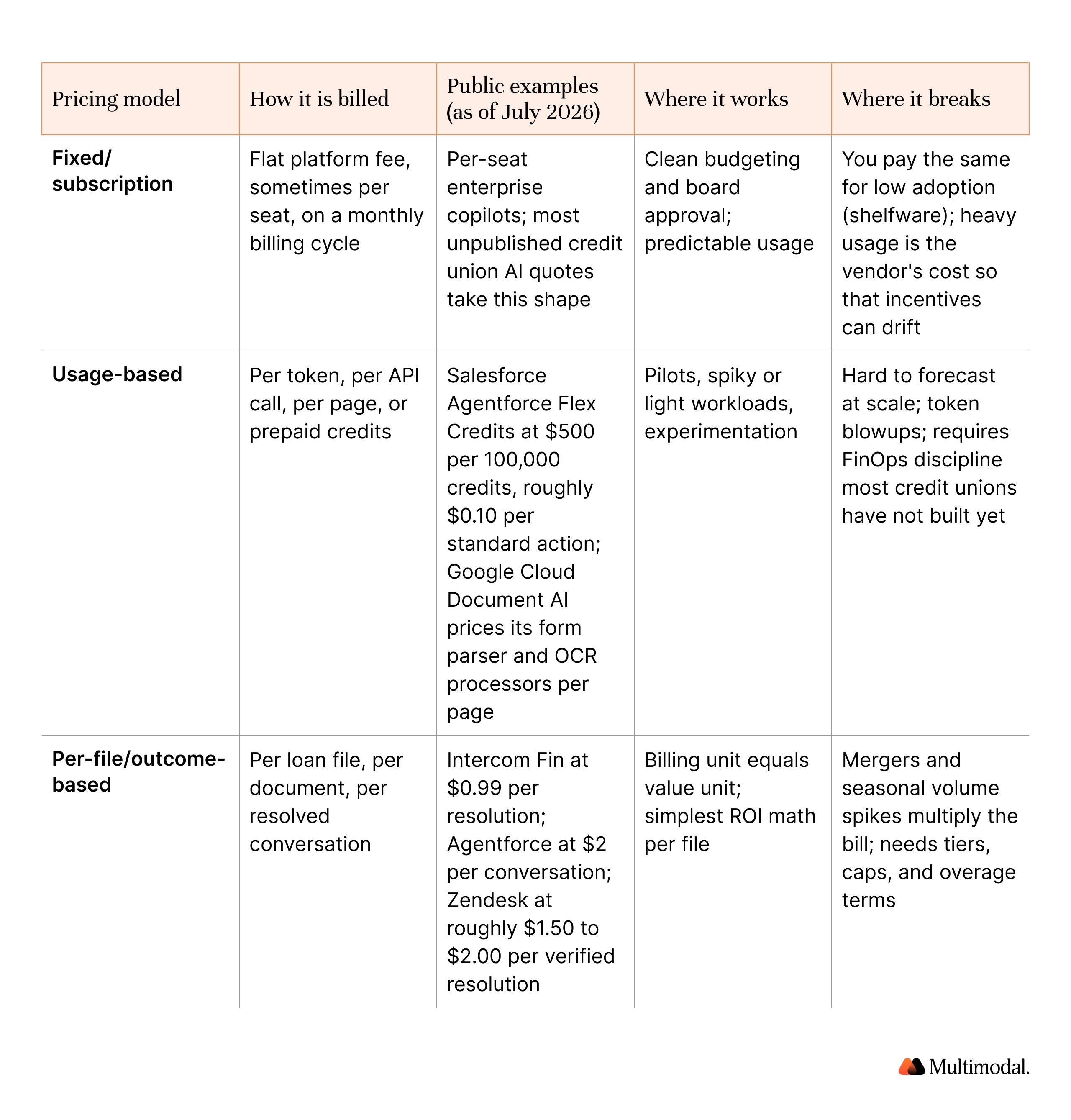
AI for credit unions is priced three ways: a fixed subscription (a flat platform fee on a monthly billing cycle), usage-based pricing (customers pay per token, API call, or action consumed), and per-unit pricing (per loan file, per document, or per successful outcome).
No AI pricing model is inherently cheaper; each one shifts risk differently between the credit union and the vendor. The right test is whether the unit you pay for matches the unit that creates customer value, and whether you can forecast the monthly bill at your own volume, including your worst-case quarter.
Most AI companies selling into credit unions will not make that test easy. This post exists to change that.
Why Is AI Pricing So Confusing for Credit Unions?
Across our sales conversations with credit unions this year, pricing model confusion is the single most common question we hear, ahead of even examiner readiness. Leaders are comparing a flat-fee platform, a per-seat copilot, and a per-file quote with no common denominator between them. One quote arrives as an annual license, another as prepaid credits, a third as a rate card tied to input tokens and output tokens that nobody in the room can translate into a budget line.
The confusion is structural, and it starts with opacity. Most AI vendors serving credit unions do not publish pricing at all. Their websites route to a sales team, and their software marketplace listings show no prices listed. Compare that with core or LOS procurement, where an RFP at least forces line items into the open.
It also starts with genuine novelty. AI pricing models are shifting from access to outcomes. Traditional software charged for seats; you knew the cost structure before the first demo. AI products carry real inference costs that scale with every request, so AI companies are experimenting with consumption meters, credit packs, tiered plans, and outcome-based pricing, sometimes all at once. Pricing structures now vary by metrics such as tokens, users, or completed tasks, and the same vendor may quote two credit unions differently.
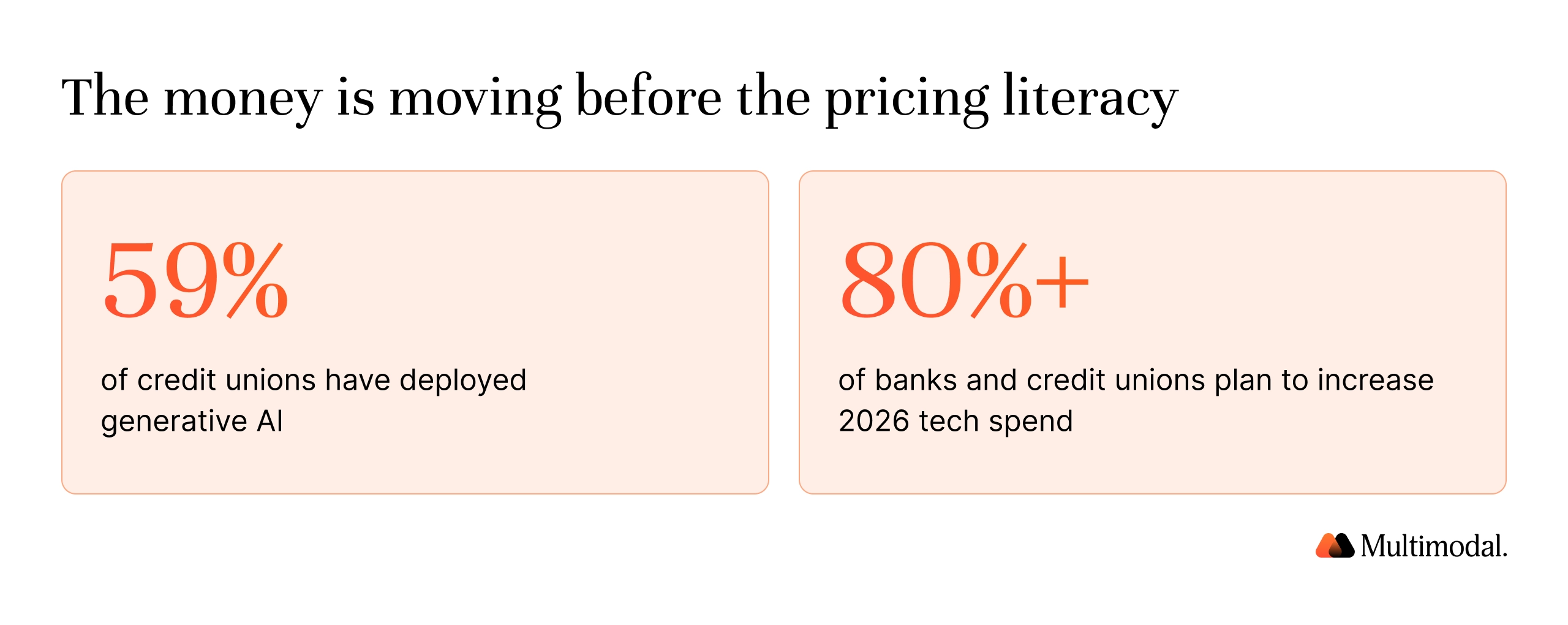
The stakes are a budget-season problem, right now. In Cornerstone Advisors' What's Going On in Banking 2026 study of 416 senior executives, 59% of credit unions had already deployed generative AI, and more than 80% of banks and credit unions intend to increase technology spending in 2026. The money is moving. The pricing literacy has not kept up.
So here is the promise of this post: the three pricing models explained in plain terms, the real math on where each one breaks, and the questions that make any vendor, including us, show the math.
What Are the Three AI Pricing Models?
A fixed subscription charges a flat monthly or annual fee for a defined level of access, sometimes per user. Tiered subscription pricing offers fixed fees for specific access levels, with advanced features reserved for paid tiers. Predictable usage benefits most from this model because the monthly bill never surprises anyone.
Usage-based pricing, also called consumption-based pricing, requires customers to pay only for the amount of AI resources consumed: tokens, API calls, pages processed, or compute time. Consumption-based pricing aligns vendor revenue with actual usage, which feels fair, but it moves forecasting risk onto the buyer. Token-based pricing is the purest form, metering large language models used under the product at different rates for input and output.
Per-file and outcome-based pricing charge for the unit of work itself. Outcome-based pricing charges for successful results achieved, not resources consumed. In lending operations, the natural unit is the processed loan file or document; in member service, it is the resolved conversation.
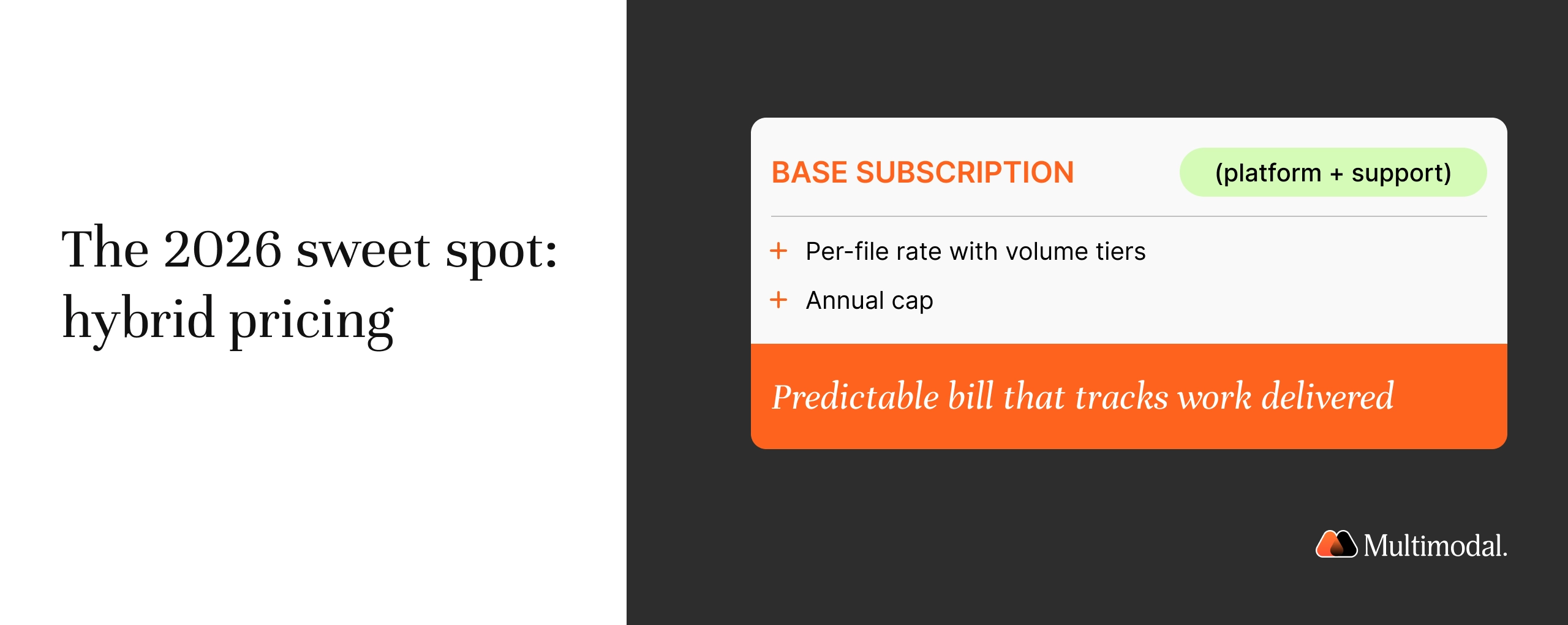
Hybrid pricing deserves its own mention because it is where the market is settling. Hybrid models combine a base subscription with usage-based or outcome-based charges above an included allowance. The base fee funds the platform, integrations, and support; the meter keeps the unit economics honest on both sides. When a vendor proposes a new pricing model mid-contract, it is usually a move from one of the pure models toward a hybrid.
Where Each Model Breaks: The Math Nobody Shows
Start with the per-file quote, because it produced the sharpest number we have heard this year. A credit union leader evaluating document automation ahead of a merger told us the quote sounded reasonable until the multiplication: "$15 a loan file... our merger volume, it's like 420,000 dollars." That works out to roughly 28,000 files a year. Per-file pricing without volume tiers turns growth into a penalty. The fix was contractual: caps, a discounted rate at volume, and a merger clause.
Usage-based pricing breaks differently. Its failure mode is the bill you did not see coming, and credit union technology leaders are already naming it as a top fear:
"That is probably one of the greatest fears I have right now, because a lot of the vendors bring you in without that cost, and then the licensing model or subscription model changes to where it's a usage-based cost versus just a seat-based cost... You actually need to have someone focused on financial ops, someone who is looking at what is the ROI and what is the cost." — Adrian Rodriguez, former SVP of Data and Innovation, American Heritage Credit Union
He added that recent weeks have brought "nonstop articles about organizations that have blown through their annual token spend in weeks." Inference costs vary dramatically with document complexity, model choice, and the number of tokens a workflow consumes, so a usage meter without usage limits is an open-ended commitment. If your demand fluctuates, consumption pricing can still be the right answer, but only with alerts, caps, and an owner watching the meter.
The fixed subscription fails quietly instead. The trade-off for predictability is that you pay full freight during the six months it takes staff to adopt the tool, and you keep paying if adoption never comes. Vendors also carry hidden incentives here: when heavy usage costs them money, the roadmap tends to drift toward limiting it.
And every model, all three, understates total cost of ownership. Hidden costs like infrastructure, integration, and support belong in the calculation from day one:
"It has overhead. It has taxes. It's not a set it and forget it. ... It comes at a cost which everybody should be aware of. And make sure you plan for it when you say, hey, I'm all in on agentic. Well, you're probably also all in on adding a couple people to your staff." — Jeffrey Staw, Chief Information and Innovation Officer, Firefighters First Credit Union
One more piece of math, from our own research: manual processing already carries a per-file price. A credit union with $500M in assets spends an estimated $4M to $6M a year on manual document processing across lending, compliance, and member services, and 55% to 70% of that cost is invisible in general ledger line items, hiding in overtime, error rework, and loans lost to slow turnaround. You are paying per file today. The line item just says something else.
What Are You Actually Buying? Match the Pricing Unit to the Value Unit
The most useful question in any AI pricing strategy discussion is not "which model is cheapest." It is "which unit creates value here, and does the pricing follow it?"
In lending, the industry already measures cost per loan. Freddie Mac's Cost to Originate research found that origination costs rose about 35% over three years, roughly $3,000 per loan, with retail-only lenders losing about $600 per loan, while lenders with high adoption of digital capabilities originate loans at about $1,500 less cost. The per-loan frame is how your CFO already thinks. An AI pricing model that cannot express its cost per processed file is asking your board to learn a new language for no reason.
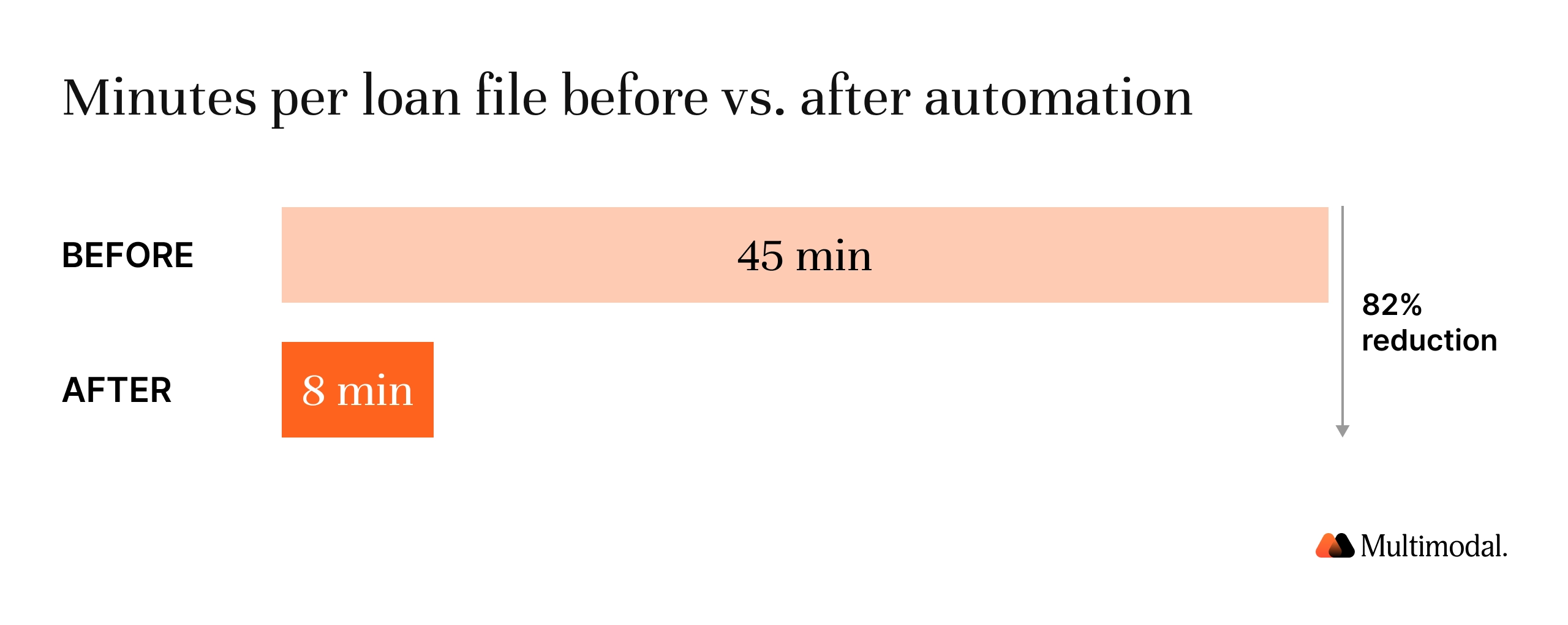
Our own deployment data gives the benchmark on the other side of the ledger: across credit union engagements in our 2026 field report, median processing time per loan file fell from 45 minutes to 8 minutes. That delta is the actual value being purchased. Measurable outcomes like that are what let a pricing model align cost with the business value the AI generates, and they turn cost savings from a slide-deck claim into a number your finance team can audit.
Speed compounds the value proposition because in lending, the unit of value is also competitive. In indirect auto, dealers route the next deal to whoever funds fastest, so every hour of file review is a share of dealer business at risk. The same logic extends to fraud detection and compliance review, where the cost of a slow decision shows up as losses and rework rather than labor.
So why do so few vertical AI vendors price against the value unit? Because outcome-based pricing transfers risk to the vendor, and it takes operational confidence to accept that risk. The customer-service AI category proves it can be done at scale: Intercom prices Fin at $0.99 per resolution and reports a 76% average resolution rate across more than 8,000 customers.
AI-native companies are moving away from seat-based SaaS pricing precisely because seats no longer map to value once agents, rather than users, do the work. Product leaders in the category increasingly describe the shift as moving from cost-plus to value-based models that reflect outcomes. Credit unions should treat a vendor's willingness to price near the value unit, with sensible caps, as a signal of confidence in their own product.
The Transparency Play: 7 Questions That Make Any Vendor Show the Math
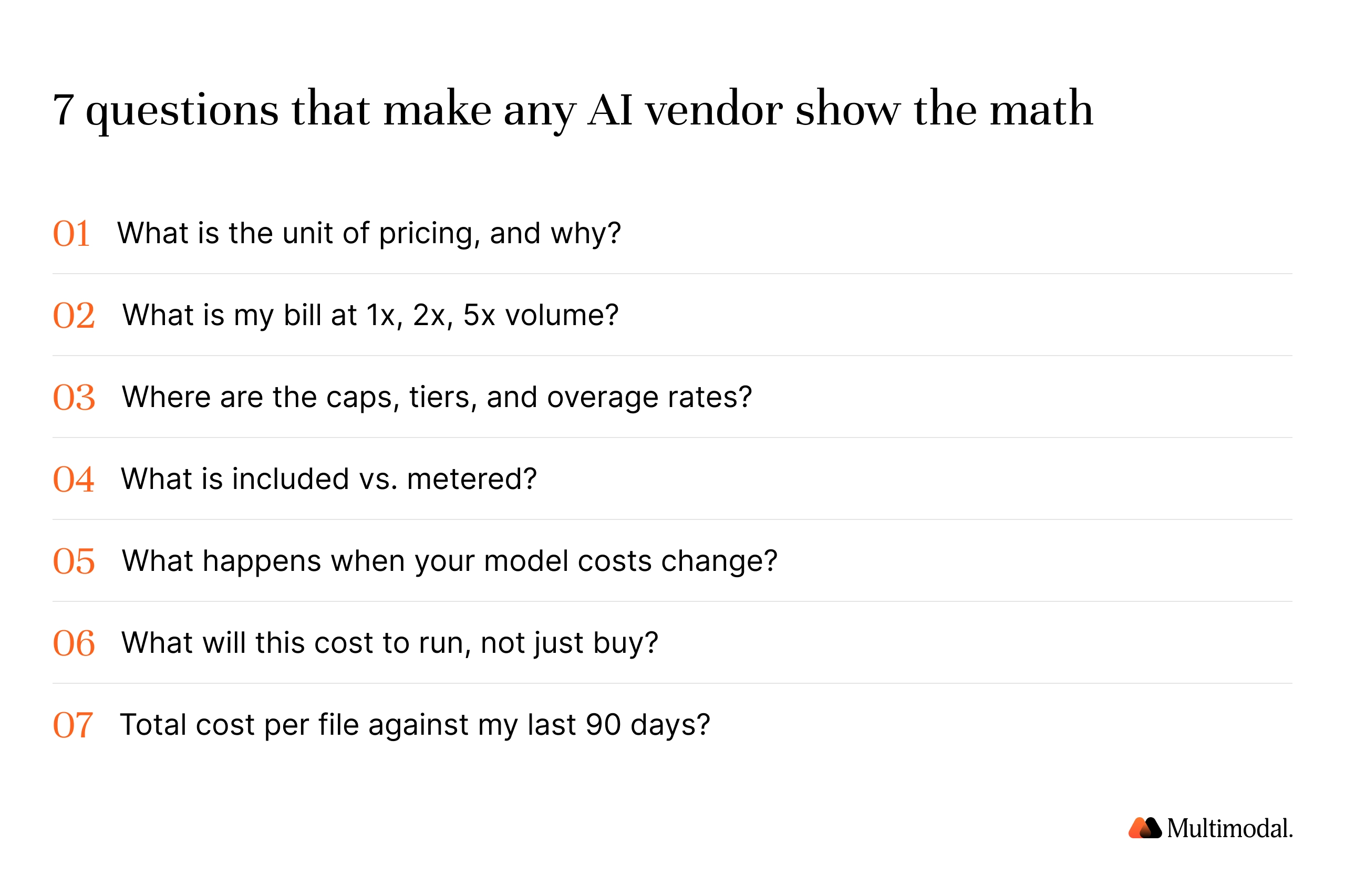
There is no universally right answer on pricing models. The answer depends on your volume, your volatility, and your risk appetite. But there is a structured framework for forcing clarity, and it fits in seven questions.
What is the unit of pricing, and why that unit? If the unit you pay for is not the unit that creates value for you, ask who absorbs the mismatch. A per-seat price for agentic work that removes seat-time is a mismatch by design.
What does my bill look like at 1x, 2x, and 5x my current file volume? Get the answer in writing. This is the merger question, and the only good time to ask it is before the merger.
Where are the caps, tiers, and overage rates? The $420,000 scenario dies here or nowhere. Volume tiers, a discounted rate above thresholds, and an annual cap convert per-file pricing from a growth penalty into a growth plan.
What is included in the base subscription versus the metered plan? Across major automation platforms, standard connectors for email and cloud storage are table stakes, while enterprise systems like Salesforce or ServiceNow are legitimately premium. If a vendor meters the basics, that tells you how the relationship will go.
What happens to my price when your model's pricing changes? Products built on large language models inherit their providers' economics. Model-agnostic architecture protects both sides, and token pass-through clauses cut both ways: falling inference costs should reach you too.
What will this cost to run, not just to buy? Support, monitoring, governance, and audit evidence are part of the cost structure of any AI deployment, and examiners will expect the governance whether or not the contract mentions it. Budget the overhead deliberately.
Will you put a total cost per processed file against my last 90 days of volume? This is the final transparency test. A vendor who will not price against your actual documents is quoting a hope.
The buyer's posture that makes these questions work comes from the venture side of the market:
"Get your hands dirty, experiment, don't sign long contracts." — Carey Ransom, Managing Director, Bank Tech Ventures
Ransom's larger point is that AI adoption "will require a different model for how they think about buying and trying and scaling some of these solutions." Institutions that underinvested in legacy infrastructure are, in his words, beneficiaries of cost deflation: today's AI tools cost far less than the systems they replace ever did. Short pilots, real documents, and written volume math beat long contracts negotiated on faith.
Get AI at the Right Price
Send us your last 90 days of loan file volume. We will put a transparent total cost per file number on your documents, in writing.
How Should Credit Unions Budget for AI in 2026-27?
Budgeting season is here, and the spend is rising: more than 80% of banks and credit unions plan to increase technology spending in 2026. AI tools are reimagining traditional enterprise budget structures, so the practical move is to translate each pricing model into a budget request format your CFO already recognizes.
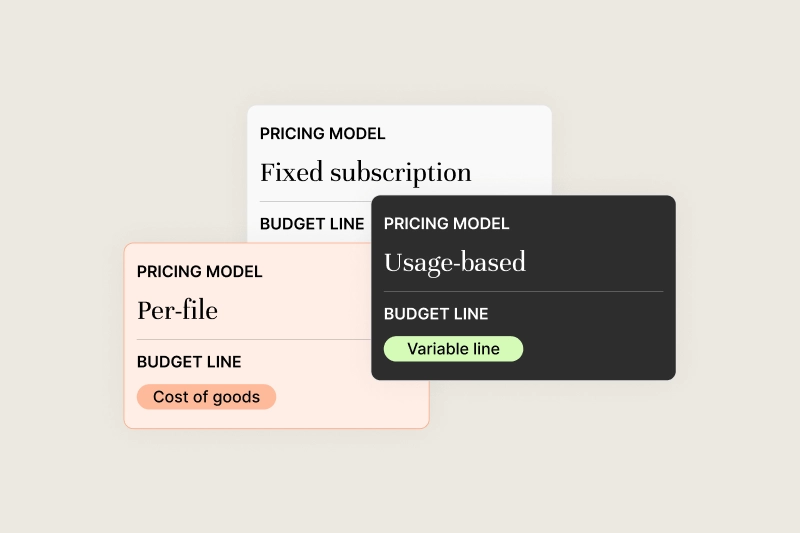
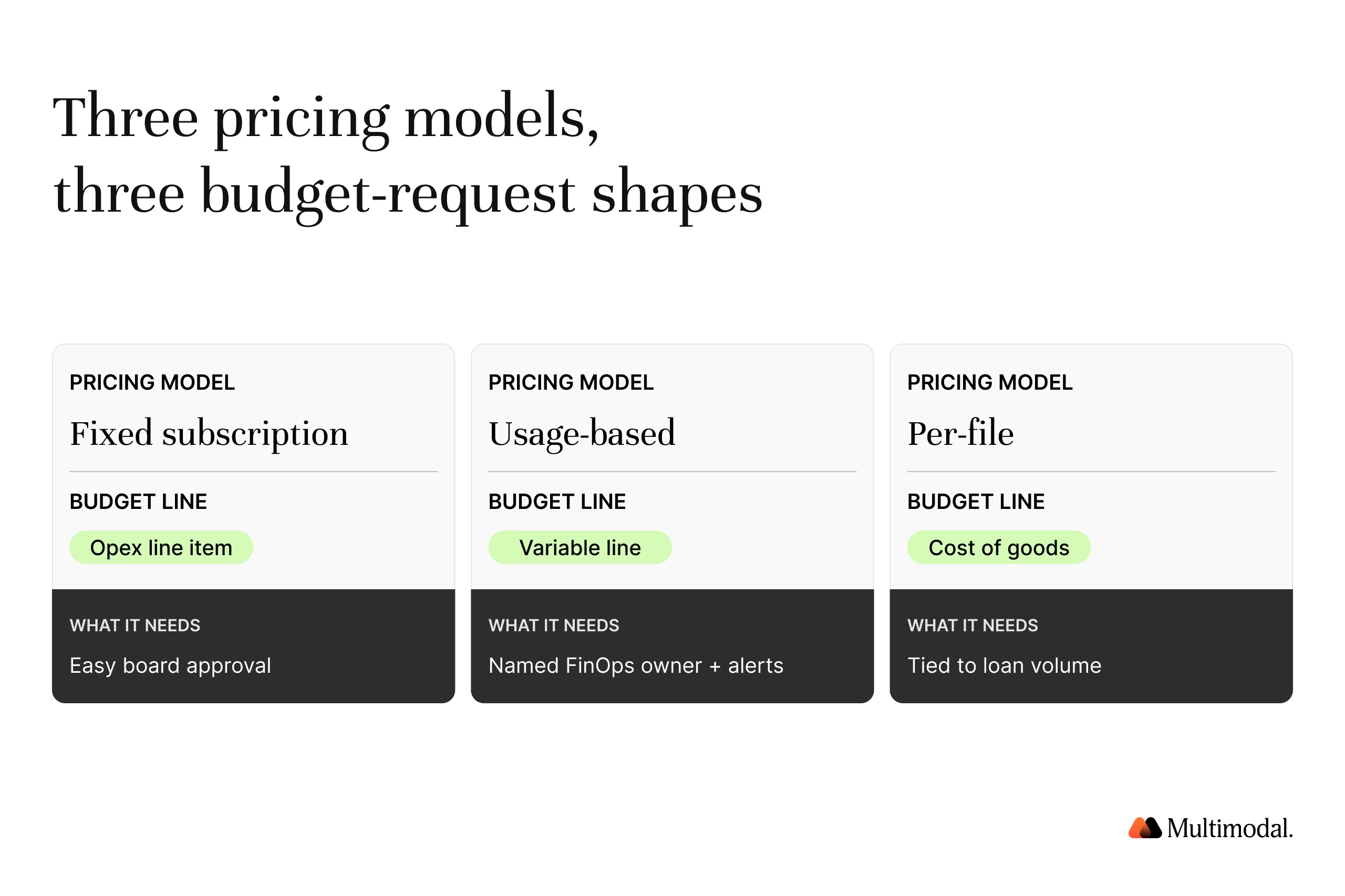
A fixed subscription is a straightforward opex line item. Usage-based pricing is a variable line that needs a named FinOps owner, alert thresholds, and a quarterly true-up. Per-file pricing is closest to a cost-of-goods framing: the CFO can tie it directly to loan volume and to the cost per loan the institution already tracks, which makes it the easiest of the three to defend in a board packet.
Pair the price with the offset. One credit union leader, in our conversations, framed the entire business case as the system paying for itself by eliminating positions they would not need to add as volume grew. That framing, cost avoided per file processed, is stronger in front of a board than any abstract efficiency claim, and it is the arithmetic our ROI calculator and Board-Ready AI Business Case report are built around.
Factor the build alternative honestly. Building in-house means a minimum of 12 to 18 months to hire or develop talent, as Rodriguez noted on the same podcast episode, and an internal build carries its own token bill and support tax, with no vendor to cap it. For most financial institutions, the realistic comparison puts the vendor price against fully loaded internal cost plus 12 or more months of lost time.
And watch this space: our next research report surveys credit union AI budgeting and spending for 2026 and planned spending for 2027, developed with our credit union advisory board. It will put shared benchmarks under exactly the questions this post raises.
The Pricing Model Is a Proxy for the Partnership
Fixed, usage-based, or per-file: each model can be fair, and each can go wrong without caps, tiers, and written volume math. The durable finding across every conversation behind this post is simpler. Vendors reveal how they will behave after the contract by how they price before it is signed. A vendor who shows you the math up front, prices against your value unit, and accepts caps is telling you they expect to earn the renewal on results.
The sweet spot for most credit unions in 2026 is a hybrid: a base subscription that funds the platform and support, plus per-file pricing with volume tiers and a cap, benchmarked against your own cost per loan. Ask the seven questions. Keep the pilot short. Make every vendor, including us, show the math.
Frequently Asked Questions
How much does AI cost for a credit union?
There is no single number because pricing structures vary based on metrics such as tokens, users, or successful tasks. Public benchmarks in adjacent categories run from $0.99 per resolved conversation to $2 per conversation. The reliable method is to ask every vendor for the total cost per processed file at your volume.
What is the difference between fixed, usage-based, and per-file AI pricing?
Fixed pricing charges a flat subscription for access regardless of activity. Usage-based pricing meters consumption in units such as tokens, pages, or API calls. Per-file pricing charges for each unit of completed work, like a processed loan file. Each model shifts forecasting risk differently between the credit union and the vendor.
What is per-file AI pricing?
Per-file pricing charges for each document or loan file the AI processes, making it the closest fit between billing and value in lending operations. It works when volumes are stable and breaks during mergers or seasonal spikes, so quotes should always include volume tiers, caps, and overage terms.
Is usage-based AI pricing risky for credit unions?
It can be. Usage-based pricing means customers pay only for resources consumed, which suits pilots and fluctuating demand, but it makes bills hard to forecast at scale. Organizations have burned through annual token budgets in weeks. Mitigate the risk with usage limits, alerts, caps, and a named owner watching spend.
What AI pricing model is best for loan and document automation?
For document-heavy lending work, pricing should track the value unit, the processed file. In practice the strongest structure is hybrid: a base subscription covering platform and support, plus per-file rates with volume tiers and a cap. That keeps unit economics visible while protecting the budget from spikes.
What should a credit union ask an AI vendor about pricing?
Seven questions: the unit of pricing and why; the bill at 1x, 2x, and 5x volume; caps, tiers, and overage rates; what is included versus metered; what happens when model costs change; the cost to run, not just buy; and a written total cost per file against your last 90 days of volume.
Why don't AI vendors publish pricing?
Most credit union AI vendors scope deals individually, and inference costs genuinely vary with workflow complexity, so many route pricing through a sales team. That is the category norm, and it is worth testing: a vendor confident in their unit economics can still price transparently against your documented volume.
How should a credit union budget for AI in 2026?
Translate the pricing model into a familiar budget shape: fixed fees as an opex line; consumption pricing as a variable line with a FinOps owner; and per-file pricing as cost of goods tied to loan volume. With over 80% of institutions raising technology spend in 2026, the discipline matters more than the amount.

.svg)
.svg)

.avif)
.png)

.png)