Clearing Loan Stipulations with AI: How Credit Unions Fund Indirect Auto Loans Faster
Loan stipulations are the conditions lenders verify before funding. See why manual stip review slows indirect auto lending and how AI clears stips in minutes.
Stipulations, not approvals, are the real indirect auto funding bottleneck
97% of packets arrived incomplete at one $4B credit union
Dealers route future volume to lenders that fund fastest
Decisioning AI never touches the stip list; funding stays manual
AI clears complete stip sheets in minutes, humans handle exceptions
Get 1% smarter about AI in financial services every week.
Receive weekly micro lessons on agentic AI, our company updates, and tips from our team right in your inbox. Unsubscribe anytime.
Thank you! Your submission has been received!
Oops! Something went wrong while submitting the form.
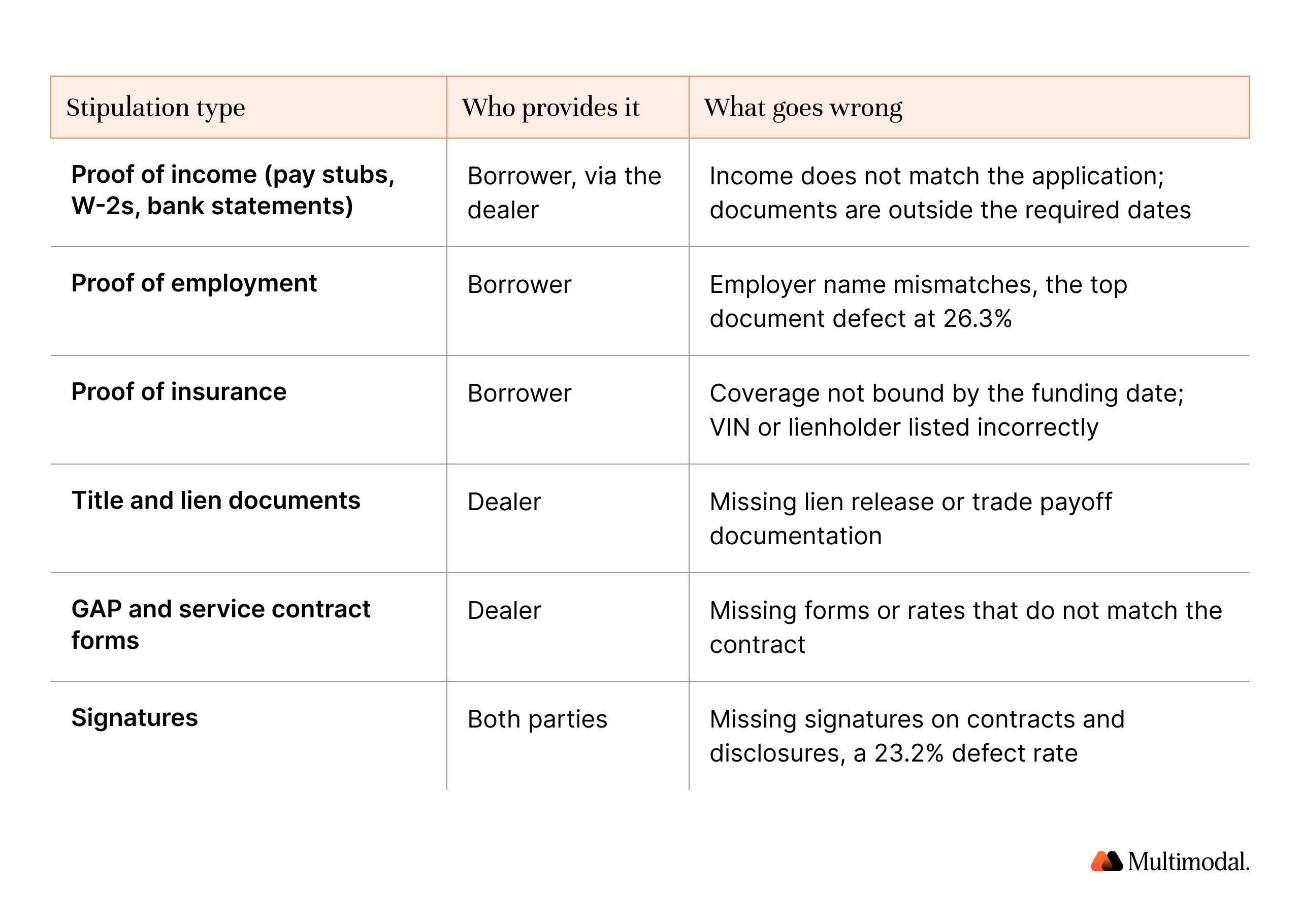
Loan stipulations, or stips, are the specific requirements a lender sets before a loan can fund: the conditions and documents that must be collected and verified, including proof of income, insurance, title and lien paperwork, GAP and service contracts, and signatures.
Lenders place stipulations to mitigate risk and to confirm a borrower's ability to repay before any money moves. In indirect auto lending, the approval takes seconds. Clearing the stips takes days, and the gap between approved and funded is where credit unions win or lose dealer relationships.
What Are Loan Stipulations?
Loan stipulations are conditions that must be met during the loan process before a lender releases funds. Their purpose is verification: stipulations confirm that the borrower data on the application matches reality, so the lender can determine repayment capability accurately and protect its interest in the collateral. Common loan stipulations include income verification, proof of employment, proof of assets or down payment, and proof of insurance on the vehicle, which protects the lender's position in the collateral securing the transaction.
In indirect auto lending, stips come from two parties. Borrowers submit personal documentation such as pay stubs, bank statements, and references. Dealers assemble the rest of the loan file, including the contract, title and lien documents, and ancillary product forms. The dealer stip list is where most funding delays start, because the dealership's finance office is compiling documents from multiple systems under time pressure.
Loan stipulations often require extensive documentation, and every item on the list exists to verify something a lender cannot afford to assume. That is also why stipulations can delay or halt the lending process entirely when they are not met promptly: delayed funding is built into the design, because funding cannot occur until all stipulations are satisfied.
Why Do Stipulations, Not Approvals, Delay Indirect Auto Funding?
The approval is nearly instant. A modern loan origination system returns a decision within seconds, giving the dealer an answer while the customer is still in the showroom. The loan packet is another story: it almost never arrives complete.
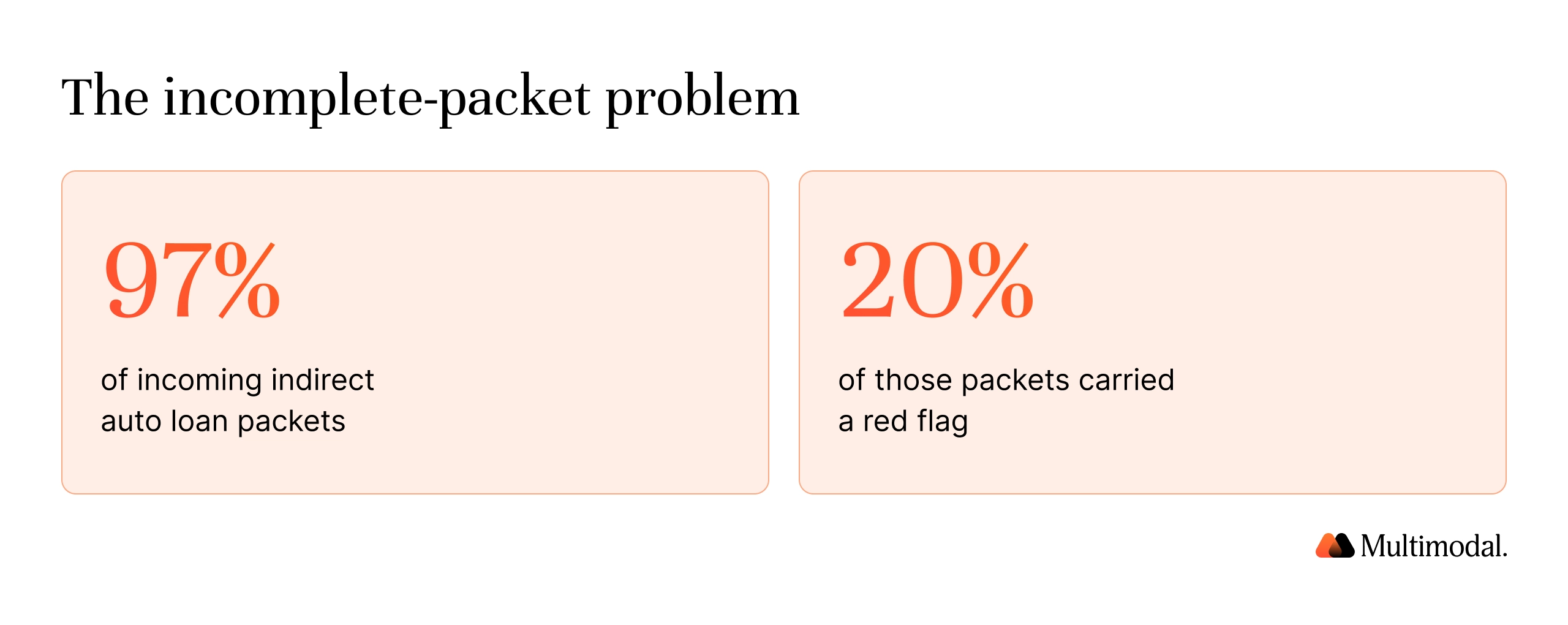
At one $4 billion credit union, 97% of incoming indirect auto loan packets arrived incomplete, and 20% carried a red flag. That number came from a single institution's own funding operations, and the industry data around it points the same direction.
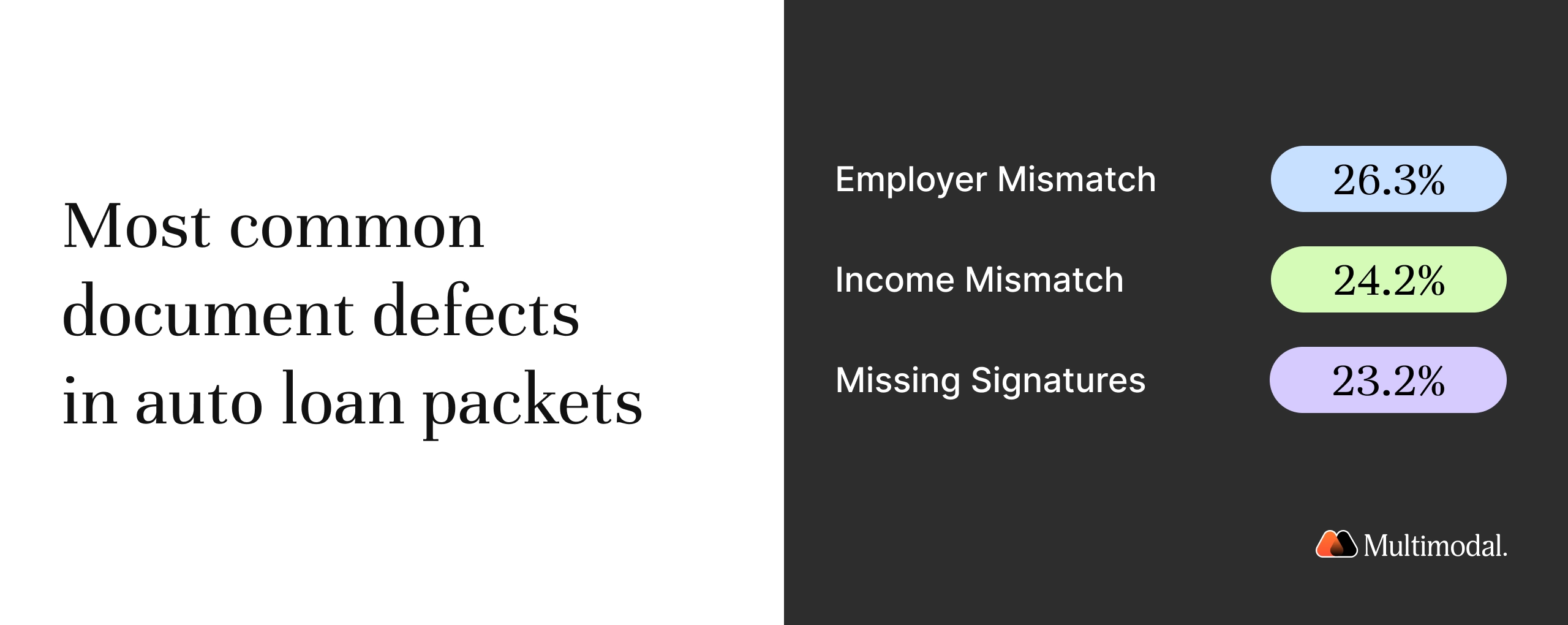
Roughly one in four lenders reports document defect rates near 30%, with employer mismatches (26.3%), income mismatches (24.2%), and missing signatures (23.2%) as the most common errors. One in four paper contracts contains an error, and about 70% of surveyed dealers say missed stips contribute to funding delays.
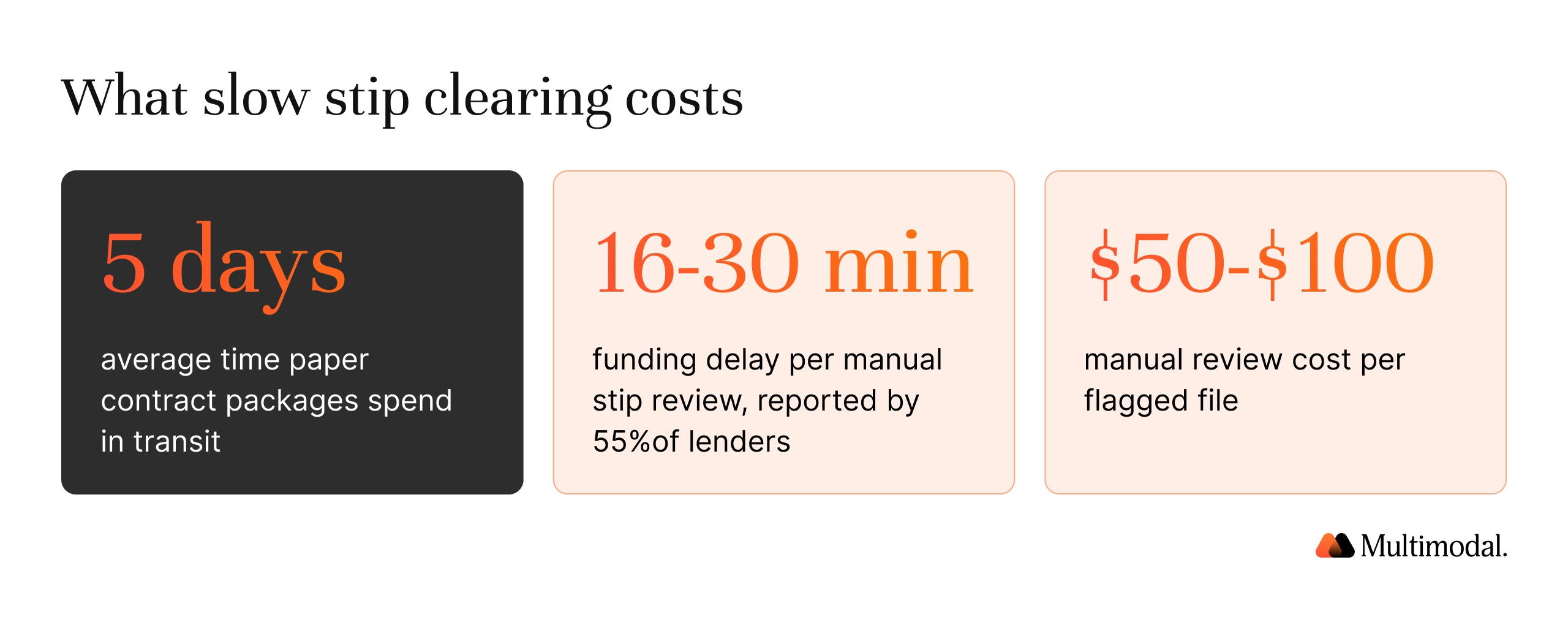
The cost of catching those errors by hand compounds per file. 55% of lenders report funding delays of 16 to 30 minutes from manual stipulation reviews alone, and 58% estimate that manual review costs $50 to $100 per flagged file.
The mechanics explain why. A funding specialist checks each document against the checklist by hand, toggling between the LOS, a document imaging system, and email. Those manual tasks stretch processing times on clean files and stall flagged ones, because every missing item triggers a phone call or email to the dealership, and the deal waits, sometimes for days, until the corrected paperwork comes back.
Disconnected systems mean the same borrower data gets re-keyed and re-checked at every step, which is precisely how errors slip through and how funding queues back up.
The Dealer Is Your Customer: What Slow Stip Clearing Really Costs
In indirect lending, the borrower is affiliated with the dealership before they are affiliated with the credit union. Members finance at the dealership for convenience, and the sales and finance teams there have already closed the deal. What the dealer cares about now is getting paid, and dealers prefer to send the next deal to the lender that pays reliably and fast.
Dealerships are cash-flow businesses, and slow stip clearing shows up on their books as contracts in transit, or CIT: deals delivered but not yet funded. Paper contract packages average five days in transit, and every one of those days is money the dealership has spent but not received. Dealers track which lenders age their CIT, and that record quietly reallocates future volume. Funding speed is a competitive position, and it is one of the few areas a credit union controls end-to-end.
The stakes for credit unions are not small. Credit unions held 20.63% of total vehicle financing in Q1 2025, and indirect auto is the growth engine behind that share for many institutions. Capacity challenges make the math harder: one credit union on a research committee we work with supports 560 dealers, while a single funding processor caps out at around 150 loans per month. Scaling that operation by hiring alone means costs grow in step with volume.
Slow funding also cascades into loan servicing. A loan cannot board until it funds, so late funding compresses everything that follows: servicing setup, first payment dates, payment reconciliation, and the welcome communication that shapes how new customers experience the credit union. Members who financed a car on Saturday judge the institution by how smoothly those first payments and interactions go. Clean, fast funding is the setup for reliable servicing.
Why Decisioning AI Does Not Clear Stips
Most AI investment in lending has gone into decision-making. Underwriting models score risk in milliseconds, and LOS platforms auto-decision a growing share of applications. Those systems answer one question: should we approve this loan? They never look at the stip list because it appears after their work is done.
Clearing stips is a document problem rather than a scoring problem. The question at the funding desk is whether the pay stub in the file matches the stated income, whether the insurance binder covers the correct VIN, and whether all signatures are present. A decision engine cannot read a scanned contract, and connecting your LOS to additional data sources does not complete the paperwork in the packet.
That is the seam in the lending stack. Decisioning AI accelerated the yes. The file work between "yes" and "funded" stayed manual, and that's half of the process dealers actually feel. We describe our position simply: we are not a chatbot, nor a decision engine. We process the loan file. Decision engines and LOS platforms do their jobs well, and AgentFlow works alongside them at the step they were never built to touch.
How AI Clears Loan Stipulations, Step by Step
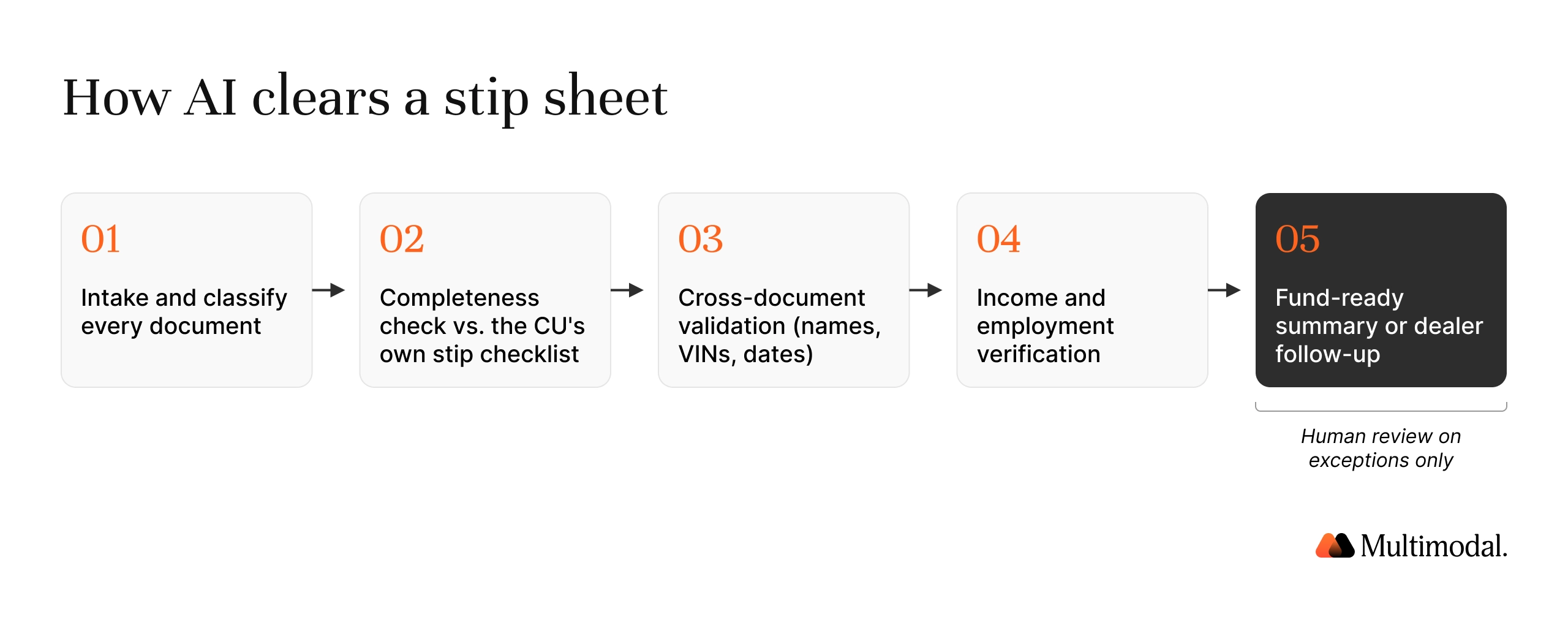
We built and tested this workflow with a credit union research committee, against real funding checklists and a deliberately incomplete packet scenario. Today, manual funding review at those institutions runs 40 minutes to 3.5 hours per application. Agentic loan automation gets a clean file to fund-ready in minutes. Here is the process.
1. Intake and classify every document
The system ingests the full loan packet in any form it arrives in: dealer portal upload, fax, email attachment, or scanned images. It identifies each document type automatically: contract, pay stub, insurance binder, title application, GAP form, without templates. Because it reads content rather than relying on brittle, position-based rules, a rearranged or nonstandard document does not break automated workflows the way it does with traditional RPA.
2. Run a completeness check against your own stip checklist
Every credit union runs its own funding checklist, and the differences matter. The agent checks the packet against your configured list, item by item, and flags exactly what is missing. This is the step that converts "the packet looks complete" from an assumption into a verified answer within seconds of arrival.
3. Cross-validate data across documents
Names, addresses, VINs, loan amounts, and dates must agree across the contract, the application, the insurance binder, and the title documents. The system compares these fields across the entire file and surfaces every mismatch. Cross-document validation is where automation helps reduce errors that tired human eyes miss at 4 p.m. on the last business day of the month.
4. Verify income and employment
Income verification is the bottleneck funding teams name most. The agent reads pay stubs and bank statements, computes qualifying income, checks that documents fall inside the required window (for example, pay stubs issued within the past 30 days), and compares stated employment against the documentation. It efficiently and consistently confirms the numbers, file after file.
5. Produce a fund-ready summary or a dealer follow-up
Clean files get a fund-ready summary with citations linking back to the exact page and field for every verification, giving compliance teams a built-in audit trail rather than a spreadsheet reconstructed after the fact. Files with exceptions get a drafted, editable dealer follow-up listing precisely what is needed, so one clear communication replaces days of back-and-forth. Humans stay in the loop where judgment matters and focus their time on exceptions instead of routine checks.
Improving efficiency at this step compounds across the operation: funders handle more volume in less time, error rates fall because every file receives the same careful review, and compliance tracking improves because every decision is automatically documented. Streamlined funding operations scale with loan volume instead of headcount, which is where the operational efficiency case for loan automation ultimately rests.
"The aspirational is same day: turning that money around to them same day. We are generally one, max two days on anything normal. Now, there are always files that come in that have some issues that we have to work through, and we can't fund those right away." — Lisa Highley, Chief Lending Officer, University of Kentucky Federal Credit Union, Main Street AI podcast
Same-day funding on every clean file is exactly what this workflow makes routine.
What Are the Alternatives to Manual Stipulation Review?
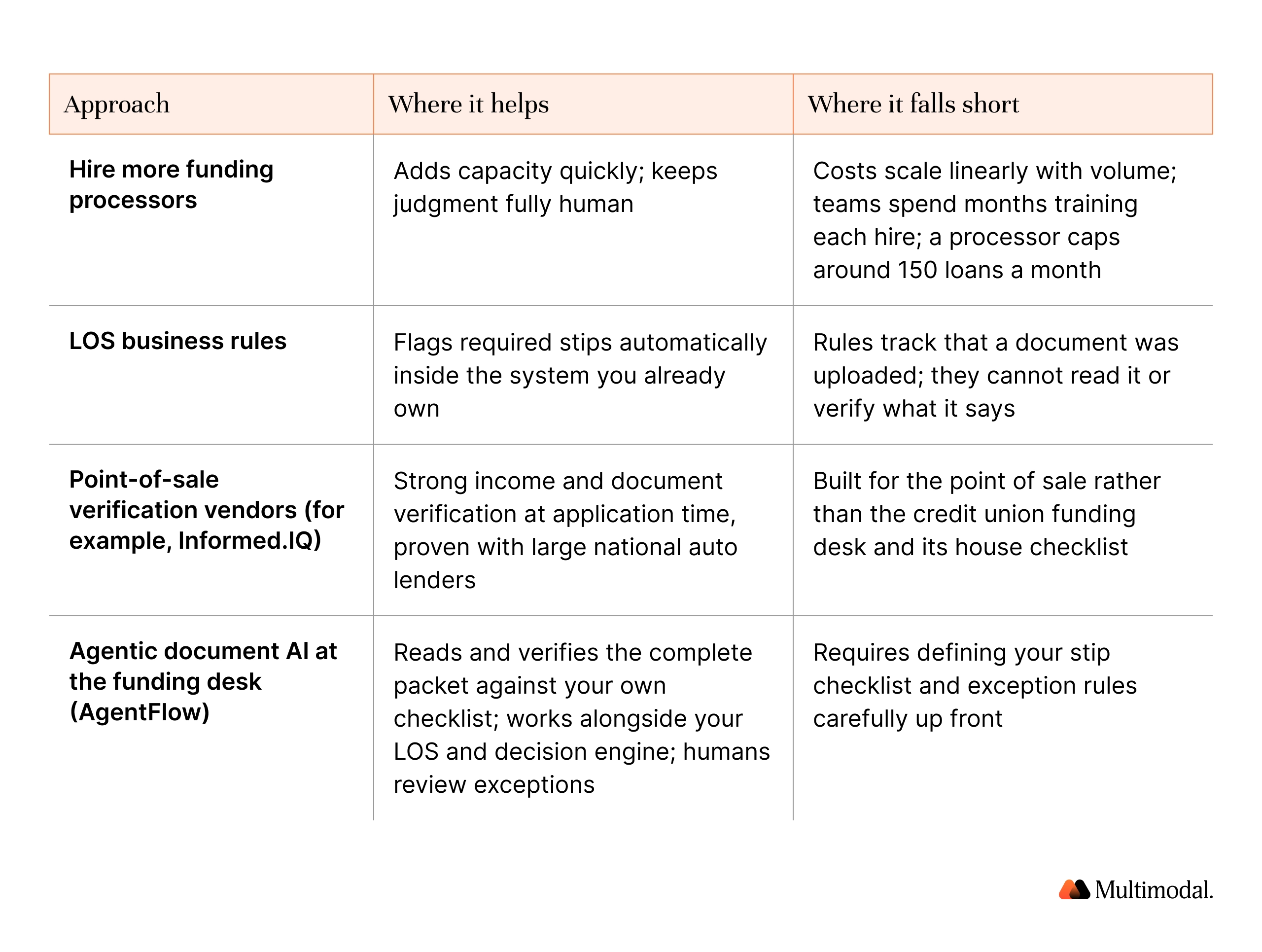
Financial institutions exploring how to streamline workflows at the funding desk generally weigh four options. An honest comparison:
For credit unions looking to optimize the gap between approval and funding specifically, the funding desk is the highest-leverage place to apply automation, because that is where the delay actually lives.
Frequently Asked Questions
What does it mean to clear stipulations on a loan?
Clearing stipulations means collecting, reviewing, and verifying every condition a lender attached to a loan approval, such as proof of income, insurance, and signed contracts. Once all stipulations are satisfied and documented, the loan is cleared to fund, and the lender releases the funds. Funding cannot occur before that point.
How long does stipulation clearing take?
It depends on the completeness of the file. Manual review of an indirect auto funding packet runs 40 minutes to 3.5 hours per application, and missing documents add days of dealer back-and-forth. Automated stipulation review verifies a complete packet in minutes and flags exceptions immediately, so only problem files wait on people.
What is the difference between a stipulation and a condition?
In consumer lending, the terms overlap: stipulations are conditions that must be satisfied before funding. The sharper difference is with covenants, which govern the borrower after funding. Affirmative covenants require specific actions, negative covenants restrict actions, financial covenants set performance targets, and default clauses define what triggers immediate repayment.
Can AI verify proof of income?
Yes. Modern document AI reads pay stubs, W-2s, and bank statements, extracts the figures, computes qualifying income, and compares the result against the application. It also checks document dates and employer names, catching income and employment mismatches, which are the most common defects in auto loan files.
Do credit unions need to replace their LOS to automate stip review?
No. Stipulation automation operates alongside the LOS and the decision engine, picking up the file after approval. The LOS keeps the record; the agent reads the documents, verifies the data, and returns results. Credit unions keep their existing lending stack and add verification capability at the funding step.
What is contracts in transit (CIT)?
Contracts in transit are retail installment contracts a dealership has delivered to a lender but that have not yet funded. CIT represents money the dealer has spent but not received. Aging CIT strains dealer cash flow, which is why dealers steer future business toward lenders that consistently fund fast.
See Your Own Stip Sheet Cleared in Minutes
Bring your funding checklist and one sample loan packet. In a 30-minute working session, we will run your documents through AgentFlow and show you which stips clear automatically and which route to your team.
Every lender in indirect auto sells a fast approval. Dealers stopped being impressed by that years ago, because the approval was never their problem. Their problem is the funding delay between the signed deal and the payment, and that delay is a stipulation problem.
The credit unions that clear loan stipulations in minutes rather than days will be the ones dealers rely on first, deal after deal. The benefits are compounding: faster funding, lower per-file costs, cleaner compliance records, and a dealer network that sends its next contract to the lender it trusts to pay.
The fastest way to explore stipulation automation is to watch it run on your own documents. Bring your funding checklist and a sample packet, and we will walk through your files, your stips, and your exception rules in a 30-minute working session.

.svg)
.svg)

.avif)
.png)

.png)