What the CUSO Investment Cap Debate Means for Your 2027 AI Budget
The 1% CUSO investment cap applies across every position a credit union holds. Here is how it constrains AI spending and what NACUSO is doing to change it.
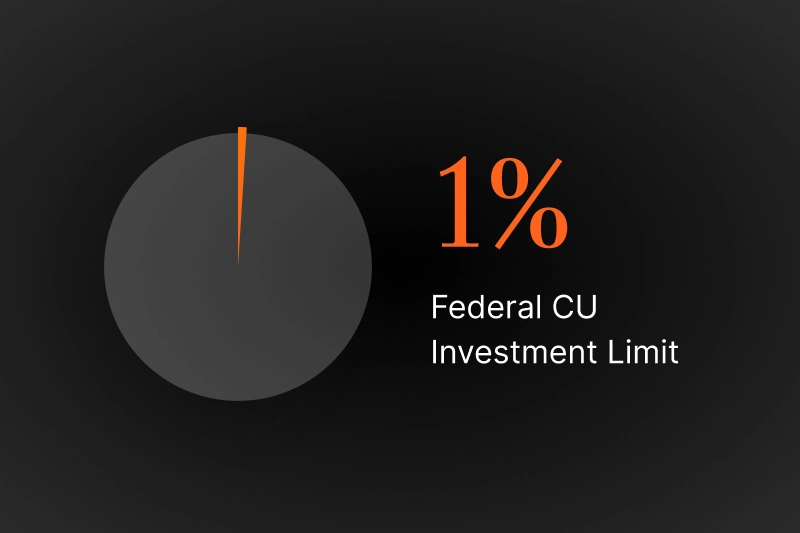
The 1% CUSO investment cap applies in the aggregate across all positions held.
Investment authority and loan authority to CUSOs are separate 1% ceilings.
Shared AI expertise, not software licensing, is the constrained budget line.
NACUSO seeks removal of the cap and expects a 5% to 10% outcome.
Buying from a non-CUSO provider avoids the cap, but forfeits influence over the roadmap.
Get 1% smarter about AI in financial services every week.
Receive weekly micro lessons on agentic AI, our company updates, and tips from our team right in your inbox. Unsubscribe anytime.
Thank you! Your submission has been received!
Oops! Something went wrong while submitting the form.
If your credit union is budgeting for AI adoption in 2027, the number that constrains you may have nothing to do with AI. A federal credit union's total investments in credit union service organizations may not, in the aggregate, exceed 1% of its paid-in and unimpaired capital and surplus. That CUSO investment limit applies across every position at once, so a stake in a technology CUSO competes with insurance, lending, and stablecoin positions for the same 1%. NACUSO is asking Congress to lift it. Randy Salser, its president and CEO, expects the final number to land somewhere between 5% and 10%.
Where this came from, and where we stand
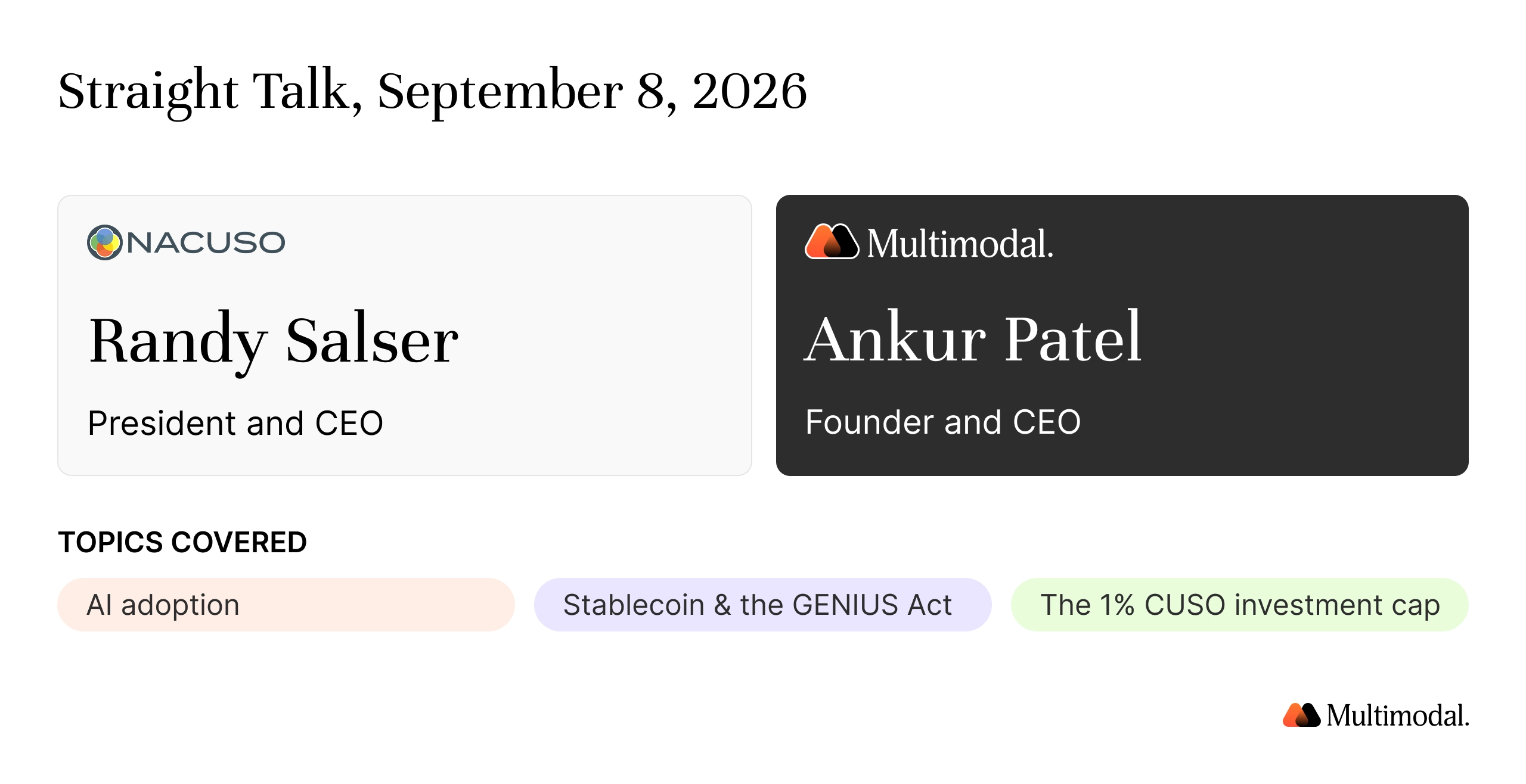
On September 8, Multimodal CEO Ankur Patel joined Randy Salser, president and CEO of the National Association of Credit Union Service Organizations, for NACUSO's Straight Talk livestream, covering AI adoption, stablecoins, and what is moving on Capitol Hill. Multimodal joined NACUSO as a member in August, which is worth stating plainly before we summarize their advocacy position.
Many credit unions choose to adopt AI through a CUSO, so the laws that govern CUSOs may slow adoption. This post carries that structural argument into the budget cycle, where it becomes a line item.
How CUSO investment rules actually work
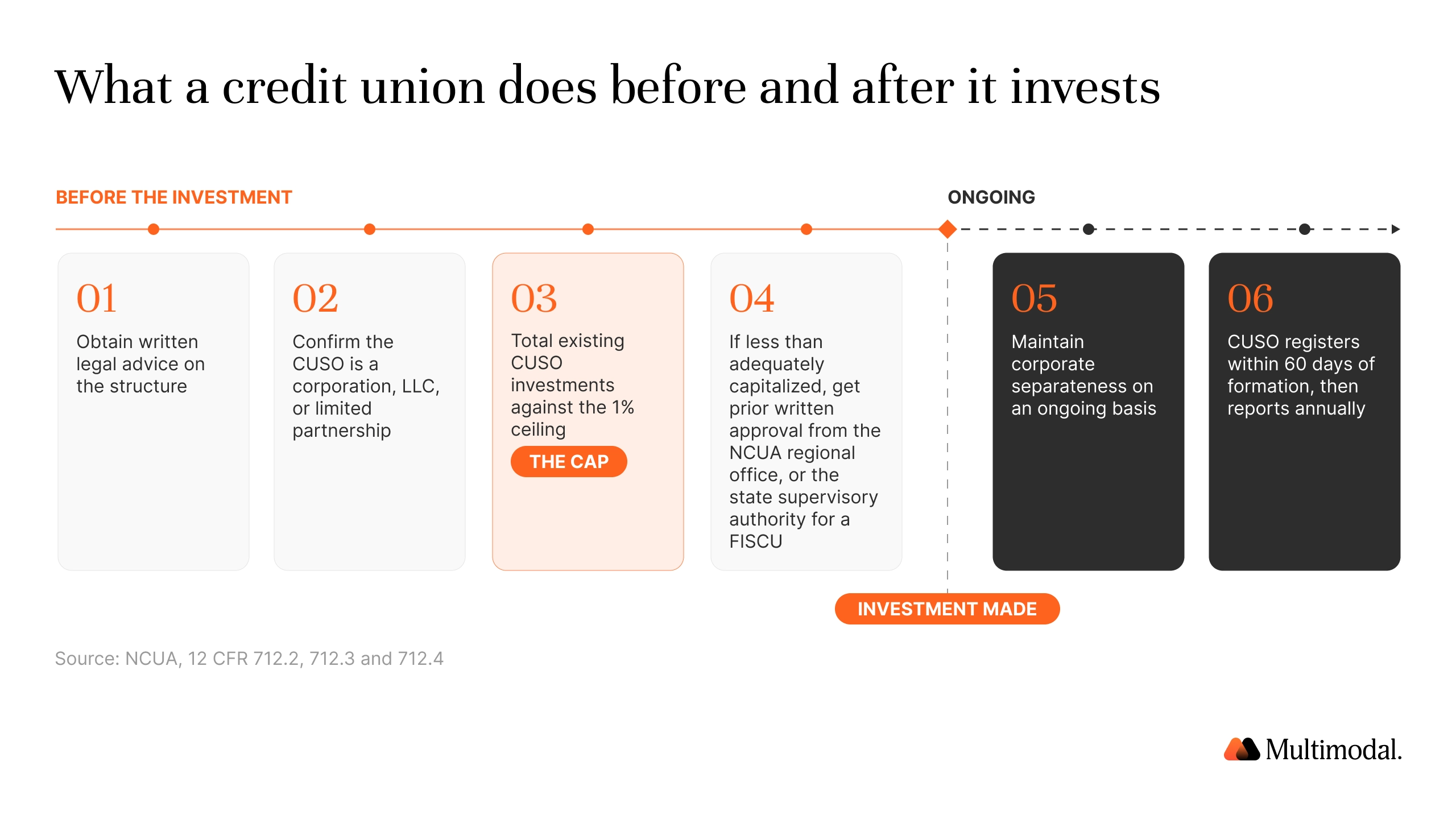
A CUSO provides specialized services to credit unions and their members. NCUA does not regulate CUSOs directly. It oversees them through the credit unions that invest in them, and it does not charter or insure them, so a CUSO investment is not federally insured. The entity must be a corporation, limited liability company, or limited partnership, and a federal credit union may participate only as a limited partner. Four mechanics matter for planning.
Investment authority and loan authority are separate. An FCU's total investments in CUSOs are subject to a 1% ceiling relative to paid-in and unimpaired capital and surplus. An FCU's total loans to CUSOs carry their own, independent 1% ceiling.
Capitalization changes the arithmetic. A credit union that is less than adequately capitalized must obtain prior written approval from the appropriate NCUA regional office once its aggregate cash outlay, measured cumulatively across the preceding seven years, exceeds that 1%. A federally insured, state-chartered credit union goes to its state supervisory authority instead, notifying the NCUA at the same time.
Accounting shapes the reported number. Positions are carried at GAAP, and a GAAP valuation increase arising from equity method accounting does not, by itself, require divestiture.
Separateness is a condition of the structure. A federally insured credit union and its CUSO must maintain separate corporate existence: transactions, accounts, and records that are not intermingled; separate corporate procedures observed; adequate separate financing; and no domination of the CUSO's routine daily operations. Written legal advice is required before a FICU invests to confirm that the structure limits its exposure to the funds it invests or loans. Corporate separateness preserves the limited liability that makes the ownership interest worth holding.
Permissible services are preapproved by category, covering data processing, electronic transaction services, checking and currency services, fixed asset services, financial counseling and financial planning, and loan support. CUSOs file basic registration information within 60 days of formation and report annually to NCUA and the state supervisory authority.
What the 1% CUSO investment cap actually does to an AI budget
One budget, not four
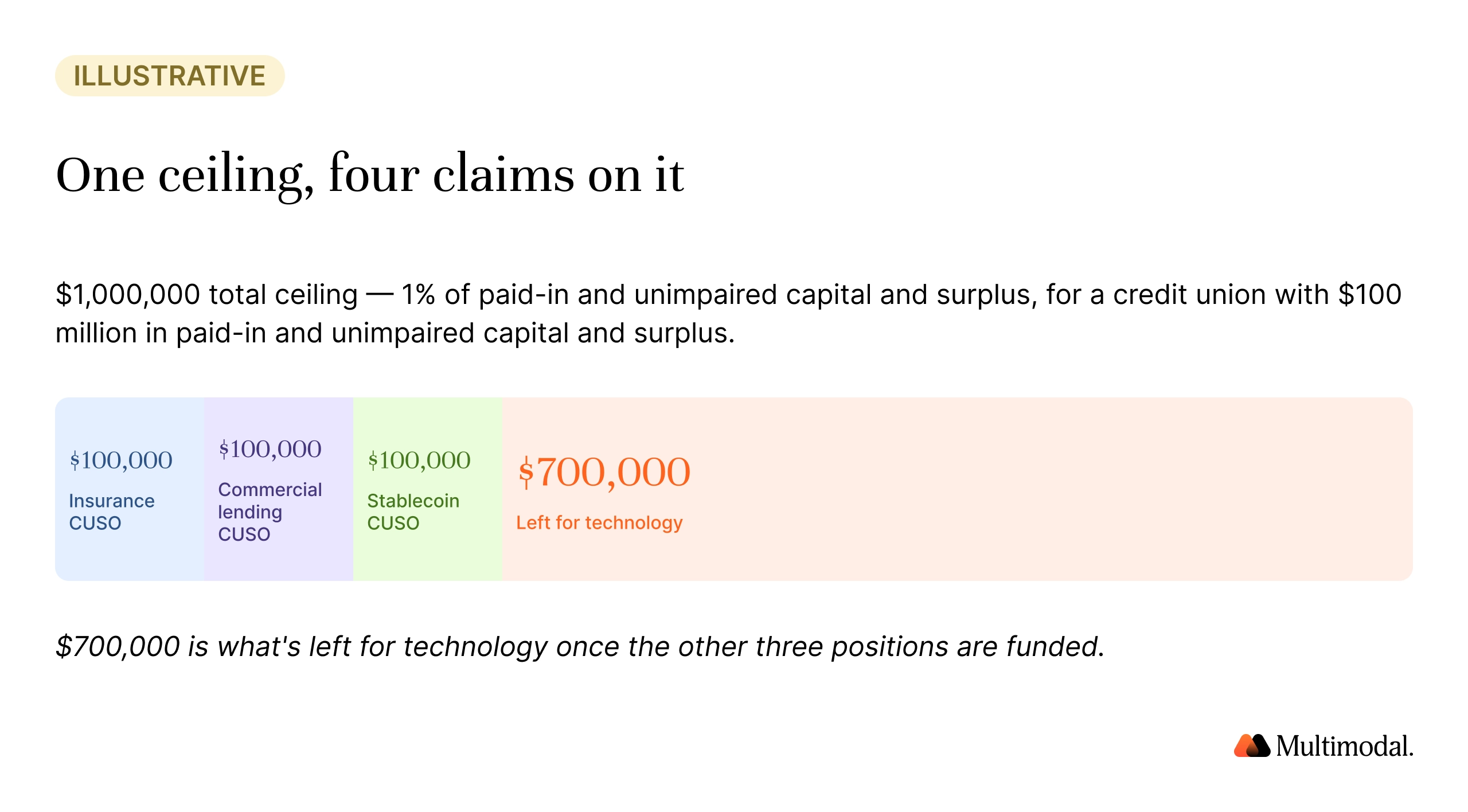
The constraint that catches planners is aggregation. Every dollar of every CUSO investment draws on the same ceiling, regardless of what the underlying business does.
"Every dollar you put in goes towards that 1%, and particularly when it's in the aggregate, because any investment that you make... if you do 1% in an insurance CUSO or a commercial business lending CUSO, if you do a hundred thousand, you do a hundred thousand in stablecoin... that all counts against the cap." — Randy Salser, President and CEO, NACUSO
A credit union already holding insurance and commercial lending positions has less headroom for a technology CUSO, and the strength of the AI business case does not change that.
Shared expertise is the line item, and the cap governs it
The harder problem sits underneath the software. Building AI capability takes people, and those people are priced for institutions far larger than most credit unions.
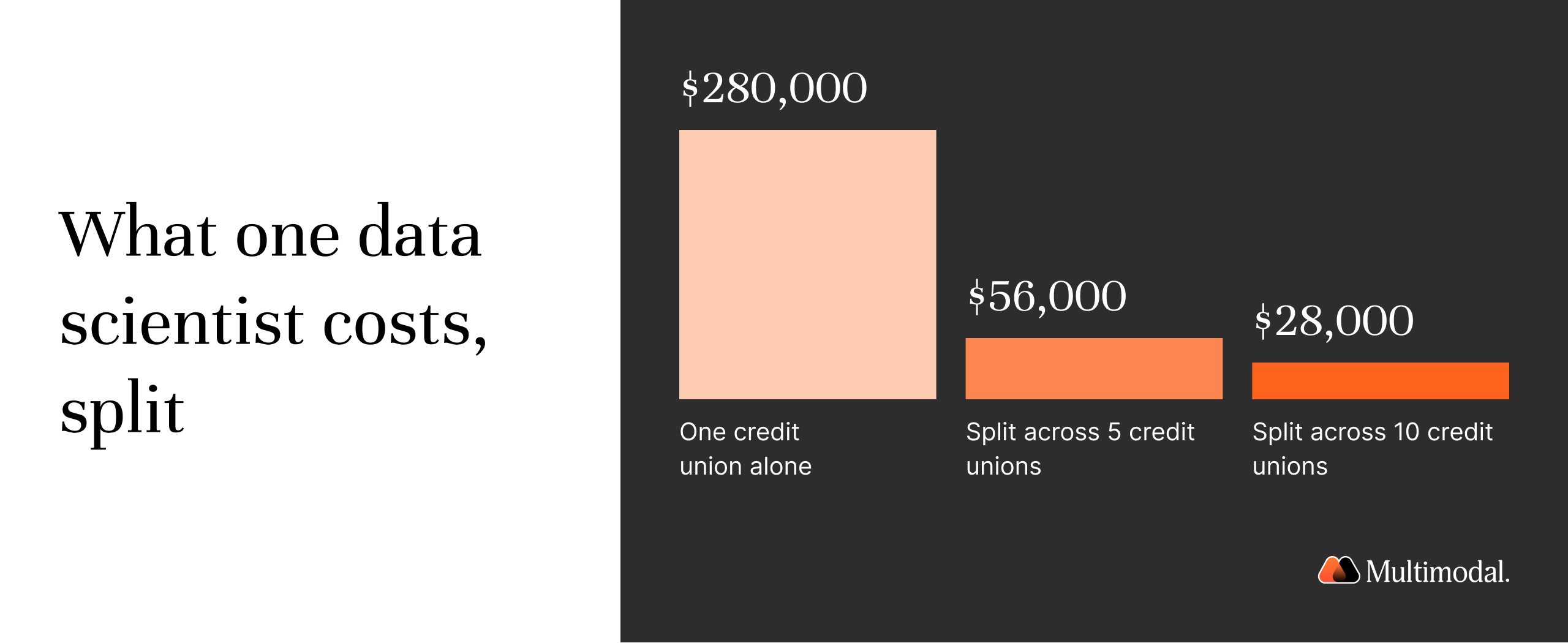
"You have a two hundred and eighty thousand dollar data scientist out there. Should I have that at a five hundred million dollar institution, or even a billion dollar institution? I don't know. But can we get three or four or five, ten credit unions together to have a data scientist... looking at this and helping us process this stuff?" — Randy Salser, President and CEO, NACUSO
CUSOs exist to spread that cost. They give credit unions access to specialized expertise that individual institutions lack, allow multiple credit unions to share the high fixed costs of back-office and operational services, and generate non-interest income along the way. The route that solves the expertise problem is the route the cap constrains.
It pushes credit unions from investor to customer
Salser's argument for investing rather than buying comes down to sequence. An investing credit union sits at the table while the product is designed, so the work happens against its actual tech stack rather than a reference stack that performed well in a demo. A customer waits in the pipeline, and when the cap forecloses the investment, the pipeline becomes the default.
His arithmetic is simple: five credit unions investing $150,000 each is a materially different proposition from one putting in $200,000 alone. Not even Navy Federal, acting alone, would carry enough scale to take a meaningful share in stablecoin.
What changes if the cap moves to 5 or 10 percent
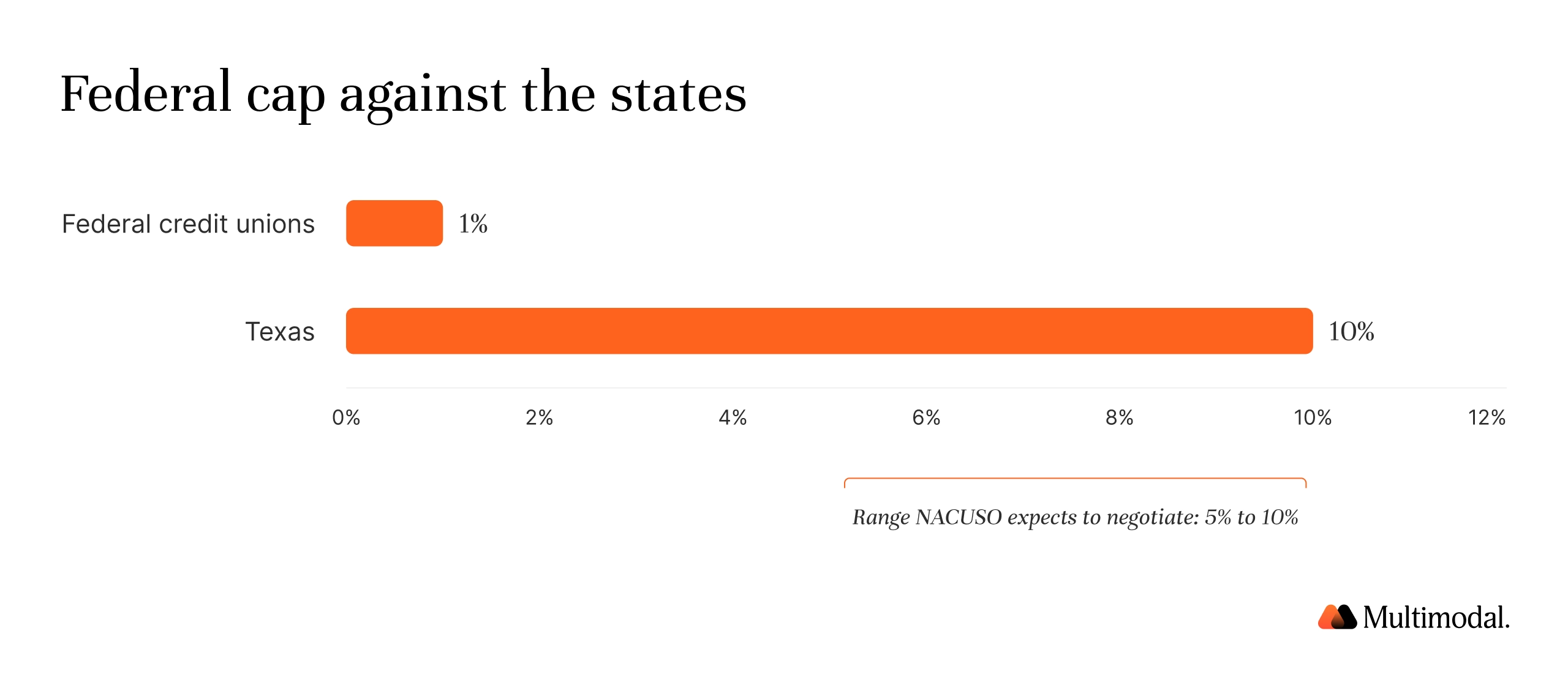
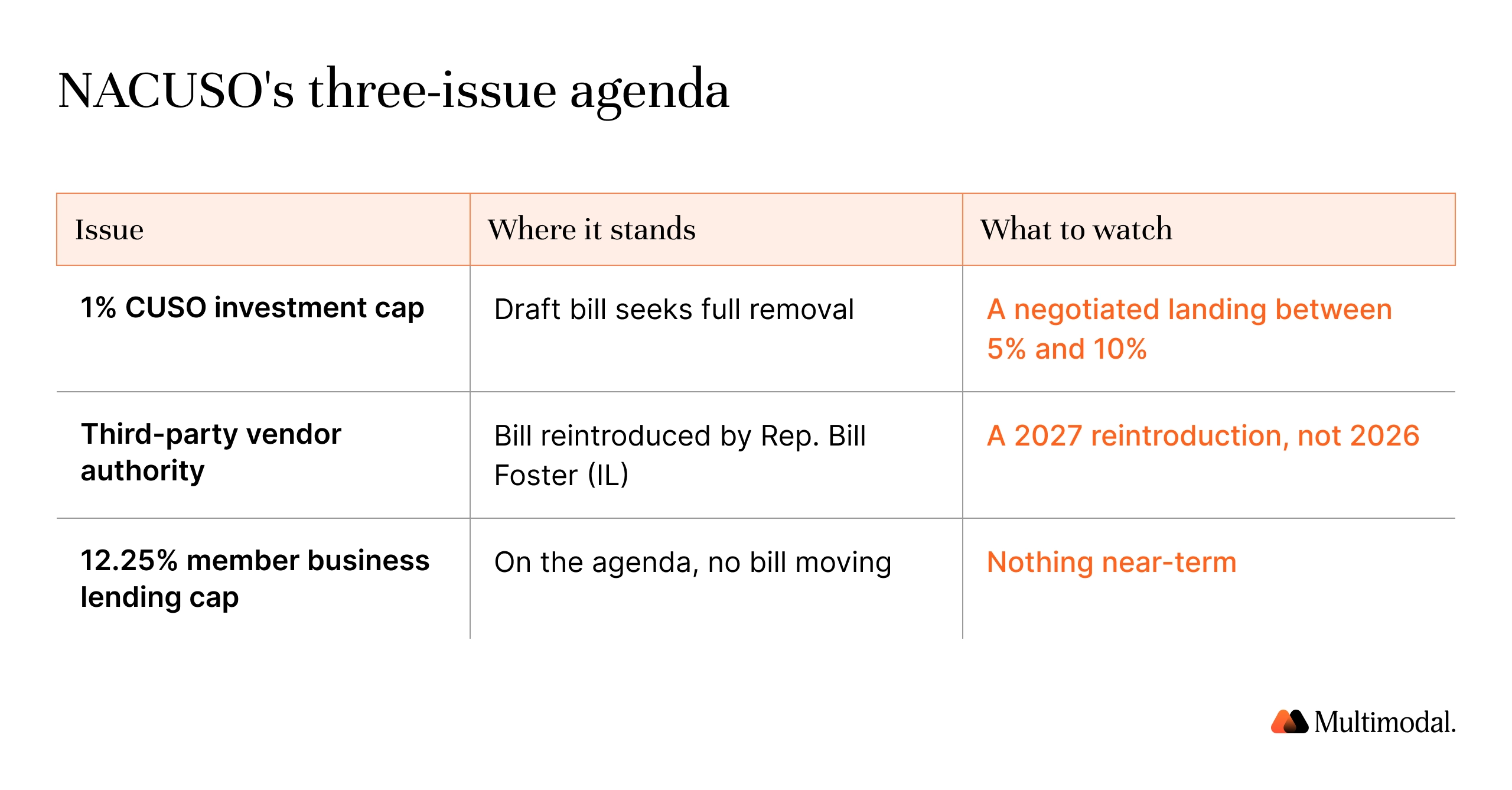
NACUSO's draft bill asks for removal of the cap outright. Salser made it clear that this is a negotiating position rather than an expectation, chosen to keep the conversation on substance rather than opening with a number. He named 5%, 7%, and 10% as the realistic range.
There is already a trade on the table. Salser said congressional offices have floated roughly 3% in exchange for third-party vendor authority, and NACUSO steers away from it because examiners can already obtain CUSO information through the credit union under existing statute.
The evidence NACUSO carries to the Hill is comparative. Salser puts Texas at 10% of net worth and estimates that 28 to 30 state-chartered credit union regimes run different rules, with no pattern of failures attributable to CUSO investment.
A ceiling in the 5%-10% range would change three things. Co-investment becomes accessible to mid-size institutions rather than the largest ones. Technology CUSOs can raise capital that supports a real roadmap. And the buy-versus-invest decision reopens for credit unions that had written it off. The cap still carries no obligation to spend against it, and a mismanaged CUSO still carries reputational risk back to its investors.
Where NACUSO's advocacy actually stands
NACUSO's Capitol Hill mandate runs to three issues: the 1% investment cap, third-party vendor authority, and the 12.25% member business lending cap. Salser's point is that no other organization is arguing the CUSO case in Washington. Six Hill visits were complete as of the livestream, with a seventh scheduled for the following Tuesday.
On vendor authority, Representative Bill Foster of Illinois reintroduced a bill the week before the event. Salser reads the move as a head count rather than a serious 2026 push, and expects a possible 2027 reintroduction to be the version worth watching.
Stablecoin is what gave the cap conversation momentum. Under the GENIUS Act, credit unions can hold stablecoins in custody but cannot issue them; issuance must go through a CUSO or a permitted payment stablecoin issuer framework. That routing puts stablecoin ambition back under the same 1% as everything else.
"The existing regulations are a blocker to credit union growth... All of a sudden you're at a competitive disadvantage, because they could offer stablecoin and they could move more quickly and win more market share." — Ankur Patel, Founder & CEO, Multimodal
What to do in your 2027 planning while the cap stands
Start with your aggregate position. Total your existing CUSO investments against the 1% before scoping anything new. That figure sets the ceiling, and it is often already committed.
Price the expertise alongside the software. If a data science or AI engineering function is unaffordable on its own, the shared route is the one governed by regulatory limitations.
Read the incumbent contracts in response to the same question. Salser's view is that five- to seven-year terms have insulated legacy providers financially and can obscure a partner that has stopped investing. Ask what your current service provider looks like in three to five years.
Track the legislative calendar the way you track examinations. A cap change would fall within a budget cycle, so a 2027 plan built only on today's 1% may be planning against a moving number.
The cap is one input into a 2027 technology plan, and most credit unions are building the rest of that plan now. Our 2027 credit union technology budget checklist covers the categories, the questions to ask each incumbent, and where AI spending realistically sits against everything else competing for the same year.
Put a real number in the 2027 plan
Model the actual cost and return of an agentic workflow against your own volumes, then take that figure into the board conversation alongside your CUSO position.
The NCUA rule limiting a federal credit union's total investments in credit union service organizations to 1% of its paid-in and unimpaired capital and surplus, in the aggregate. A separate 1% limit applies to loans to CUSOs.
Does the cap apply to each CUSO separately or to all of them together?
Together. Insurance, lending, payments, and technology positions all draw on the same 1%.
How does the CUSO investment cap affect a credit union's AI budget?
Any AI capability acquired through a CUSO ownership interest competes for the same ceiling as every other position. The cap constrains shared investment in technology and in the specialized staff it requires.
Is the CUSO investment cap changing in 2027?
Nothing is enacted. NACUSO's draft bill seeks removal, and Salser expects a negotiated outcome between 5% and 10%. Treat it as a planning scenario, not an assumption.
Do state chartered credit unions have a higher CUSO investment cap?
Often. Rules vary by state, and Salser cites Texas at 10% of net worth. Federally insured, state-chartered credit unions seek approval through their state supervisory authority.
Can a credit union buy AI technology without investing in a CUSO?
Yes. Buying from a non-CUSO service provider under a commercial written agreement does not touch the investment limit. A customer has less influence over the roadmap than an owner.

.svg)
.svg)

.avif)
.png)

.png)