What Do OCC and FDIC Examiners Expect When a Bank Uses AI in Lending?


Table of contents
Key Takeaways:
- No AI-specific lending exam procedure turned up in primary sources.
- SR 26-2 excludes generative AI and is non-binding, aimed at banks over $30B.
- Math, extraction, and drafted text each sit differently under SR 26-2.
- Hold five artifacts ready: citations, log, overrides, change log, spreads.
- Regulation B retention is 25 months, or 12 for business credit, after notice of action.
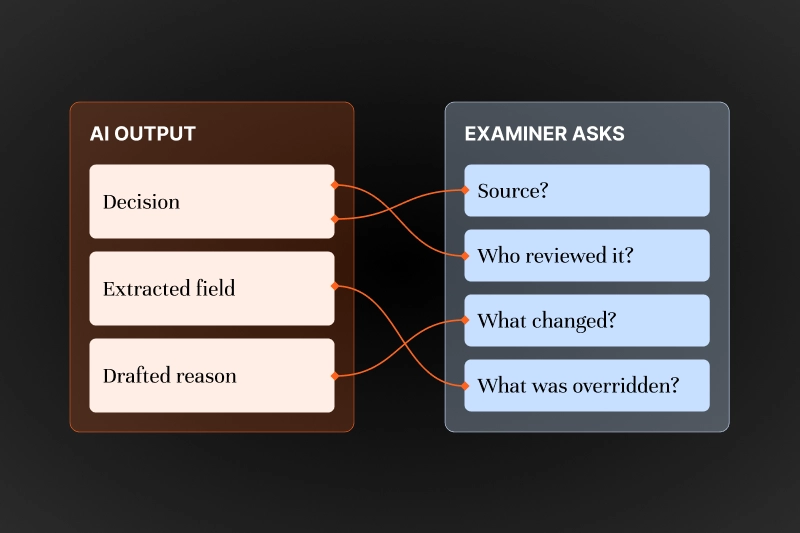
No OCC or FDIC exam procedure on AI in lending was found in the sources checked. Examiners work from existing model risk, third-party and lending rules, so a community bank should hold a packet ready: source citations on every figure, an input-to-output log, override history, a change log, and exportable spreads.
Some guides still describe the current regulatory environment with SR 11-7 as the baseline for regulatory compliance in banking. The agencies superseded it with SR 26-2 on April 17, 2026.
The packet below is our framing of how existing guidance would be tested, and it carries no agency authority. The sections ahead cover the guidance, the packet, change control, and vendor questions.
What do OCC and FDIC examiners expect when a bank uses AI in lending?
What do OCC and FDIC examiners expect when a bank uses AI in lending? In the sources checked, no agency publishes an exam checklist for it. Examiners work from existing regulatory requirements for financial institutions: guidance on model risk, third-party risk and credit files, plus consumer lending rules.
Federal Reserve Vice Chair for Supervision Michelle W. Bowman said on May 1, 2026, that banks are relying on existing risk-management frameworks to guide their use of artificial intelligence. The OCC's June 2026 credit risk booklet on lending takes the same line. Credit models used for underwriting and decisioning should be subject to sound model risk management, and examiners are directed to consider whether underwriting exceptions and overrides are captured in bank reporting.
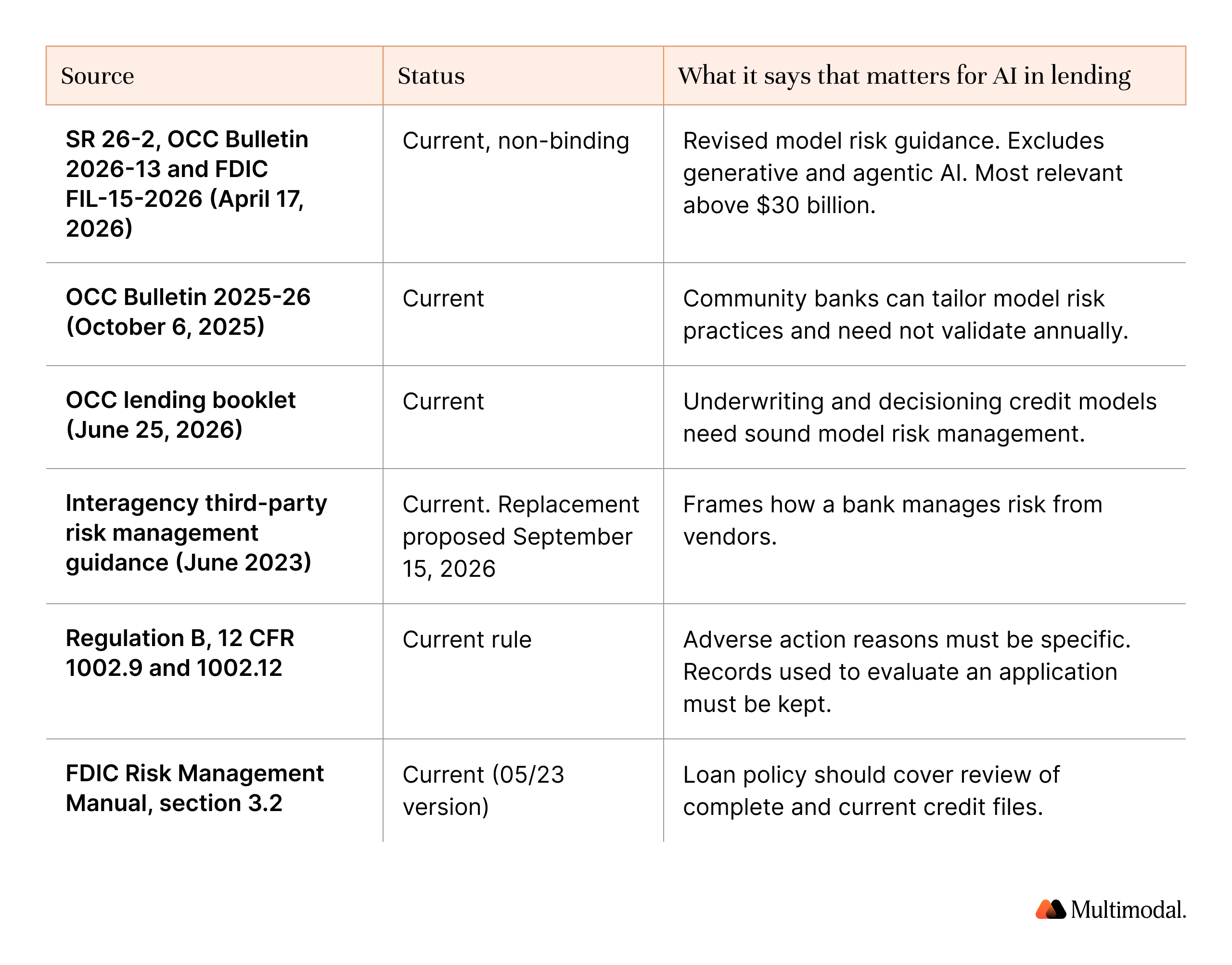
Table 1 lists the sources that matter.
Does SR 26-2 cover AI in lending?
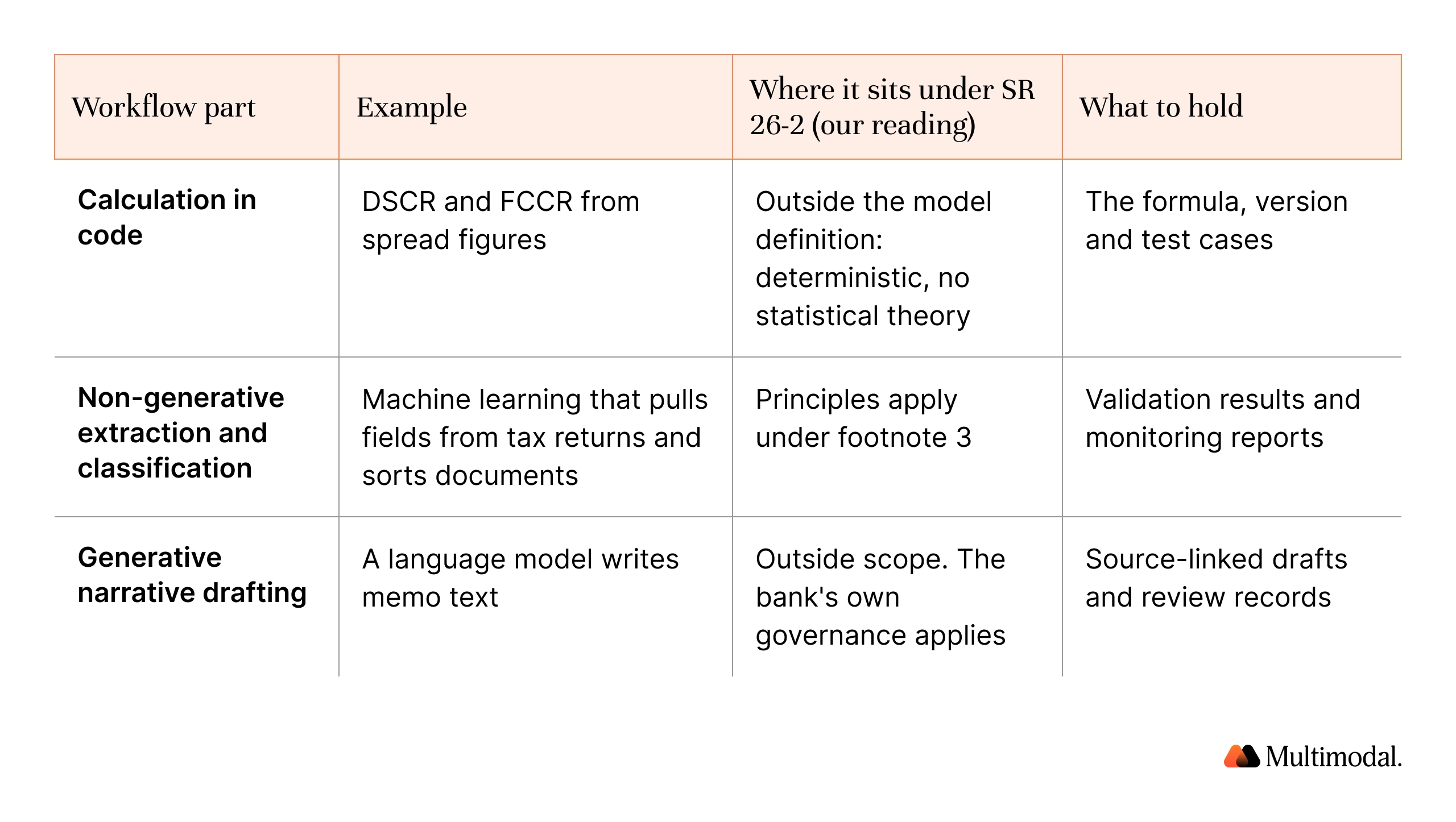
SR 26-2 covers part of it. The revised guidance, issued as OCC Bulletin 2026-13 and FDIC FIL-15-2026, replaced SR 11-7. Footnote 3 states that generative AI and agentic AI models are not within its scope and that a bank's own risk management and governance practices should guide controls for those tools. Its principles apply to non-generative, non-agentic AI models.
The definition of a model is narrow. It excludes simple arithmetic and deterministic, rule-based software without statistical, economic, or financial theory behind it.
The guidance sets no enforceable standards, and the OCC and Federal Reserve text states that non-compliance will not result in supervisory criticism, although action can still follow for unsafe or unsound practices. It is expected to be most relevant above $30 billion in total assets.
Table 2 is our reading of where three common lending tools land. Each bank decides for itself.
What goes in the examiner packet?
The packet has five artifacts. Each answers a question an examiner can reasonably ask, and each traces to a named source.
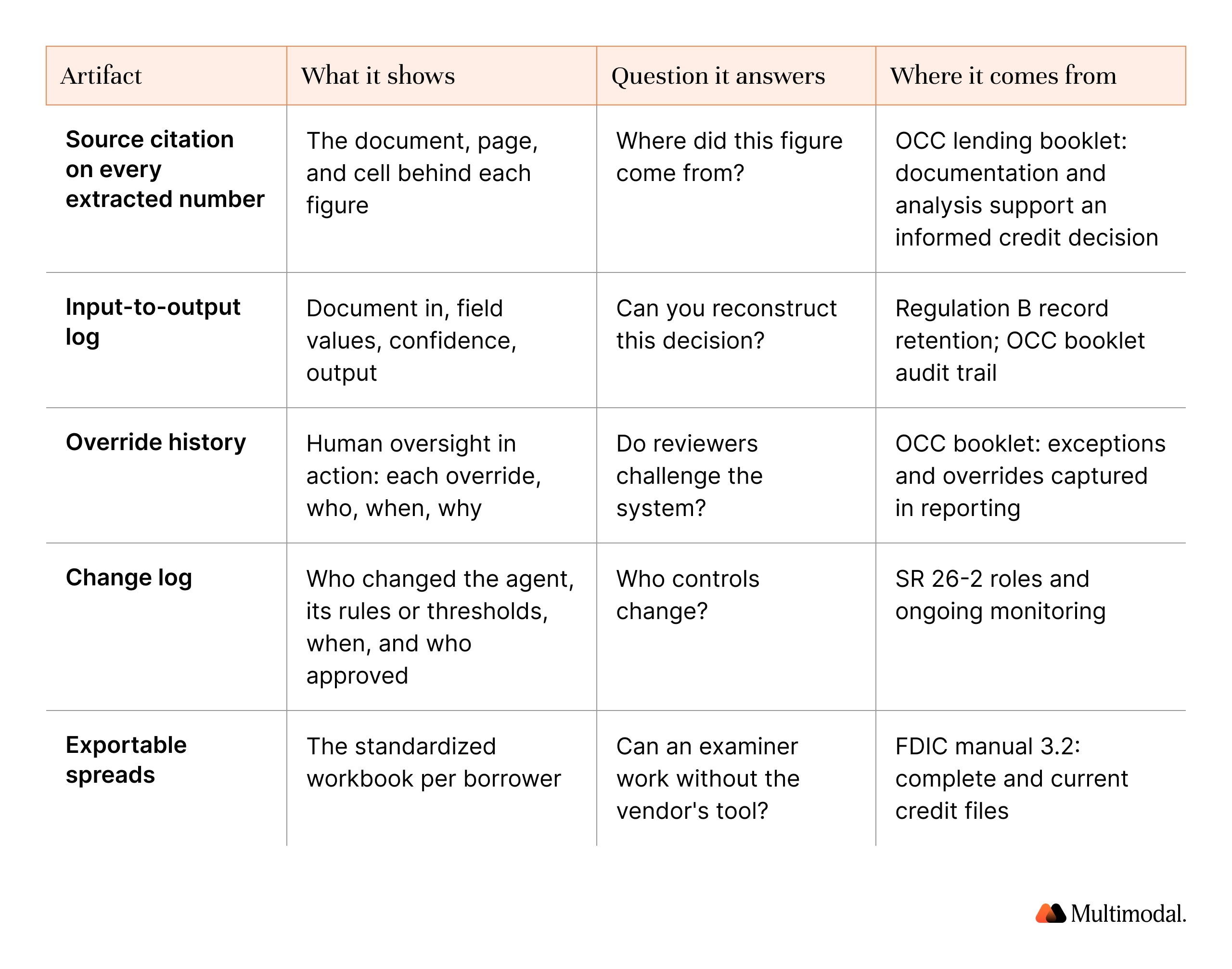
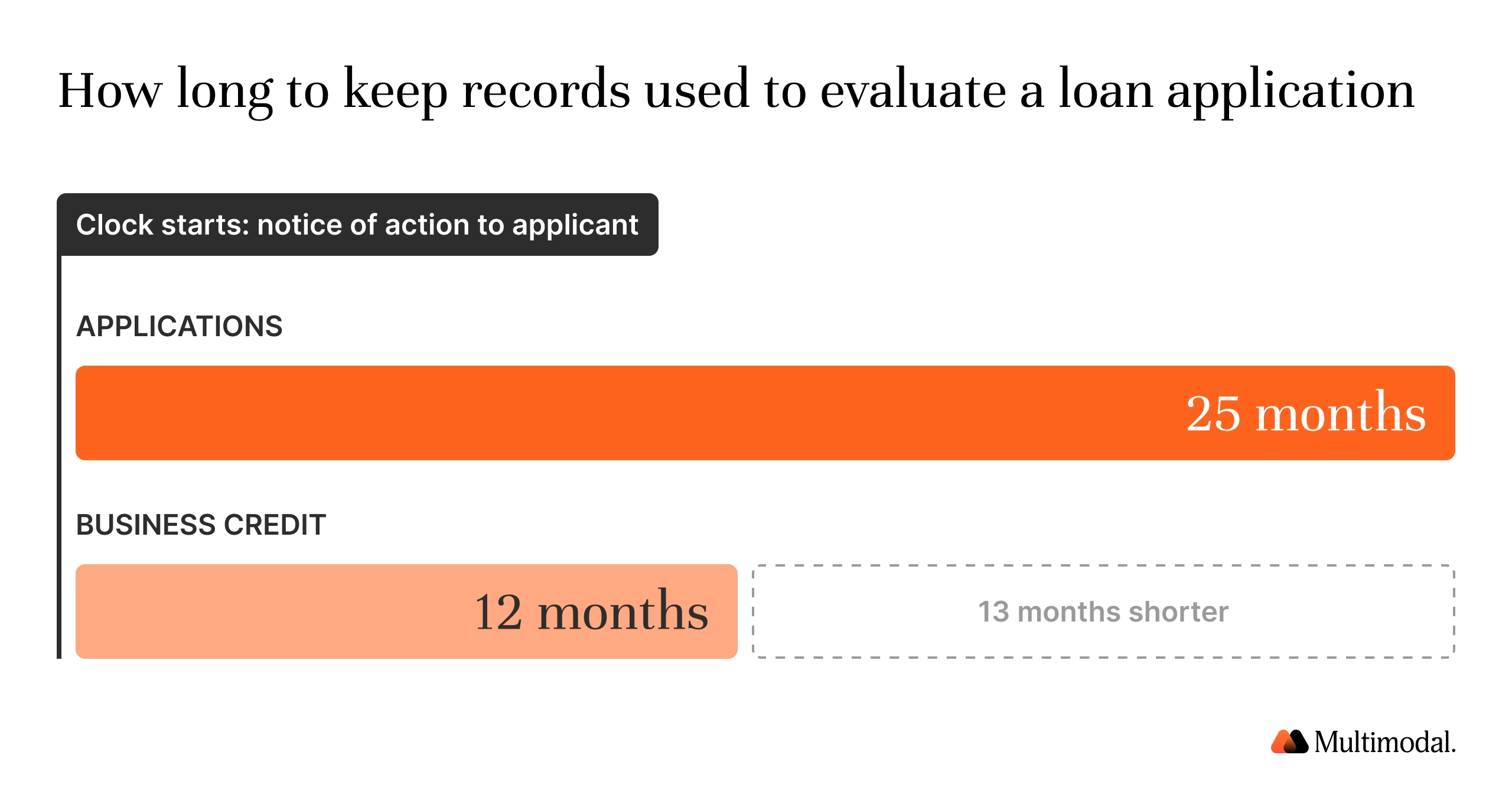
Regulation B sets the retention clock. A creditor must keep the application and “any other written or recorded information used in evaluating the application” for 25 months after notifying the applicant of its action, or 12 months for business credit. An AI output that informed the credit decision belongs inside that phrase, so the log should be kept for the same period.
SR 26-2 says documentation supports the tracking of recommendations, responses, and exceptions. Michael Heller, an attorney who advises credit unions on vendor deals, described the record an examiner will ask for:
“If you don't follow your framework, I think it's important to notate those exceptions as well, because … you will be asked about these deals and kind of what your thought process was as you're making them. So as much record keeping in that regard, I think is also pretty essential.” — Michael Heller, Associate Attorney, Messick Lauer & Smith
How should change control work for an AI agent?
Change management for an AI agent starts with a definition. A change is anything that can alter an output: a model or version swap, a prompt or rule edit, a threshold or mapping change, a new source-document template, or an update to the bank's policy documents. Uncontrolled change is an operational risk, and five steps reduce risk.
- Request. Record the change, the reason, and who asked in ticketing systems or an equivalent.
- Test. Run the change on a fixed set of past files and compare results with the current version.
- Approve. Someone with authority signs off after human review of the test results. The OCC lending booklet says decision criteria for automated approvals should be approved by the appropriate level of management under internal policy delegations.
- Release. Ship with a version stamp so every output records which version produced it.
- Monitor and roll back. Watch outcomes after release and keep a path back to the last passing version.
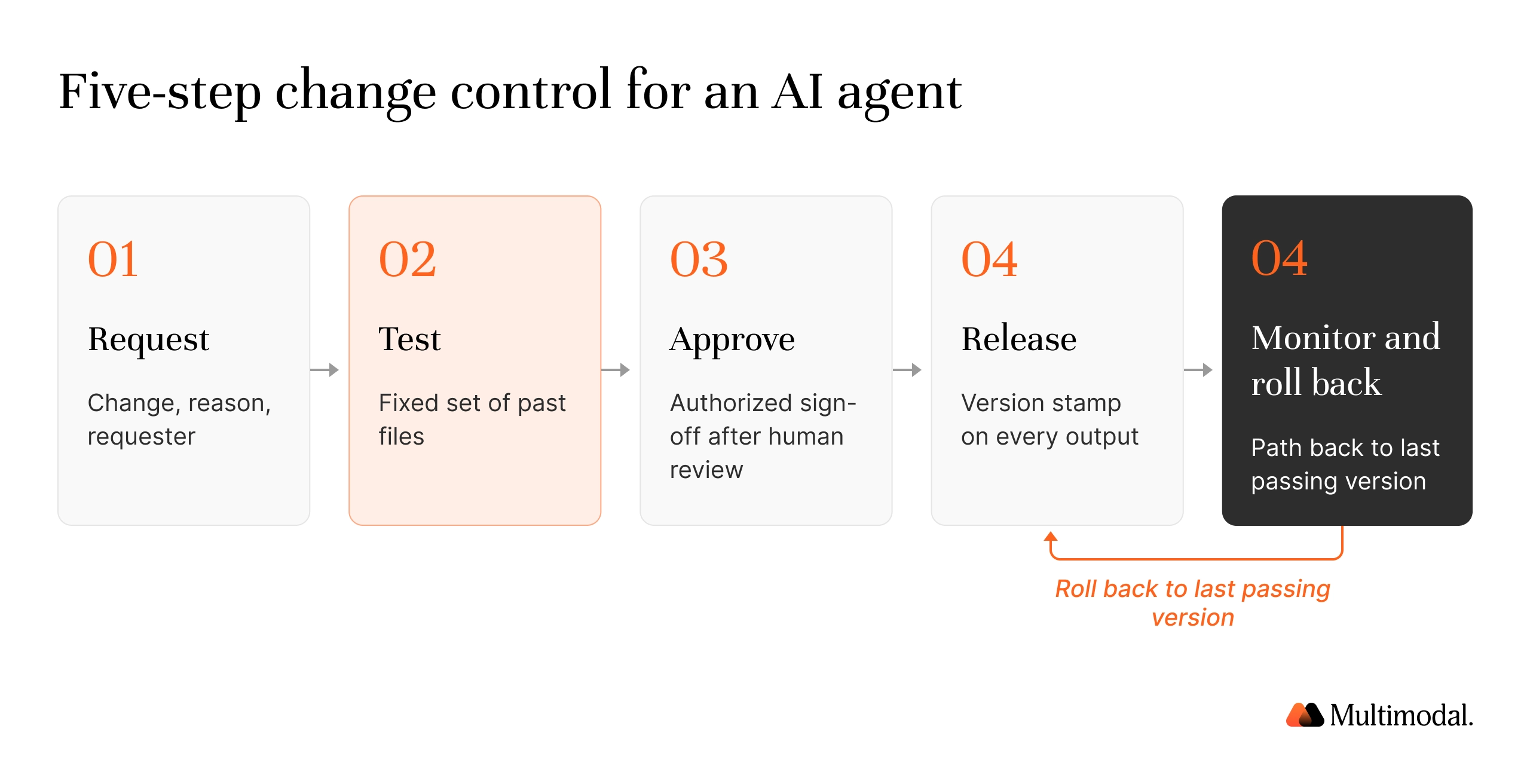
SR 26-2 frames the last step. For vendor models, sound practice includes “ongoing monitoring and outcome analysis to assess whether vendor models are accurate, remain fit for purpose, and continue to be reliable.” Keep a golden set of past files for the test step and set drift thresholds for monitoring. Validation frequency is the bank's risk-based call under OCC Bulletin 2025-26.
A credit union leader described the loop behind steps two and five:
“How can we do very controlled testing on some of these to really verify and vet if what we just built is right or not? Or can we, if we see it go off the rails, can we pull it back real quick … and then at least be able to correct it and try it again.” — Aaron Cain, Director of Digital Innovation, Credit Union 1
What should a bank ask an AI vendor to supply?
Before signing, a bank should vet agentic AI vendors against the packet and ask for six things:
- Export formats for spreads and logs.
- Change notices and approval rights before any version that touches your credits goes live.
- Log retention that covers the Regulation B period.
- Data governance terms for customer data and sensitive data, including data protection and data quality testing.
- Validation evidence. SR 26-2 says sound practice includes understanding a vendor model's conceptual soundness, design, development data, and performance. Ask for independent validation results.
- A named incident contact and a way to roll back.
Buying AI systems does not transfer responsibility; vendor oversight and management remain with the bank, including for third-party models. The June 2023 interagency guidance remains the reference until the agencies finalize a replacement. They proposed one on September 15, 2026, and extended the comment period to December 16, 2026, so legal teams should track those regulatory updates.
Where do explainability and fair lending fit?
Regulation B requires that the statement of reasons for an adverse action be specific and treats a failed qualifying score on a credit scoring system as insufficient. The Equal Credit Opportunity Act, a consumer protection law, applies to AI-driven underwriting as it does to other credit decisions. How a model justifies an adverse action notice is a question of explainability in lending. The packet supplies the records that the review depends on.
What does this look like in practice?
Multimodal built AgentFlow, an agentic AI platform for financial services, so each credit file stays examiner-ready: every extracted figure links to its page and cell, overrides carry a reason code, changes to the agent are logged with who made them and when, and spreads export to Excel.
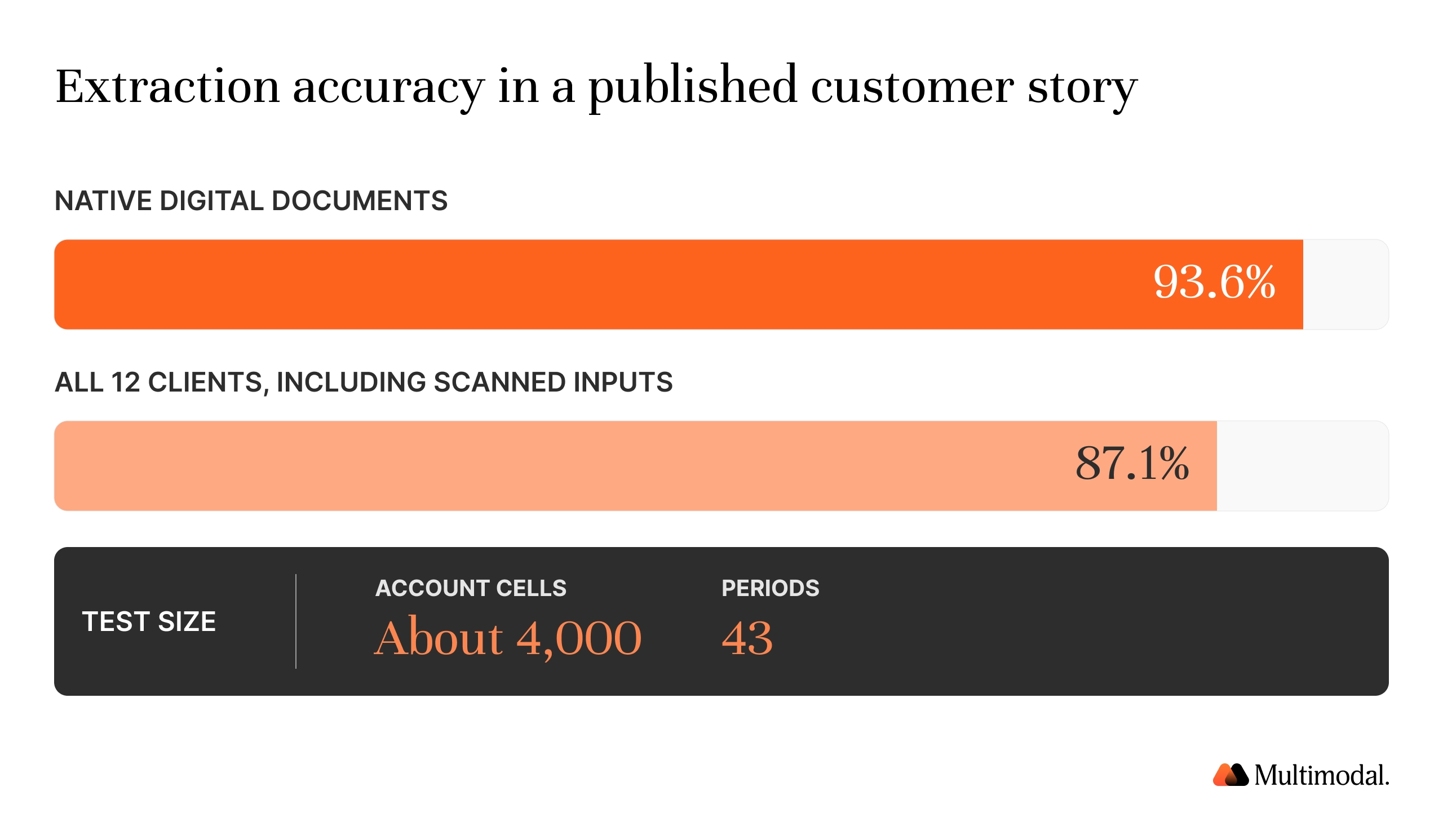
A Libra Internet Bank's story shows the document side. An EU-regulated bank cut the time to build a client's analytical workbook from hours to minutes by automating document intake. Across a 12-client test of roughly 4,000 account cells, the workflow reproduced 93.6% of the analyst's corrected workbook for native digital documents and 87.1% across all clients, including scanned inputs. The story calls 87.1% a floor because the test set leaned toward the hardest cases. These figures describe the workflow and say nothing about an OCC or FDIC exam.
What would you do before the next exam?
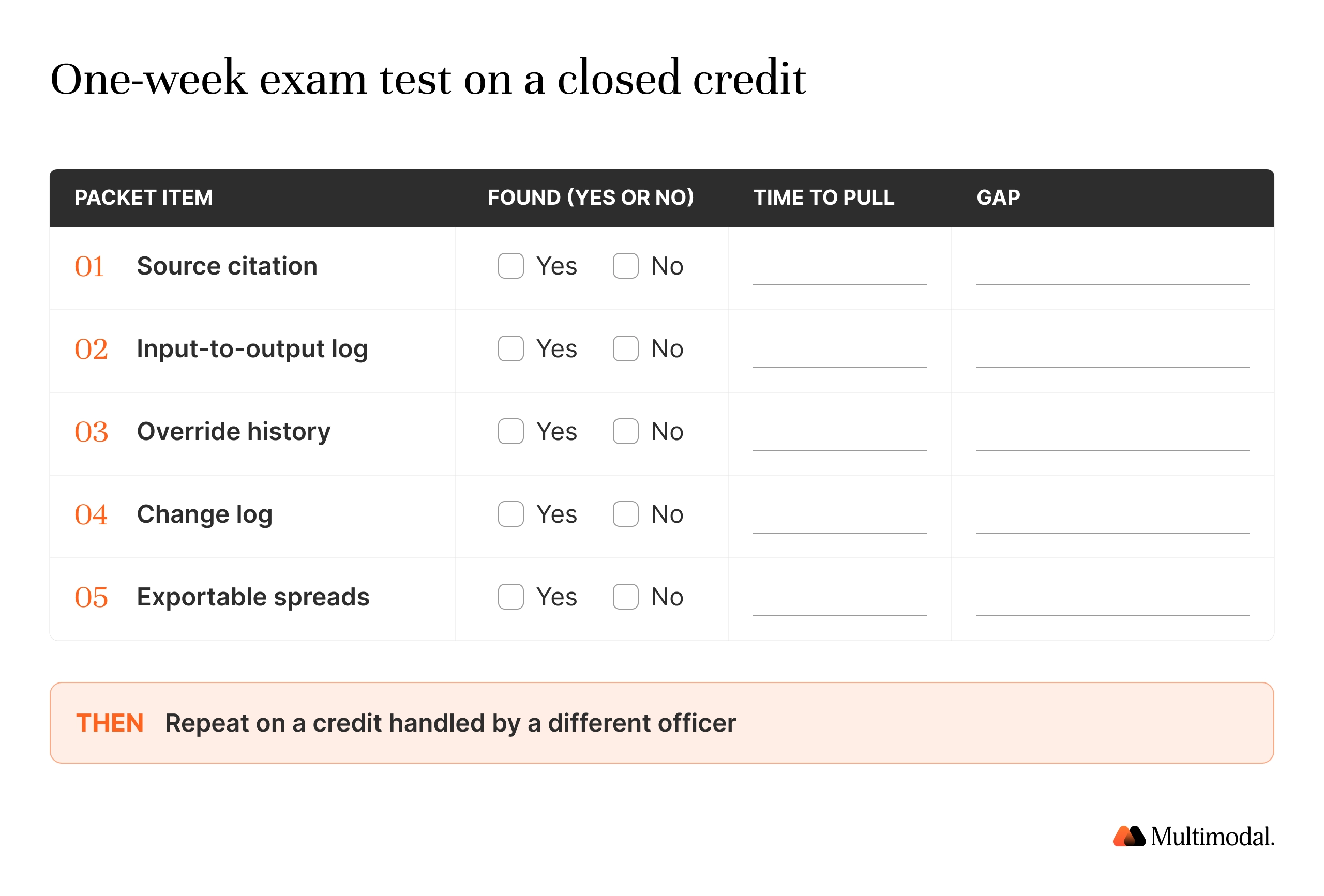
For regulatory compliance exam preparation, compliance teams can run one test in a week. Take one closed credit, pull each of the five artifacts, and time the evidence collection and any manual review. List every gap. Repeat on a credit handled by a different officer, because a gap on only one file points to a process problem.
Give change control clear ownership: one named person with authority to approve a release and to stop one. Add the agent to the model inventory, and check the credit memo draft against the packet too, since the same cited figures feed it. Compliance officers and credit analysts should both be able to produce the packet.
The bank that can show its work meets examiners on familiar ground
Examiners apply existing rules to new tools. Banks implementing AI stay ahead of the exam when they can show where each number came from, who changed what, and how to export their records from a vendor's system. That holds across AI for banks and the banking sector. Credit unions face parallel questions from NCUA examiners, and AI governance and adoption at both types of institutions depend on the same records.
Bring us three closed credits, and we will show the packet an examiner would ask for, built from your own files with our lending workflow for banks.
See an OCC and FDIC-Ready Credit File
Bring three closed credit accounts. We will build the packet an examiner would ask for from your own files and show where each figure came from.
Frequently Asked Questions
What do OCC and FDIC examiners expect when a bank uses AI in lending?
No AI-specific lending exam checklist turned up in the sources checked. Examiners apply existing guidance on model risk, third-party risk, credit files and Regulation B, so a bank should hold source citations, an input-to-output log, override history, a change log and exportable spreads.
Does SR 26-2 apply to generative AI?
No. Footnote 3 states that generative and agentic AI models are not within the guidance's scope. A bank's own risk management and governance practices should guide controls for those tools. The principles apply to non-generative, non-agentic AI models.
Is SR 11-7 still in effect?
No. SR 26-2 superseded SR 11-7 on April 17, 2026, and the OCC and FDIC rescinded their earlier model risk guidance the same day. Citing SR 11-7 as the current standard means working from rescinded text.
Does a community bank have to validate models every year?
No. OCC Bulletin 2025-26 states that the OCC's model risk guidance does not require community banks to conduct annual model validation. A bank sets the validation frequency and scope based on its risk exposures, activities, and use of models.
How long must a bank keep records used to evaluate a loan application?
Regulation B requires 25 months after notice of action, or 12 months for business credit. The rule covers the application and any other written or recorded information used in evaluating it. A bank should treat AI outputs used in the decision as covered.
Is there an AI-specific exam checklist for lending?
None turned up in the OCC, FDIC or Federal Reserve sources checked. The OCC lending booklet asks examiners to assess model risk management for lending models, including model documentation and internal controls. The packet above is our framing, not agency guidance.