
Intelligent Document Processing
Intelligent document processing (IDP) uses AI to read, classify, and extract data from business documents. AgentFlow goes further: it validates that data across every document in a file and acts on it, so a loan file, claim, or invoice moves from intake to a decision-ready package.
Last updated: October 2026


What Is Intelligent Document Processing?
Why Template-Based IDP Solutions Hit a Ceiling
Robotic process automation (RPA) can move data between systems once it's extracted, but RPA follows fixed rules. It does not read a document or judge whether a number is right. Classic IDP plus RPA covers intake and movement, and neither validates meaning across documents.
New template per layout
Labeled data
Custom integration
Ongoing maintenance
The model needs ongoing maintenance.
How AgentFlow Processes Documents

Capture and Classify
Documents arrive from email, a loan system, a claims portal, or a scan, in any format. Each one is sorted by type, from a pay stub to a loss run, with no fixed template.
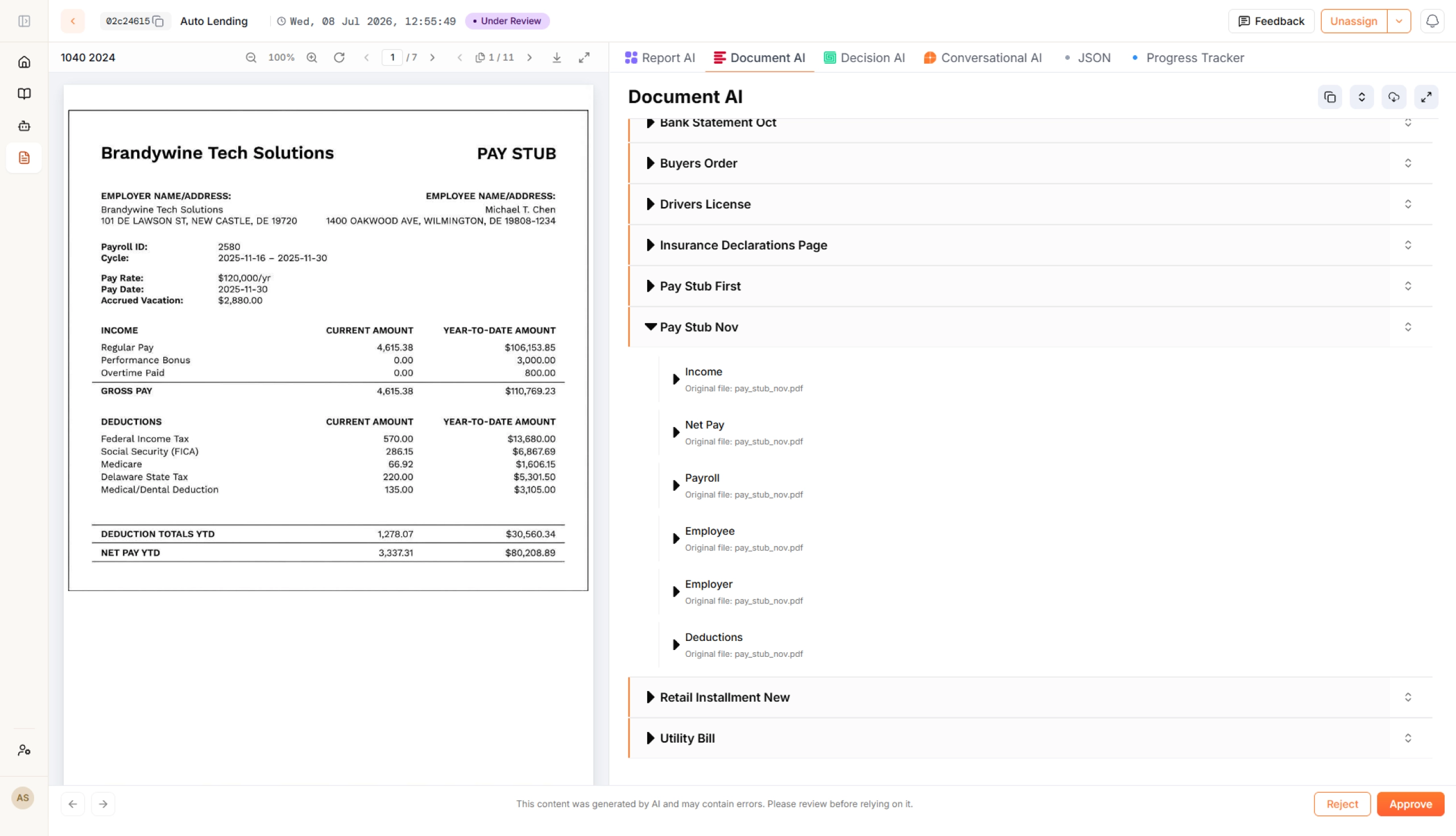
Extract Structured Data
AgentFlow pulls the fields that matter from any document, structured or not, such as income figures, policy numbers, and dates, into data your systems can use.
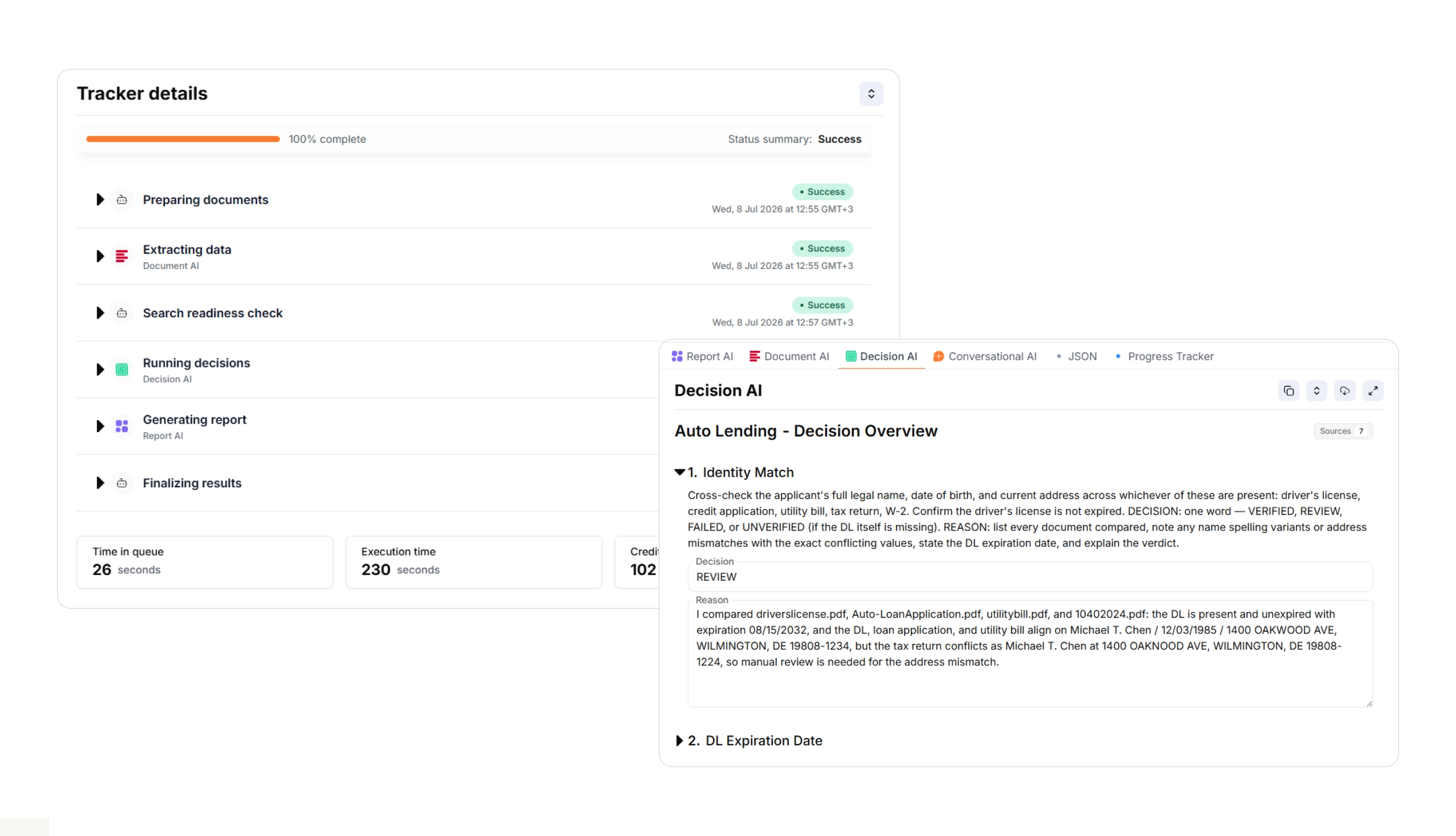
Validate
AgentFlow checks its own work: totals must add up, and names, addresses, and ownership must agree across every document in the file. Clean files pass through; anything else goes to a human.
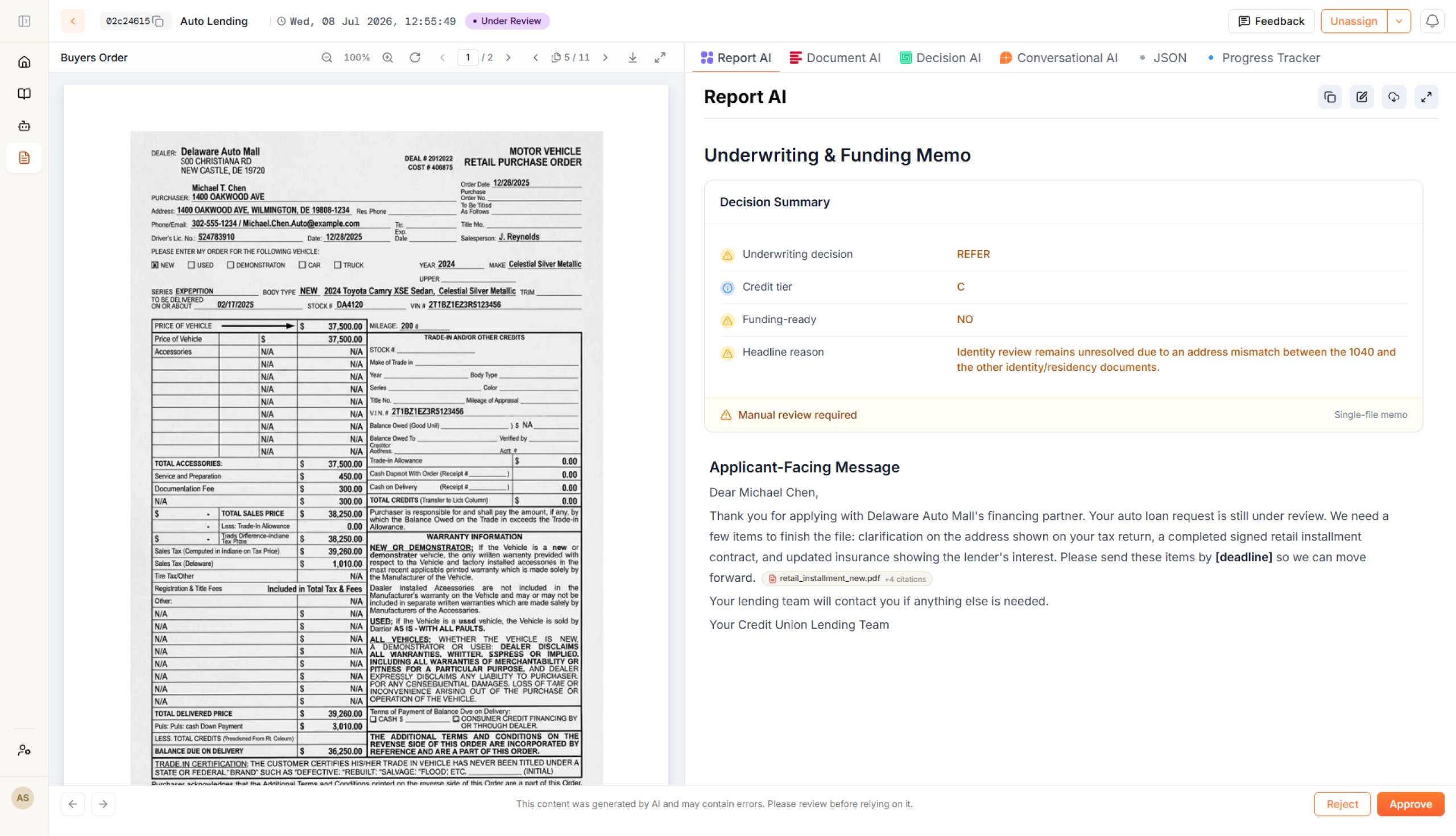
Act and Integrate
Validated data flows through an API into your loan system, core, claims platform, or ERP, so it reaches the system that acts on it.
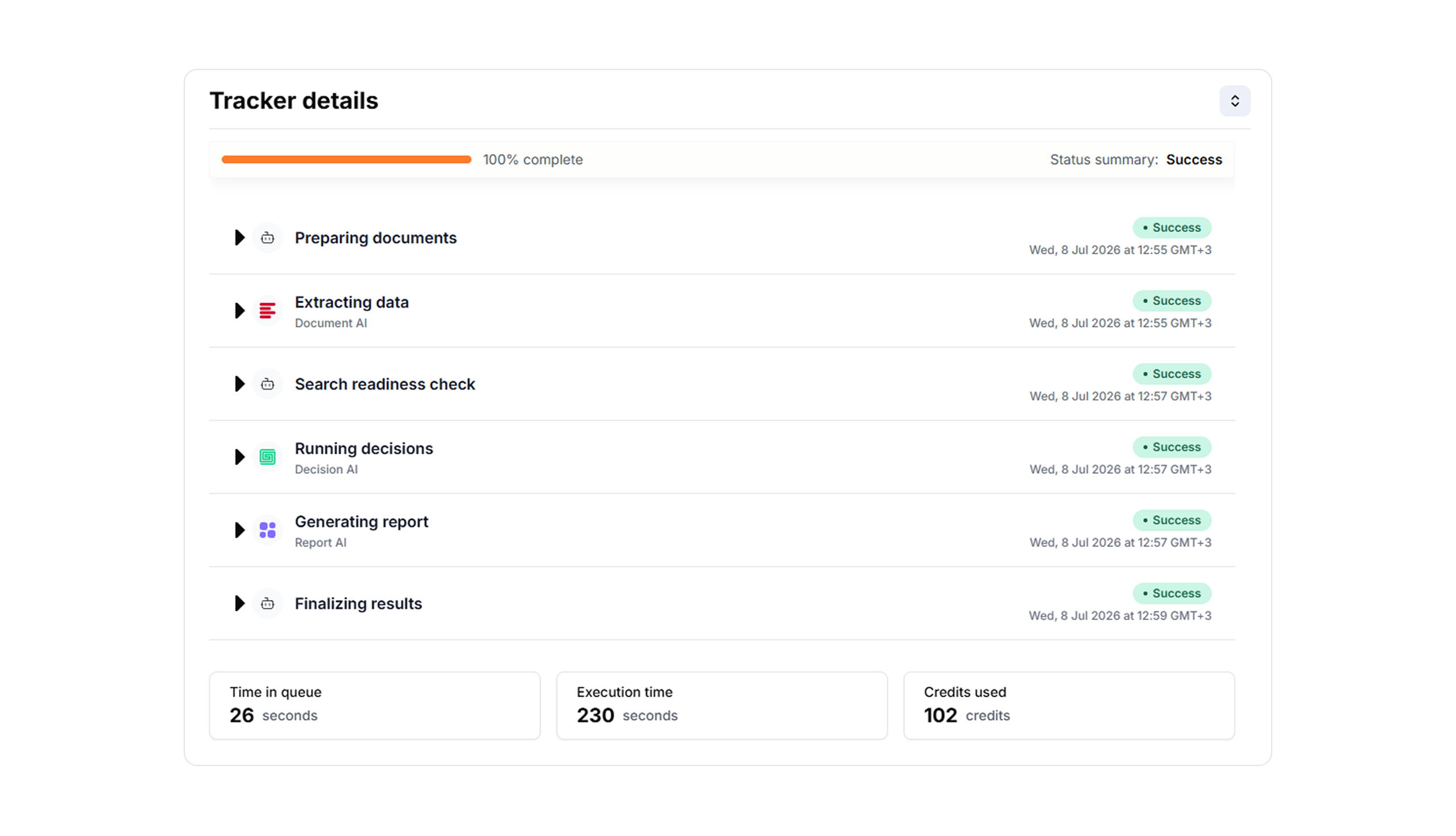
Learn
Every human correction trains the model, so accuracy on new document types improves without a full retraining.
Results Credit Unions and Lenders See With AgentFlow

99% Accuracy at FORUM Credit Union

80% Lower Cost at Direct Mortgage Corp.

93.6% Extraction Accuracy at Libra Internet Bank
See It on Your Own Files
How Document Processing Approaches Compare
| Approach | Handles new document formats | Validates across documents | Acts on the data after extraction | Learns from corrections |
|---|---|---|---|---|
| AgentFlow | Yes. Adapts to new formats | Yes. Cross-document validation | Yes. Decision-ready output with audit trail | Yes. Continuous learning loop |
| Optical character recognition alone | No. Reads text only, no understanding of meaning | No | No | No |
| Robotic process automation | No. Follows fixed rules | No | Moves data, doesn't judge it | No |
| Template-based IDP software | Needs a new template or retraining | Limited, field-level only | Outputs data for a human to act on | Periodic retraining |
Why Teams Choose Multimodal for Document Processing
Targeted review
Staff looks only at the fields that carry a low-confidence flag or fail a cross-document check; clean files pass straight through.
Validated, traceable data
Every extracted field is validated and traceable to its source document.
Fits the systems you run
Connects through an API to the loan origination systems, cores, and claims platforms you already use, with no separate silo to maintain.
Audit trail built for examiners
Lenders, insurers, and finance teams automate document-driven work and keep the record an examiner expects.
Security and Governed Autonomy

SOC 2 Type 2
AgentFlow is SOC 2 Type 2.

Supports DORA Requirements
AgentFlow supports the operational resilience requirements of the EU's Digital Operational Resilience Act (DORA).

Customer Data Separated By Account
Customer data is separated by account and encrypted in transit and at rest.
Keep Learning
What Is Agentic Document Processing? The Complete Guide
Read moreBest AI Document Processing Platforms, 2026
Read moreClearing Loan Stipulations With AI
Read moreHMDA Reporting Automation
Read moreThe True Cost of Manual Document Processing in Credit Unions
Read moreThe Incomplete-Packet Problem
Read moreDo You Need Clean Data for AI?
Read moreServing a credit union? See AI for credit unions, or explore AgentFlow for financial services.
FAQ
Intelligent document processing (IDP) is software that uses AI, including OCR, NLP, machine learning, and computer vision, to classify, extract data from, and validate documents before they reach a business system. It handles structured, semi-structured, and unstructured documents in one pipeline.
Optical character recognition converts a scanned image into machine-readable text. It does not classify the document, extract specific fields, or validate the data. Intelligent document processing software adds that layer, plus optical mark recognition for checkbox and form-based fields, so the output is usable structured data, not a text dump.
Robotic process automation moves data between systems using fixed rules. It does not read a document or judge whether extracted data is correct. Intelligent document processing handles the upstream work of turning a document into structured data, and AgentFlow goes further by validating and acting on that data, which is the layer RPA depends on rather than a competing tool.
AgentFlow processes loan applications, pay stubs, tax returns, bank statements, invoices, insurance claims, policies, and patient records, across structured, semi-structured, and unstructured document formats, including scanned and handwritten pages.
FORUM Credit Union achieved 99% document classification accuracy and 99% data extraction precision across 62 auto loan packages ranging from 15 to 61 pages, with every extracted field traceable to its source document.
No. AgentFlow automates the bulk of data entry and classification, then routes only low-confidence fields or genuine exceptions for manual review, so staff time shifts from repetitive manual tasks to judgment calls.
AgentFlow runs under Governed Autonomy, with data encryption in transit and at rest, customer data separated by account, SOC 2 Type 2 compliance, and support for DORA requirements.
Timelines depend on the number of document types and systems in scope. Book a demo to see AgentFlow process your own files before committing to a timeline.