Best for end-to-end workflow automation: AgentFlow
Best for credit decisioning with a focus on fraud prevention: Provenir
Best for expanding customer bases with AI-driven underwriting: Zest AI
Best for regulatory compliance in credit risk decisioning: Pega
Best for integrating AI-powered credit models: Alloy
Best for fast, scalable loan origination and decisioning: Lendflow
Best for leveraging alternative data in credit evaluations: Experian
Best for credit underwriting with deep AI insights: ACTICO
Get 1% smarter about AI in financial services every week.
Receive weekly micro lessons on agentic AI, our company updates, and tips from our team right in your inbox. Unsubscribe anytime.
Thank you! Your submission has been received!
Oops! Something went wrong while submitting the form.
AI adoption is critical for banks to remain competitive in today’s rapidly evolving financial landscape. However, for banks, implementing AI comes with unique challenges, particularly around regulatory compliance, legacy systems, and data security. While agile fintechs may innovate quickly, banks must carefully select AI solutions that not only meet industry regulations but also integrate with existing infrastructure and scale to meet future needs.
To remain competitive, banks need flexible, scalable, and compliant AI platforms, solutions that go beyond basic capabilities to meet their more intricate operational needs. Choosing the right tool is essential to avoid falling behind in a rapidly evolving market.
What to Look for in a Credit Decisioning Solution
In 2026, decisioning solutions for banks must do far more than simply evaluate a borrower’s credit score or history. On top of automating credit decisions across complex portfolios, from consumer and small-business loans to commercial credit, they must also enable robust risk management and regulatory compliance.
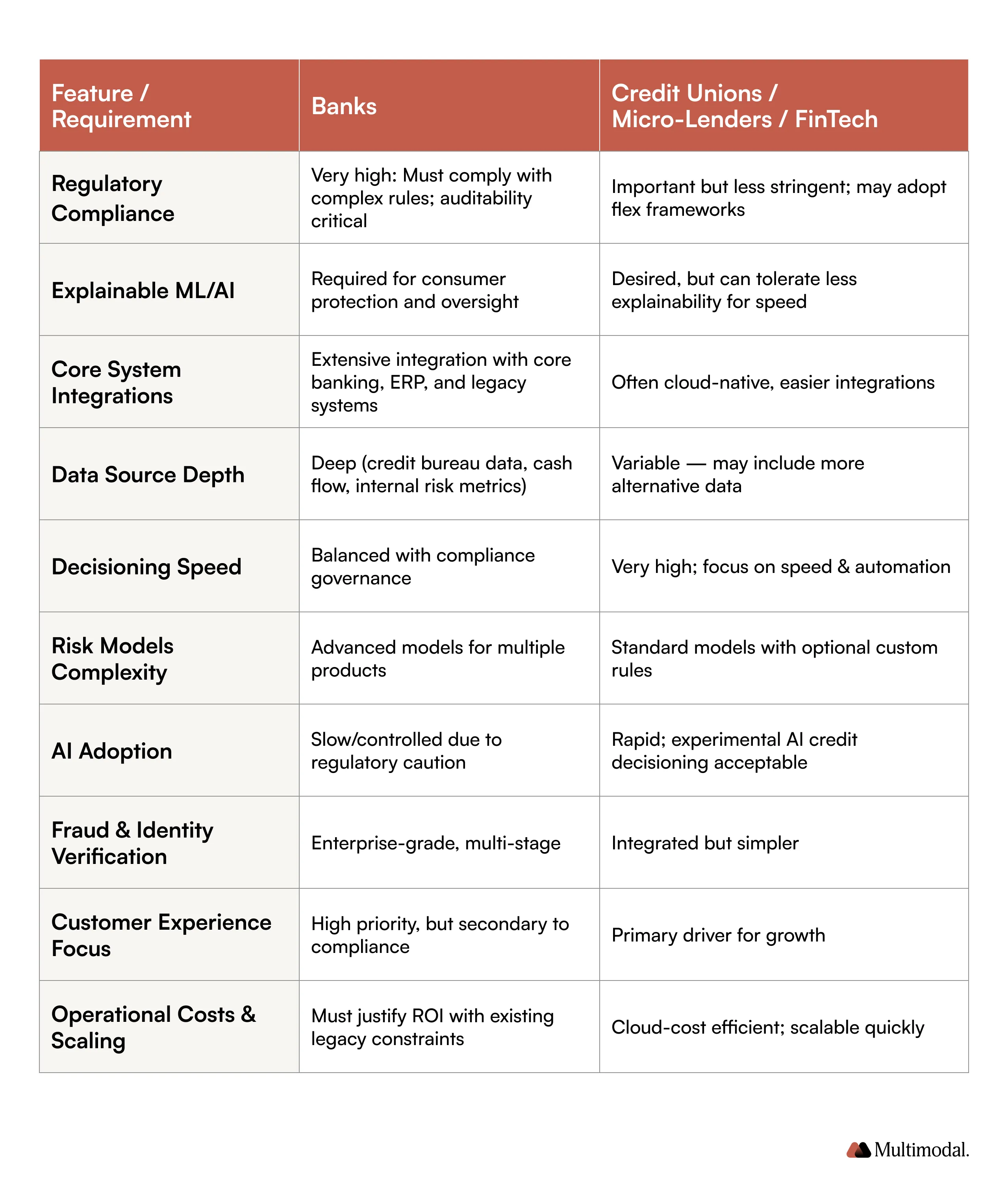
Banks operate under stringent regulatory frameworks and face heightened scrutiny around AI-powered credit decisioning, fairness, and explainability, so their needs differ meaningfully from those of credit unions, micro-lenders, or fintech lenders.
For example, banks may be hesitant to fully adopt AI/ML models for credit underwriting due to diverse regulatory requirements; a dynamic less pronounced for nonbank lenders, which often have more permissive supervision and thus may lead to machine learning adoption for underwriting and alternative scoring methods.
With that in mind, banks’ priorities could (and should) differ from those of smaller or nonbank financial institutions when it comes to credit decisioning solutions.
Banks vs. Smaller Financial Institutions: Feature Comparison
Below is a side-by-side view of how credit decisioning solutions should differ between banks and smaller institutions (e.g., credit unions, micro-lenders, and fintechs):
1. AgentFlow
AgentFlow stands out as the most flexible and configurable credit decisioning solution, enabling banks to automate and manage their most complex workflows. With its focus on multi-agent orchestration, regulatory compliance, and security, it is the ideal solution for banks seeking to streamline credit decision-making while maintaining control over their data.
Unlike point solutions that address only part of the workflow, AgentFlow connects data ingestion, decisioning, and audit steps into a cohesive, automated pipeline. This makes it a perfect fit for financial institutions that require an all-in-one platform to reduce operational complexity and minimize manual interventions.
Key Features
Multi-agent orchestration, real-time feedback loops, and low-code rule management
Best For
Banks with complex workflows and regulatory requirements
Pros
Full flexibility in configuring workflows and decision models
Seamless integration with internal systems and third-party APIs
Comprehensive security with on-premise, VPC, or cloud deployment options
Cons
Requires some time to fully configure and deploy due to its broad range of capabilities
Alloy specializes in AI-powered credit decisioning, leveraging a wide range of data sources to help financial institutions assess borrower risk and make more accurate decisions. With its focus on automation, Alloy seamlessly integrates with existing banking infrastructure and enables real-time decision-making across multiple channels. It’s an excellent choice for banks looking to enhance credit decisioning with advanced machine learning models and high flexibility.
Key Features
AI-based decisioning, data integrations, fraud detection, and real-time credit assessments
Best For
Smaller or remote teams seeking scalable, AI-powered credit decisioning with a focus on fraud prevention.
Pros
Seamless integration with core banking systems and third-party data sources
Real-time, data-driven decisioning to improve loan approval rates
Cons
Primarily focused on credit decisioning and fraud detection, with less emphasis on broader workflow automation
Pricing
Available upon request
Comparison to AgentFlow
Alloy excels in AI-powered credit decisioning, particularly for fraud detection, but AgentFlow offers a more expansive solution, automating the entire credit decisioning lifecycle, including data ingestion, regulatory compliance, and multi-agent orchestration for greater flexibility across a variety of workflows.
3. Pega
Pega is renowned for its credit risk decisioning capabilities, especially within highly regulated industries. It offers decisioning software that banks can use to evaluate the risks associated with loans and credit products.
Banks focused on regulatory compliance that require rule-based decisioning for credit risk in highly controlled environments.
Pros
Strong rule-based decisioning for compliance-heavy industries
Advanced workflow automation for faster decisions
Cons
Less flexible in terms of incorporating non-traditional data
Comparison to AgentFlow
Pega excels in credit risk decisioning, but AgentFlow offers greater flexibility and multi-agent orchestration, making it a superior solution for banks requiring full automation across credit decisioning and other integrated workflows.
Pricing
Available upon request
4. Lendflow
Lendflow is a platform designed to help financial institutions scale their credit decisioning processes with ease. Its primary value lies in automating the loan origination process for banks, fintechs, and alternative lenders. By providing an easy-to-use API, Lendflow enables financial institutions to make faster, more informed credit decisions through AI and data-driven insights.
Institutions looking to scale their loan origination processes quickly
Pros
Quick deployment through API integration
Highly configurable to fit various lending models
Cons
Lacks deep customization for complex decisioning logic
Pricing
Available upon request
Comparison to AgentFlow
Lendflow excels at loan origination, but AgentFlow offers a more comprehensive approach, managing not just origination but the entire credit decisioning lifecycle, with advanced orchestration of multiple agents and workflows.
5. Zest AI
Zest AI offers advanced AI-driven credit underwriting, leveraging machine learning models to more accurately predict borrower risk. It is particularly suited for banks looking to leverage predictive analytics for faster, better credit decisions.
Key Features
AI underwriting, predictive analytics, and model interpretability
Best For
Banks looking to enhance their credit underwriting process using AI
Pros
Strong emphasis on AI-driven insights and accuracy
Transparent and explainable models for improved decision confidence
Cons
Limited in supporting full loan origination workflows
Pricing
Available upon request
Comparison to AgentFlow
While Zest AI offers powerful AI models for underwriting, AgentFlow provides a more integrated solution, allowing banks to manage the entire credit decisioning process, from data ingestion to final approval.
6. ACTICO
ACTICO specializes in AI-driven credit underwriting for banks, enabling more accurate risk assessments through machine learning models. The platform integrates with existing banking systems and supports complex credit decisioning processes, offering a scalable, automated solution for credit institutions.
Key Features
AI-powered underwriting, rule-based decisioning, and integration with banking systems
Best For
Banks looking to leverage AI for underwriting and risk management
Pros
Advanced machine learning models for better accuracy in underwriting
Seamless integration with existing banking systems
Cons
More suitable for institutions focused specifically on underwriting rather than full loan origination
Pricing
Available upon request
Comparison to AgentFlow
While ACTICO offers specialized AI-driven underwriting, AgentFlow provides end-to-end workflow automation, covering data ingestion through final decisioning and reporting, making it a more comprehensive solution for banks.
7. Provenir
Provenir is a solution that focuses heavily on credit risk decisioning, providing banks with AI-powered models to evaluate borrower risk. It is ideal for institutions that need to assess creditworthiness based on traditional credit bureau data alongside alternative data sources.
Banks focusing on credit risk management and fraud prevention
Pros
Excellent at integrating alternative data for improved decision-making
Advanced AI models for credit scoring and fraud detection
Cons
Primarily focused on risk management, with less emphasis on the full loan origination process
Pricing
Available upon request
Comparison to AgentFlow
While Provenir focuses heavily on risk management, AgentFlow provides a broader solution by automating end-to-end workflows, from decision-making to reporting, making it the more comprehensive choice for banks looking to streamline all aspects of credit decisioning.
8. Experian
Experian offers a robust credit decisioning solution that integrates alternative data sources to enable more comprehensive credit evaluations. With its access to vast credit bureau data and its ability to pull from alternative data, Experian helps banks make more informed decisions, especially for borrowers with limited credit histories.
Key Features
Access to credit bureau data, integration of alternative data, and machine learning models
Best For
Banks seeking to improve decision accuracy by leveraging alternative data
Pros
Strong integration of alternative data to assess borrower risk
Reliable access to credit bureau data for credit assessments
Cons
May be less flexible in adapting to unique regulatory needs compared to other platforms
Pricing
Available upon request
Comparison to AgentFlow
While Experian is powerful for integrating alternative data into credit evaluations, AgentFlow offers broader flexibility and orchestration across the entire decisioning process, giving banks a more holistic solution that integrates data, decisioning, and compliance.
Key Features Banks Need in a Credit Decisioning Solution
The solution must align with strict consumer protection and fair lending laws, ensuring explainability for model decisions. It should also provide an audit trail and thorough documentation to demonstrate to regulators how decisions were made, particularly in AI-powered credit decisioning.
2. Integration with Core Banking & External Data Sources
The platform should offer seamless integration with existing loan origination systems, credit bureau data, and internal databases. It must also support a diverse range of data sources, including credit bureaus, cash flow data, alternative data, and external data providers.
The solution should leverage machine learning models and predictive analytics to enhance credit risk evaluation beyond traditional scorecards. It should also be able to account for dynamic market conditions and borrower behavior, providing more accurate and adaptable assessments.
4. End-to-End Automation
The platform must support online credit applications through automated rules, workflow orchestration, and quality checks. This will help reduce manual data entry and enable timely, accurate credit decisions.
5. Customer Experience & Operational Efficiency
The solution should streamline approval workflows, offer transparent decision outcomes, and integrate with customer interfaces. These features will help boost customer satisfaction while enhancing operational efficiency.
6. Risk Management & Fraud Detection
The system should have built-in fraud detection and identity verification features, along with alerts for unusual patterns and model validations. This will track evolving risks and ensure robust risk management.
How to Choose the Right Credit Decisioning Solution
When selecting a credit decisioning solution, it’s important to choose a platform that can handle the complexities of banking environments while ensuring regulatory compliance, data security, and workflow automation. While point solutions excel in specific tasks, they often lack the flexibility and configurability that larger institutions need.
See AgentFlow Live
Book a demo to see how AgentFlow streamlines real-world finance workflows in real time.
AgentFlow stands out by offering a comprehensive, flexible solution that adapts to your unique requirements. With multi-agent orchestration, end-to-end automation, and low-code rule management, it provides a customizable platform that manages everything from data ingestion to final decisioning, ensuring smoother operations and faster, more informed credit decisions.
Ready to experience the future of credit decisioning? Schedule a 30-minute call to see how AgentFlow can transform your credit decisioning process.

.svg)
.svg)

.avif)
.png)