AI for Credit Union Mergers: Reviewing the Acquired Loan Files and Comparing Two Loan Policies
When two credit unions merge, the merging CU's policies end, and its loan files live on. How to review the acquired book and compare two loan policies.
A credit union merger loan review is where the acquirer learns what it bought.
The merging credit union ceases to exist, but its loan files move onto your balance sheet.
NCUA counted 4,250 federally insured credit unions in Q1 2026, down from 4,411.
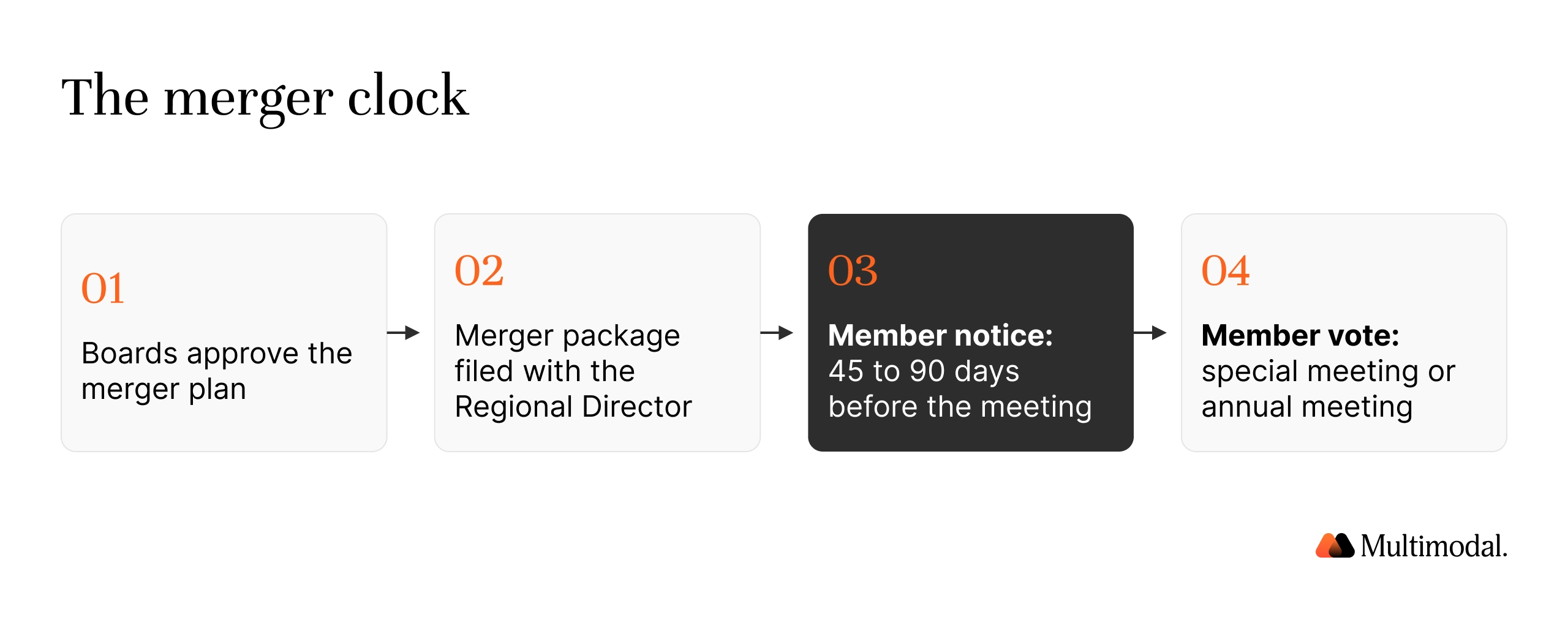
Members get 45 to 90 days' notice before the member vote, which sets the diligence clock.
The work splits into two parts: file-level completeness and a lending policy diff.
Get 1% smarter about AI in financial services every week.
Receive weekly micro lessons on agentic AI, our company updates, and tips from our team right in your inbox. Unsubscribe anytime.
Thank you! Your submission has been received!
Oops! Something went wrong while submitting the form.
AI helps with a credit union merger by reviewing every file in the acquired portfolio for completeness, lien perfection, and policy fit, and by comparing two loan policies to identify where the rulebooks disagree. Both are document jobs at a volume no diligence team can clear by hand within the window a merger transaction allows.
The financial risks fall on the surviving credit union, which inherits loans it did not originate and that were underwritten to standards it did not set. Multimodal builds agentic AI for credit unions, and merger file review is a workflow credit union executives often ask about.
What Are the Continuing Credit Union and the Merging Credit Union?
12 CFR Part 708b defines a continuing credit union as "the credit union that will continue in operation after the merger" and a merging credit union as one that "will cease to exist as an operating credit union at the time of the merger."
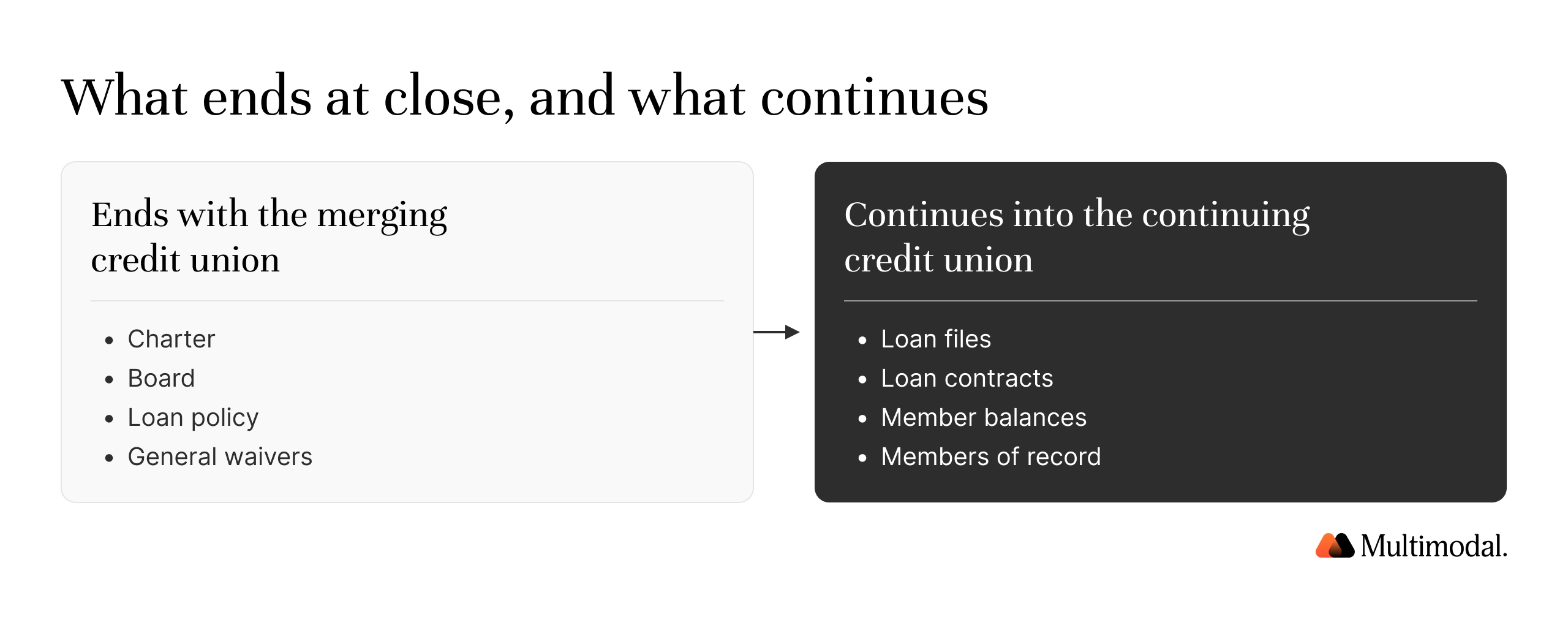
At close, the merging institution's charter, board members, and loan policy cease to exist, while its loan files, loan contracts, and members' balances continue with the acquiring credit union. NCUA's Truth in Mergers adds that "general waivers for a merging credit union do not transfer over to the continuing credit union."
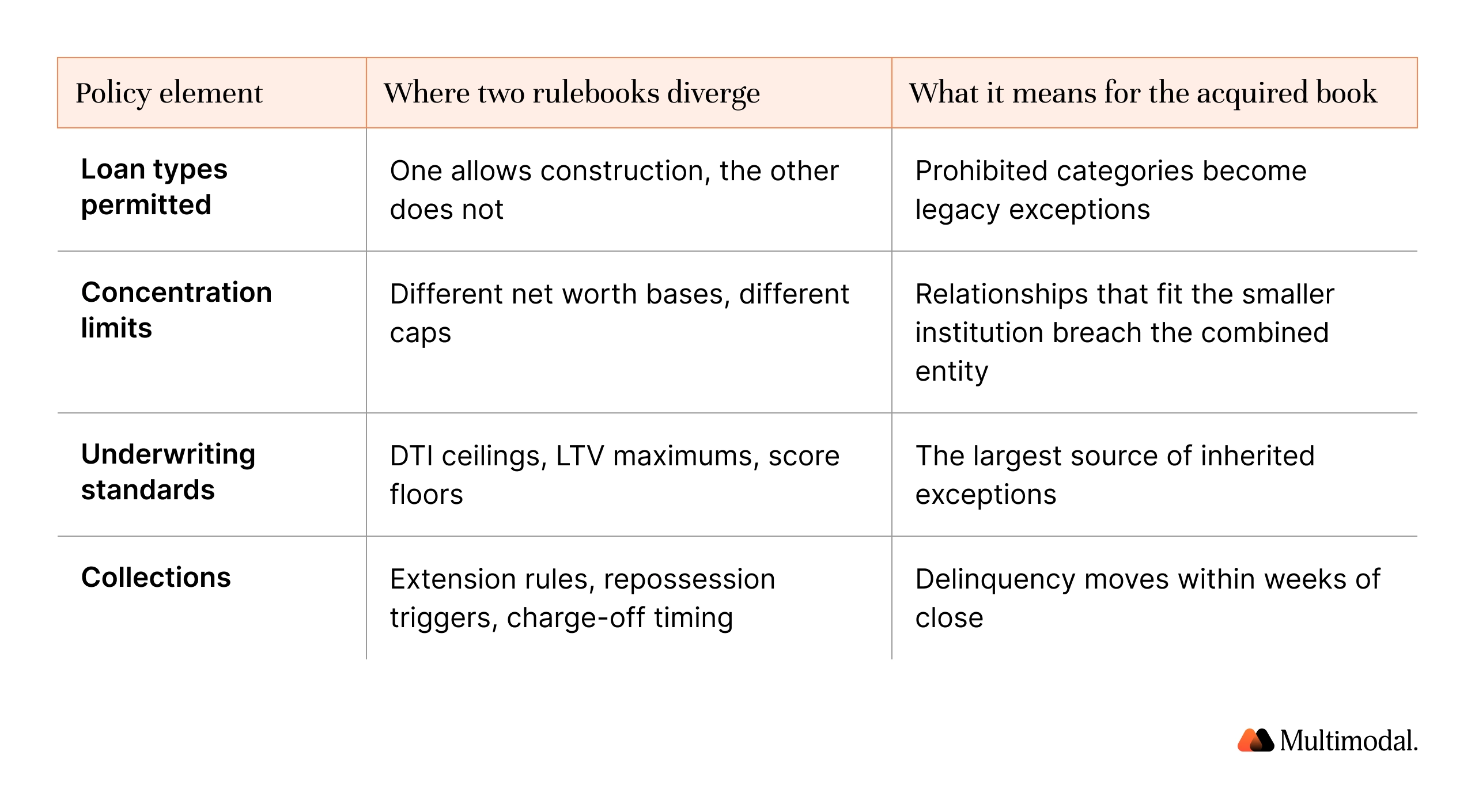
Loans that were compliant on Friday can be policy exceptions on Monday. Membership is the exception: the surviving institution "may continue to serve members of record."
Why Is a Credit Union Merger Loan Review So Hard to Get Right?
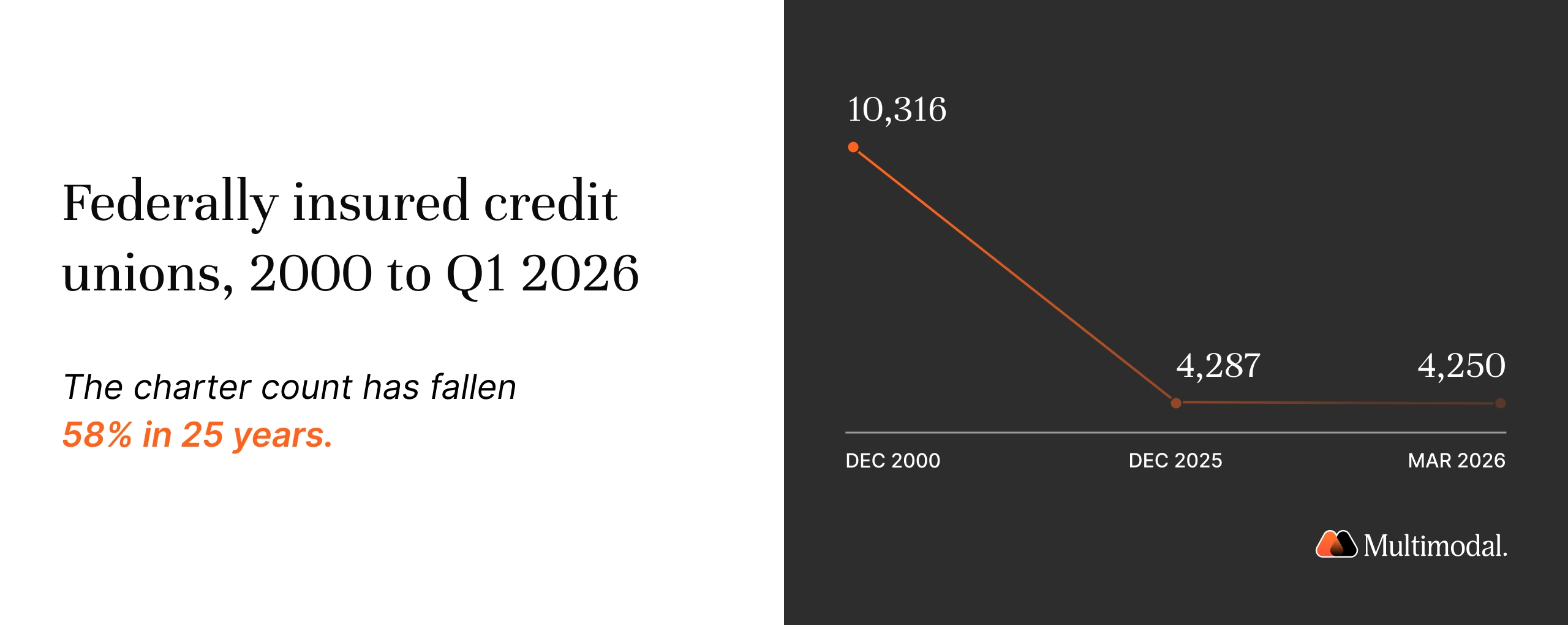
The credit union movement has contracted over the past 25 years. NCUA counted 10,316 federally insured credit unions at the end of 2000 and 4,287 at the end of 2025, a decline of roughly 58%. The number then "declined to 4,250 in the first quarter of 2026, from 4,411 in the first quarter of 2025," across 145.8 million credit union members and $2.48 trillion in assets.
Unassisted mergers ran 138 to 162 a year from 2020 through 2024, and NCUA approved 27 in Q1 2026. Across 613 credit union mergers reviewed from 2017 to 2021, "the primary reason provided for mergers was 'expanded services,' at approximately 76 percent," with poor financial condition at about 12%.
So most are voluntary mergers between healthy institutions, driven by multiple reasons: growth, technology, and succession planning, a written requirement for every federal credit union from January 1, 2026. Smaller credit unions merge up to strengthen a value proposition against banks and fintechs. Credit union mergers and acquisitions begin with strategic planning: boards determine what the combined organization should do, screen potential partners for cultural fit, and confirm that the merger aligns with both organizations' business plans.
"I will say that we have found that it might not be the easiest way of growing... Mergers are not a simple task to take on. And with this being our first one, we've definitely felt a little bit of the pain. I'm not gonna sugarcoat it." — Lisa Highley, Chief Lending Officer, University of Kentucky Federal Credit Union
Then the merger process starts its clock. Boards approve the plan, the parties file the merger package, and only then do credit union members vote at a special meeting or the annual meeting, with notice "at least 45 calendar days, but no more than 90" beforehand. NCUA waives that member vote only where insolvency threatens the share insurance fund. Every workstream backs into the window, against tens of thousands of loan files.
The Six Checks That Belong in a Merger Loan File Review
Delinquency and charge-off history describe the risk profile, not whether the note is signed. A loan-level review is where the due diligence process finds assets weaker than the financial statements suggest and liabilities nobody booked. Each check below comes from NCUA's audit guide or Examiner's Guide.
Signed note on file, with the application, appraisal, and title behind it.
Perfected lien, "recorded or otherwise perfected to indicate the credit union as lien holder," with type and effective date documented. Lapsed UCC-1 continuations silently convert secured loans into unsecured loans.
Collateral value against your policy. Test fair value against "the maximum loan to value requirements included in the credit union's loan policy," which after close means the acquirer's. This measures the acquired book's underwriting accuracy and collateral valuations against a standard it never met.
System terms match paper terms. Rate, term, note date, and collateral code are deliberately mapped to the new platform.
Current monitoring items: insurance, flood determinations, covenant ticklers, unresolved examination findings, and HMDA data errors.
Categorized exceptions, sorting "technical exceptions, credit administration weaknesses, and regulatory violations" into credit, loan, collateral, and policy exceptions.
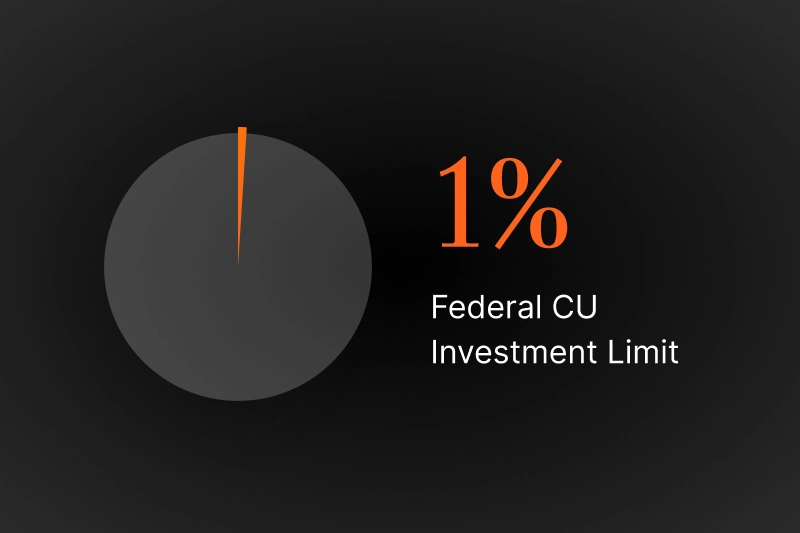
Member business lending is also capped at 1.75 times net worth (12 CFR 723.8), so two books that each clear the limit can combine into one that does not.
What Does a Loan Policy Diff Between Two Credit Unions Look Like?
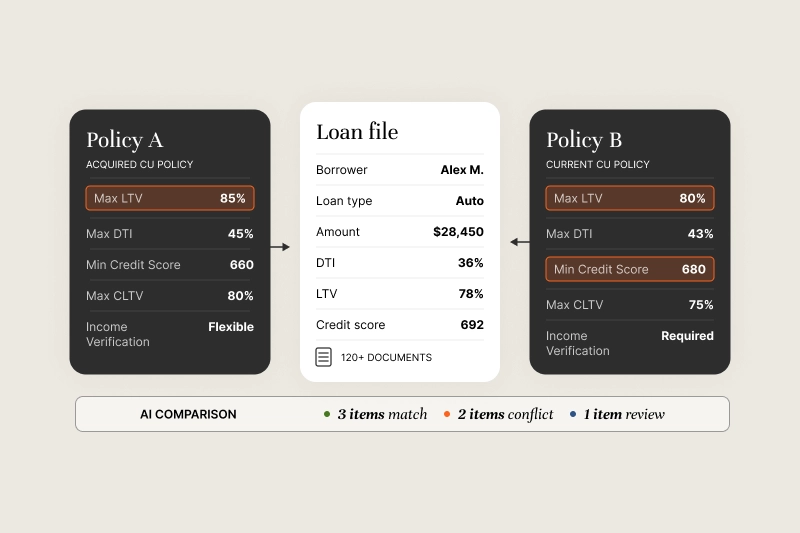
Nobody publishes this analysis, so build it from 12 CFR 723.4, which lists the loan policy elements every credit union must have.
Cultural fit becomes auditable here. Two credit unions can hold identical standards and read risk differently, and merger discussions stall over that more often than over purchase price. A diff turns the disagreement into a count of affected loans, which is what NCUA's merger plan wants when it asks for "delinquent loan summaries and analyses of the adequacy of the Allowance for Loan and Lease Losses account."
How File Quality Shows Up in the Fair Value Marks
Interagency guidance NCUA co-signed directs an acquirer to "apply the acquisition method of accounting to all business combinations in accordance with ASC Topic 805." No cash changes hands between two credit unions, so merger accounting works differently: valuation firms treat enterprise value as an imputed purchase price, while ASC 805 substitutes the fair value of the acquiree's equity interests.
The acquirer then values the acquired assets and liabilities, marks loans to market, recognizes a core deposit intangible, and books goodwill or a bargain purchase gain into the combined entity's capital and financial performance. Rate marks stay separate from loan loss marks, since a book originated at a different interest rate carries its own pricing adjustment. FASB's ASU 2025-08 changes purchase accounting for periods beginning after December 15, 2026, but one point holds: a credit mark is an estimate built on file-level facts, so the benefits of getting them right compound.
Security, Governance, and What Examiners Ask After the Merger Closes
NCUA's AI page states that "credit unions may use AI tools and technologies" and that it "supports the adoption of technology, including AI, when implemented in a safe, sound, and compliant manner." No AI-specific rules exist, so existing requirements apply, including third-party vendor due diligence.
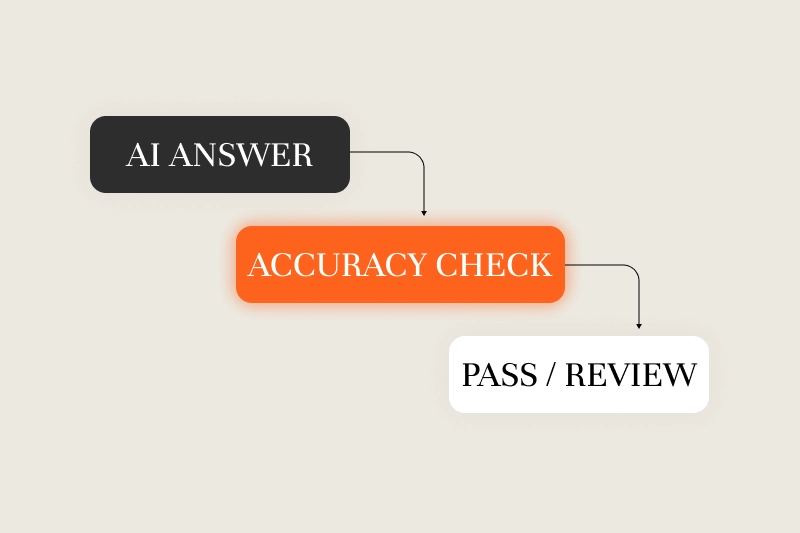
The 2026 Supervisory Priorities name credit administration, underwriting, loss mitigation, and allowance methodology, and never mention mergers. The acquired book enters all four at close. Three controls keep the review defensible: a confidence score per field, a citation to the source page, and an audit trail.
What Does This Look Like in Practice?
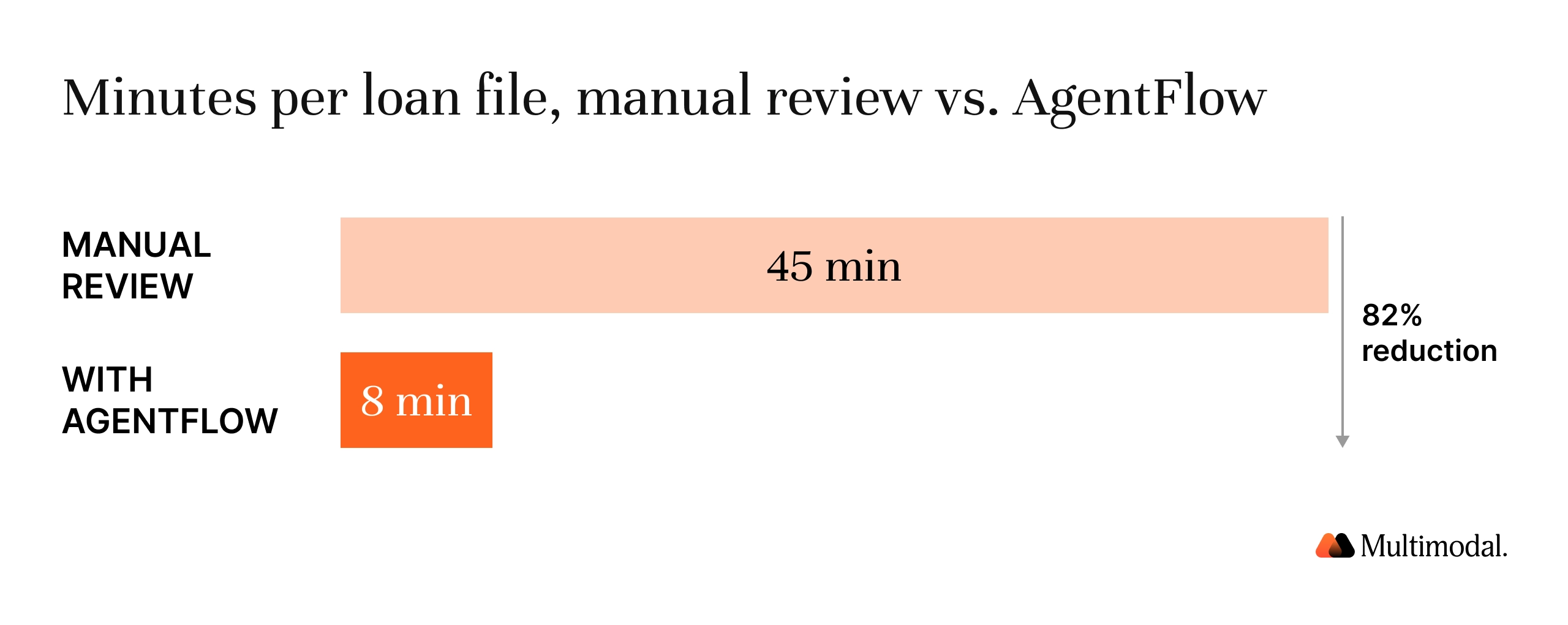
AgentFlow classifies every document in a file, checks completeness against a configurable checklist, validates fields across documents, verifies lien and collateral evidence, and returns a per-file result with categorized exceptions and citations. It reads document content rather than matching a template position, because a merger partner's note format will not match yours. FORUM Credit Union runs this workflow with 99% accuracy, reducing review time per file from 45 minutes to 8 minutes.
"We can take AI, and I can do a virtual merge of two credit unions or a conversion from one core to another with AI. And I can get the entire subset of everything that went wrong within minutes... So now we can do a virtual merger or a virtual core conversion in minutes." — Jed Meyer, CEO, St. Cloud Financial Credit Union
The output is a list, not a percentage: these files are clean, these have documentation exceptions, these have unperfected liens, and these would not have been approved under your policy. AI agents help credit unions price the deal, then hand integration its first queue.
The Files Outlive the Charter
A merging credit union's board dissolves, and its charter is surrendered. The loan files do none of that. They land in the surviving credit union's core, its allowance, its financial statements, and its next examination, underwritten to a rulebook that no longer exists. A successful merger and the organization's long-term success are decided there.
Send us a sample of the acquired loan files and both loan policies. We will run them through AgentFlow and return a completeness and lien-perfection result for each file, a categorized list of exceptions with citations, and a side-by-side policy diff. No core migration required.
See Your Acquired Loan Files Reviewed Before You Close
Send us a sample of the acquired loan files and both loan policies. We will run them through AgentFlow and return a completeness and lien-perfection result for each file, a categorized list of exceptions with citations, and a side-by-side policy diff.
What is the difference between the continuing credit union and the merging credit union?
Under 12 CFR 708b.2, the continuing credit union operates after the merger and the merging credit union ceases to exist. Its charter, board, and policies end at close, while its loan files and member balances transfer.
What should a loan file review cover in a credit union merger?
A signed note, a perfected lien with type and effective date, collateral value tested against the acquirer's limits, matching system and paper terms, monitoring items, and categorized exceptions.
How long does a credit union have to complete merger due diligence?
NCUA requires member notice 45 to 90 calendar days before the vote and publishes no review timeline of its own.
What happens to the merging credit union's loan policy after the merger?
It stops applying. The acquirer's policy governs from close, so loans underwritten to the other standard can become exceptions overnight, and general waivers do not transfer.
Can AI be used for merger due diligence at a credit union?
Yes. NCUA states credit unions may use AI "when implemented in a safe, sound, and compliant manner," so existing vendor governance requirements carry over.

.svg)
.svg)

.avif)
.png)

.png)