HELOC demand is back and fintechs fund in days. The six HELOC-specific steps credit unions can automate, from CLTV and title search to draw-period servicing.
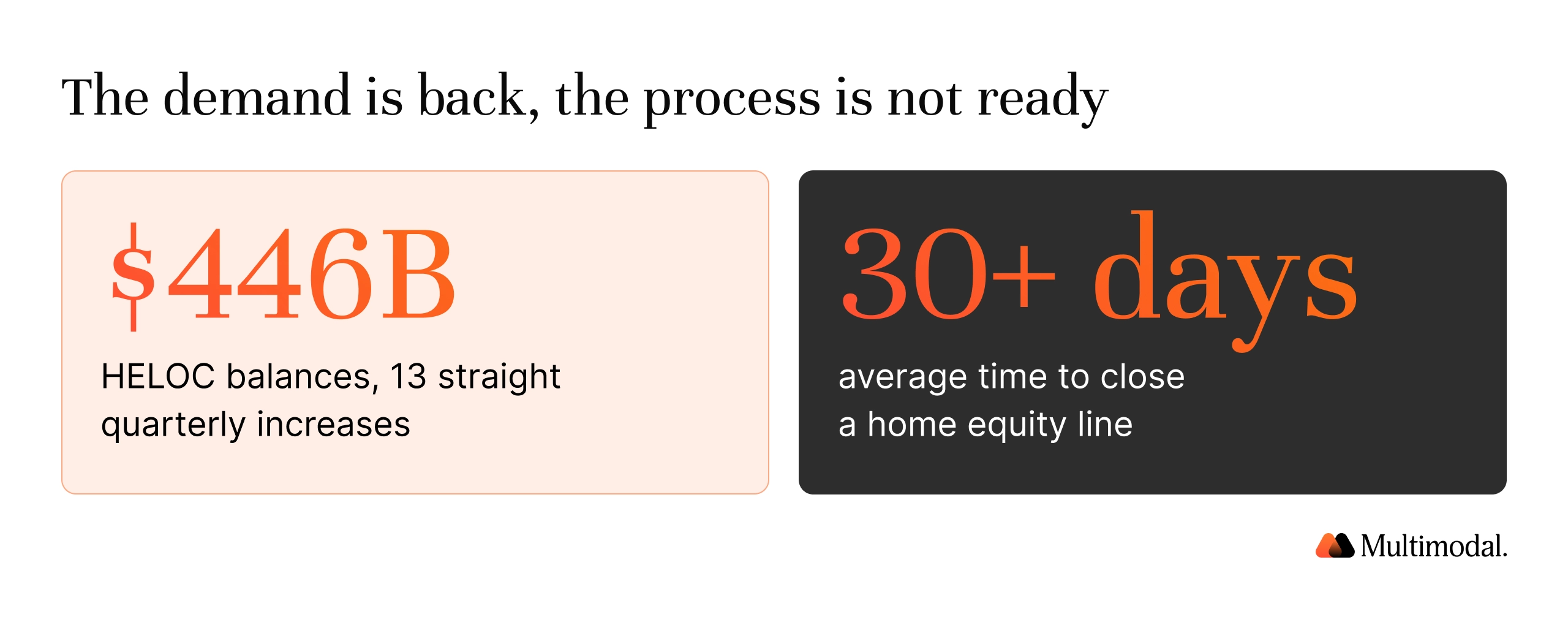
HELOC balances hit $446B after thirteen straight quarterly increases.
Second liens accounted for 54% of equity withdrawals, an 18-year high.
Fintech lenders fund HELOCs within days; industry cycles still exceed 30 days.
Six second-lien steps, from CLTV to subordination, are automatable today.
The interagency AVM rule, including the NCUA, took effect on October 1, 2025.
Get 1% smarter about AI in financial services every week.
Receive weekly micro lessons on agentic AI, our company updates, and tips from our team right in your inbox. Unsubscribe anytime.
Thank you! Your submission has been received!
Oops! Something went wrong while submitting the form.
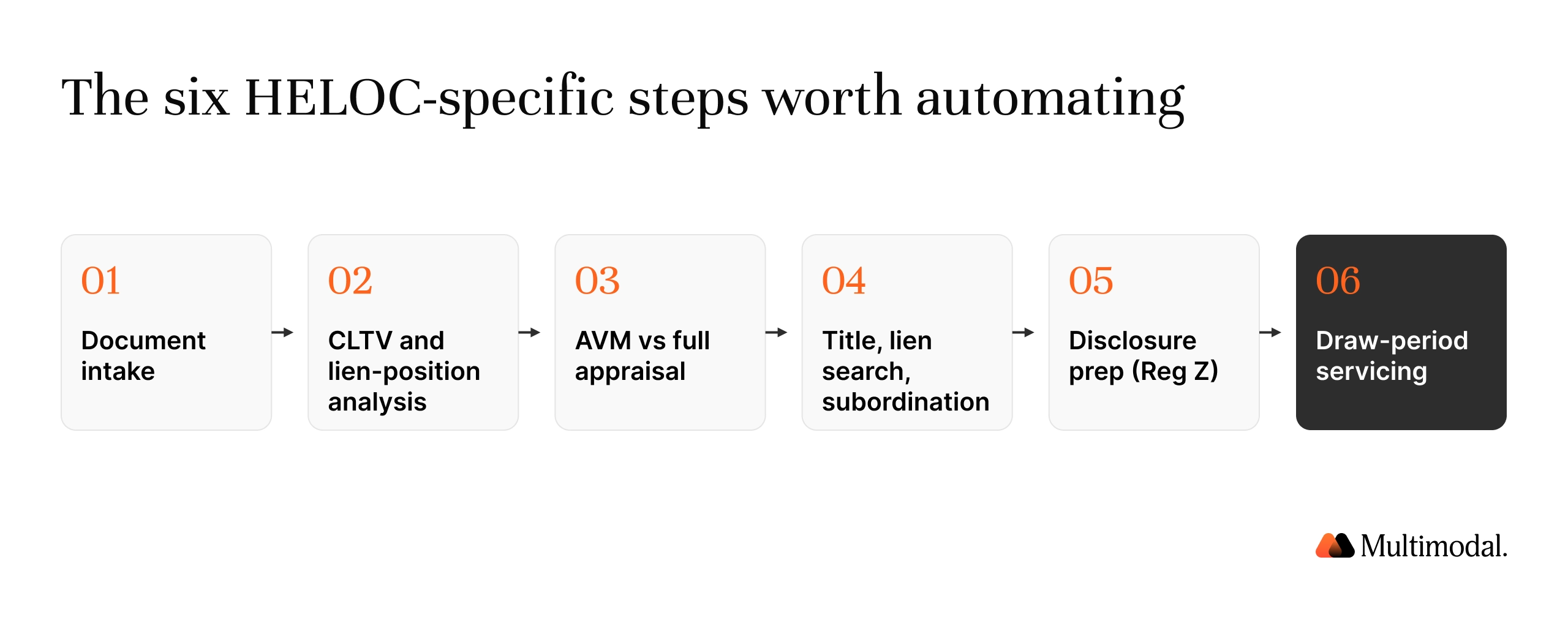
Automating HELOC origination means automating the steps unique to a second lien: document intake, CLTV and lien-position analysis, valuation, title search and subordination, disclosures, and draw-period servicing.
Home equity demand is at multi-year highs, yet the average home equity line takes over 30 days to close, while fintech lenders fund in 5 days. This guide covers the six steps of HELOC automation, the new AVM rule, and the first 90 days.
Why Is HELOC Demand Surging at Credit Unions?
The rate lock-in makes the second lien the only rational way to tap home equity: 70.4% of mortgaged homeowners hold a rate below 5%, so members keep the mortgage and open an equity line of credit behind it. Balances rose to $446 billion in Q1 2026, the thirteenth straight quarterly increase; second liens drove 54% of equity extraction, an 18-year volume high; originations grew 15.8% year over year.
A HELOC is a revolving credit line with a credit limit set against the home's appraised value minus the outstanding mortgage balance, usually at a variable rate tied to the prime rate published in the Wall Street Journal. Members pay interest only on the funds drawn, using the money for home renovations, college tuition, or to consolidate debt at a lower interest rate than personal loans typically carry; interest can even be tax-deductible in certain circumstances (ask a tax advisor).
Home equity loans deliver all the money upfront as a lump sum at a fixed rate for a fixed term; a home equity line of credit (HELOC) lets members borrow funds as needs arise. Financial institutions that offer home equity products to existing customers hold the edge; credit unions already have members' savings accounts, mortgages, online banking, and federally insured deposits.
Why Does a HELOC Still Take a Month to Close?
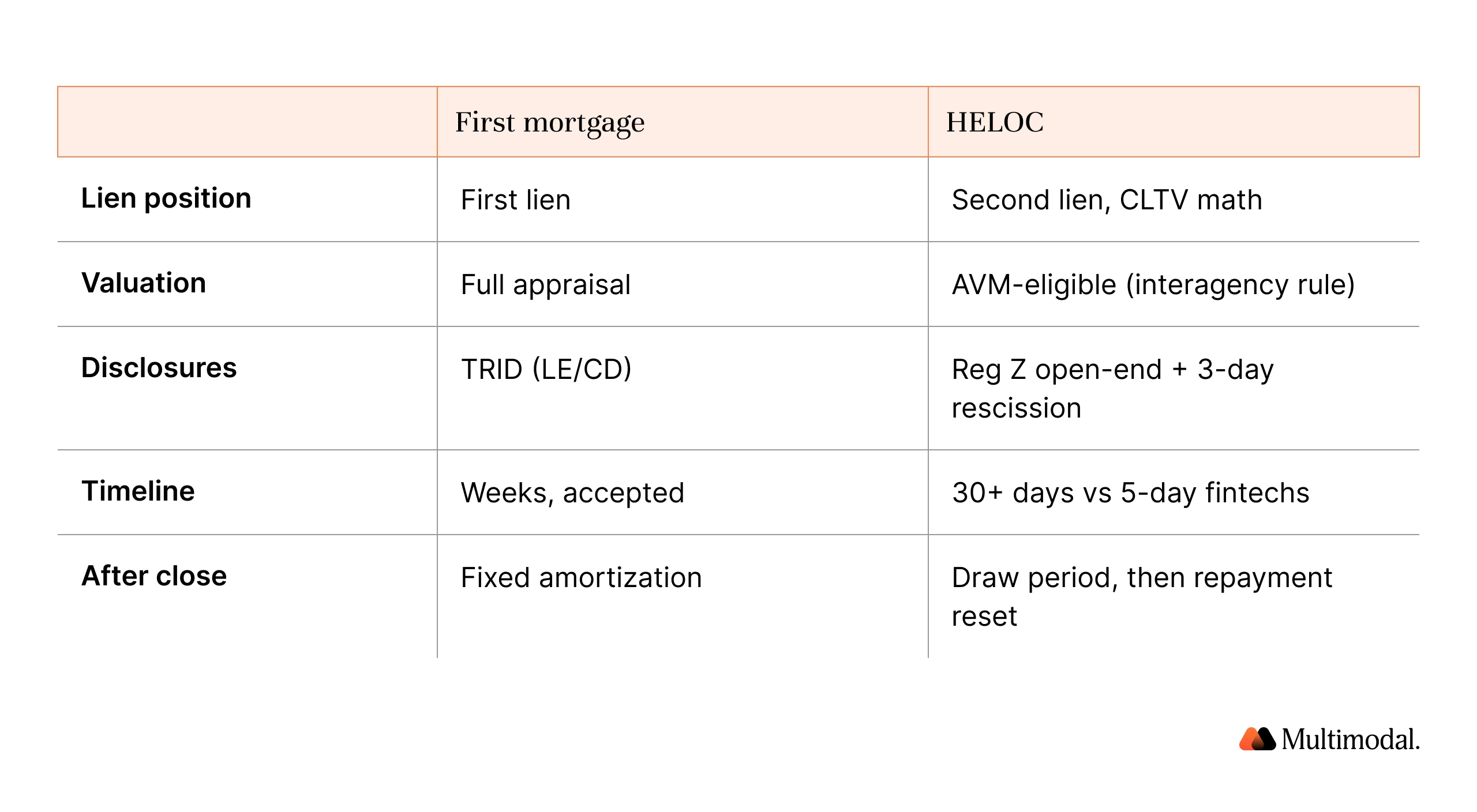
A home equity line runs the first mortgage's document gauntlet with almost no automation: cycle times average more than 30 days, the cost to originate is near $4,600, and pull-through falls below 50%. Members feel it in both money and time: closing costs, application fees ranging from $15 to $75, appraisal fees around $350, an annual fee up to $250, and an early-closure fee of $200 to $500, stacked on top of weeks of loan officers chasing down documents. Fintech lenders advertise five-minute loan approvals and funding in as few as five days.
Automation produces that speed: fewer data-entry errors, real-time application status, loan approvals compressed from weeks to days, lower operational costs. Home equity lending grew 37% in 2022 as digital tools spread, and Coviance reports a 20% pull-through improvement for customers that automated. A chief lending officer locates the wait:
"If they can get a decision on a loan within seconds, instead of waiting… an answer on a home equity, that might take a few hours or so to get an answer. So if they can get an answer on that more quickly, then to me that's an enhanced member experience, and it's worth taking that leap in order to serve our members better." — Lisa Highley, Chief Lending Officer, University of Kentucky Federal Credit Union
The Six HELOC-Specific Steps Worth Automating
1. Document intake for the second-lien file
Income documents, tax returns for self-employed borrowers and co-borrowers, property insurance, the first-lien mortgage statement and payoff data. Digital workflows let members upload from a phone, verify identity and income electronically, and turn the stack into structured data without keying.
2. CLTV and lien-position analysis
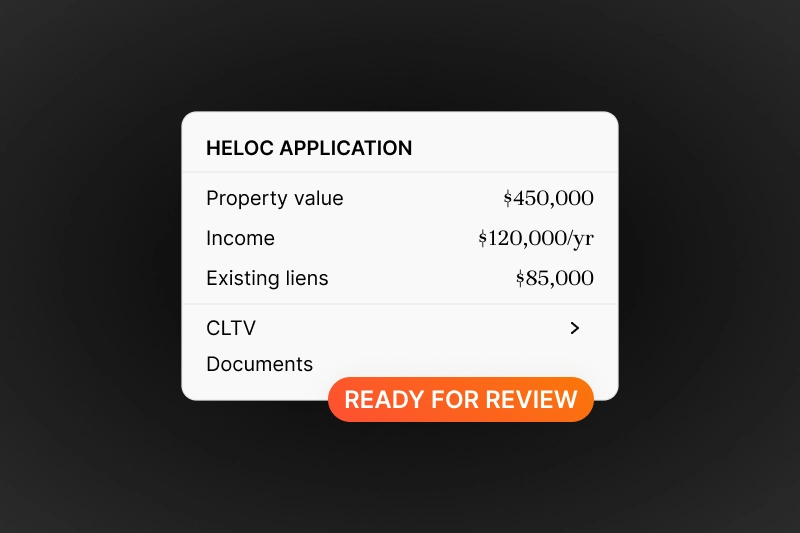
The math that makes a second a second: combined loan-to-value against current value, the verified outstanding balance on the first, the credit report, and the catches manual review misses, like an undisclosed solar lien already in second position. Automation runs the same check on every file, in real time, with no manual intervention on clean files.
3. AVM versus full appraisal decisioning
AVMs already run roughly half of home equity valuations, where one replaces a full appraisal, appraisal fees can drop to zero, and days can leave the timeline. The interagency AVM rule, which NCUA co-issued, took effect October 1, 2025; the answer is rules-based valuation routing with a QC trail an examiner can read.
4. Title, lien search, and subordination
The quiet calendar-eater. Every HELOC needs a title or O&E review to confirm lien position and clear judgments and tax liens; later, the member's first-mortgage refinance sends a subordination request that crawls through a two-week email chain. Automation reads title reports, flags exceptions, and assembles subordination packages the day they arrive, which helps a lender win more loans when that member shops again.
5. Disclosure prep, done correctly
HELOCs are open-end credit under Regulation Z and exempt from TRID: early program disclosure and brochure at application, account-opening disclosures, and the three-day right of rescission on a principal dwelling. Automation generates and timestamps the set so the compliance file assembles itself.
6. Draw-period servicing and end-of-draw
A revolving product keeps originating after funding. Members want convenient access to funds via checks, cards, and online banking; lenders must track daily rate changes and manage line reductions when values decline. Automated alerts ahead of the draw period's end, where interest-only monthly payments convert to principal and interest, plus automatic payments set up early, turn the repayment period reset into a retention moment.
What Do Fintech HELOC Lenders Do Differently?
The five-day fintech recipe is visible once the branding comes off: an application that asks a few quick questions, instant income verification, AVM-first valuation, automated title decisioning, e-sign, a mobile-friendly interface with real-time status. None of it is exclusive technology. What fintechs cannot replicate is the relationship, and the best lenders will pair that advantage with fintech-grade speed throughout the entire home equity journey.
"Their life cycle actually becomes our member cycle, so when they need wealth management, we are there for them. When they need a new home or home equity, we are there for them, because we're engaging with them and we know that that's possible." — Amy Stevens, SVP of Member Experience, GreenState Credit Union
How Do You Run the First 90 Days?
Baseline (weeks 1-2). Capture application-to-fund days, touches per file, pull-through, cost per funded line.
Pilot (weeks 3-10). Run automation human-in-the-loop, starting with intake and CLTV analysis; add AVM routing once QC documentation is in place. Loan officers keep the judgment calls.
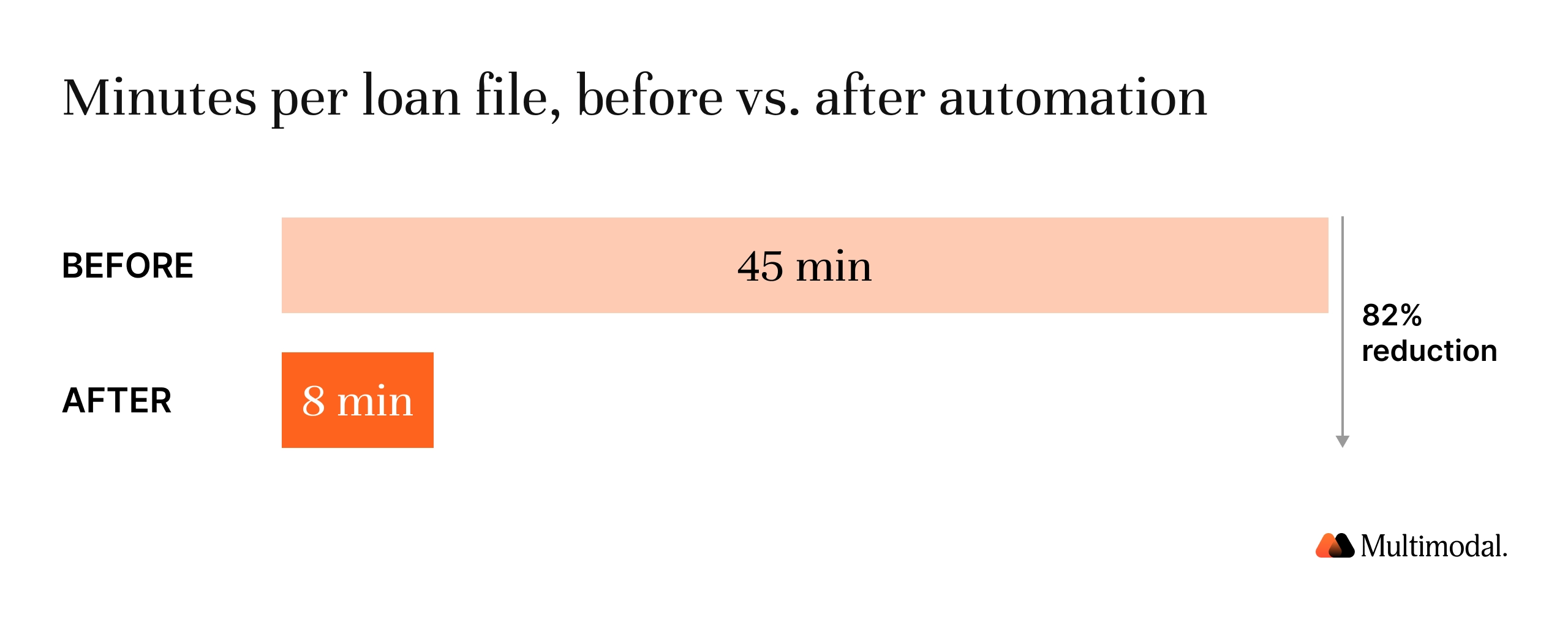
Prove and expand (weeks 11-13). Compare against baseline, take the result to the board, then extend into title and subordination. In production, this pattern reduced one lending team's time per loan file from 45 minutes to 8 minutes; FORUM Credit Union achieves 99% extraction accuracy on live volume. HELOC intake passes the same filters as any first AI workflow; the ROI calculator builds the board slide.
The Credit Union Should Be Winning This Product
The HELOC is a relationship loan secured by collateral the member already trusts the credit union with; demand is at an 18-year second-lien high, and the rate lock-in guarantees the pipeline. The only thing ceding the product to fintech lenders is a 30-day process competing with a 5-day one. Automate the six steps and the advantage flips back to the lender who knew the member first.
Send us a redacted HELOC file. We will run it through AgentFlow and show you in writing where the days go. Your file, your numbers.
See Your HELOC File Move Before You Commit
Send us a redacted HELOC file. We'll run it through AgentFlow and show you exactly where the days go. Your file, your numbers.
Document AI and workflow software applied to the six steps of opening a home equity line, moving the process from weeks to days.
How long does it take a credit union to close a HELOC?
Industry cycle times average more than 30 days; automated programs fund in days.
Can credit unions use an AVM instead of a full appraisal on a HELOC?
Yes, within program limits; AVMs already handle about half of home equity valuations, and the interagency AVM rule requires documented quality-control standards.
Do HELOCs require TRID disclosures?
No. A HELOC is open-end credit under Regulation Z and TRID-exempt; the set is the program disclosure and brochure, account-opening disclosures, and the three-day rescission right.
What is subordination and why does it slow HELOCs down?
When a member refinances the first mortgage, the new lender needs a subordination agreement from the second-lien HELOC lender; automation returns in days what manual handling takes weeks to produce.
What should a credit union automate first?
Document intake and CLTV analysis: highest volume, no member-facing change, measurable within weeks.

.svg)
.svg)

.avif)
.png)

.png)