How AI in mortgage lending works in 2026: document processing, underwriting, and compliance, with verified results from FORUM Credit Union and Direct Mortgage.
AI cuts mortgage document costs by 80% while keeping decisions audit-ready.
Named lenders report 99% accuracy and 20x faster loan approvals.
Underwriters supervise AI decisions; humans keep final approval control.
Compliance, bias, and model drift demand monitoring and explainable decisions.
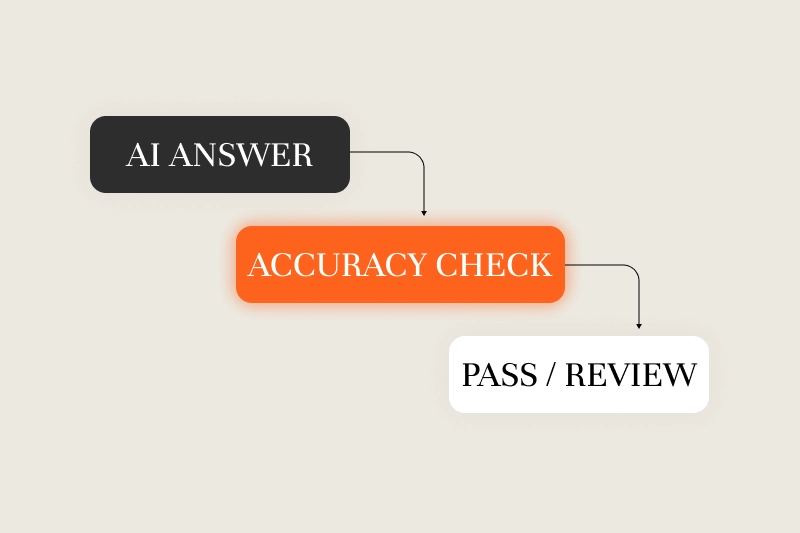
Agentic workflows process the full loan file, escalating only exceptions.
Get 1% smarter about AI in financial services every week.
Receive weekly micro lessons on agentic AI, our company updates, and tips from our team right in your inbox. Unsubscribe anytime.
Thank you! Your submission has been received!
Oops! Something went wrong while submitting the form.
AI in mortgage lending uses document processing, automated decisioning, and agentic workflows to move a loan file from application to decision with minimal manual touch. Lenders use it to classify and extract data from borrower documents, automate underwriting evaluations, detect fraud, and stay audit-ready.
A mortgage is usually the largest transaction of a consumer's life, the loan that buys a home. Yet manual underwriting drives high operational costs, documents eat loan officers' time, and long approval timelines frustrate borrowers. Fannie Mae found that 73% of lenders cite operational efficiency as their primary motivation for adopting AI, up from 42% five years earlier.
This guide covers how AI mortgage lending works in 2026, the verified results behind it, and the compliance requirements that come with it.
What Is AI in Mortgage Lending?
AI in mortgage lending is the use of machine learning, natural language processing, and agentic AI to automate the workflow from a mortgage application to a funded loan: reading documents, verifying data, evaluating credit risk, checking compliance, and routing decisions.
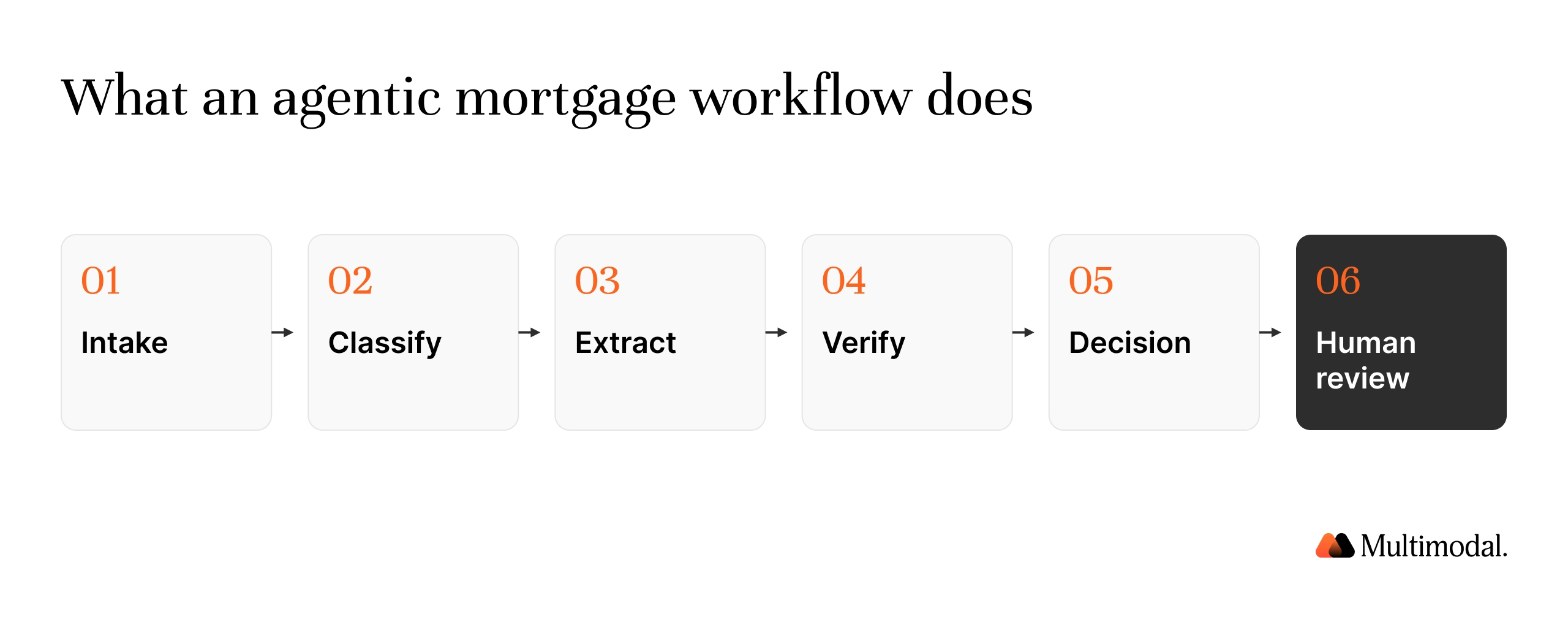
OCR digitized paper. RPA scripted repetitive clicks but broke the moment a document changed format. Agentic AI is different in kind: an AI agent can classify a scanned pay stub, extract dozens of fields, cross-check them against the application, flag discrepancies, and pass a decision-ready file to an underwriter, all inside one agentic mortgage workflow with a full audit trail.
Mortgage files are messy: tax returns, bank statements, credit reports, handwritten forms. Data fragmentation complicates the creation of unified borrower profiles, and interoperability with core systems is crucial at scale. The operational core of AI mortgage lending and the fastest ROI sits in documents, decisions, and compliance.
How Is AI Used in Mortgage Document Processing?
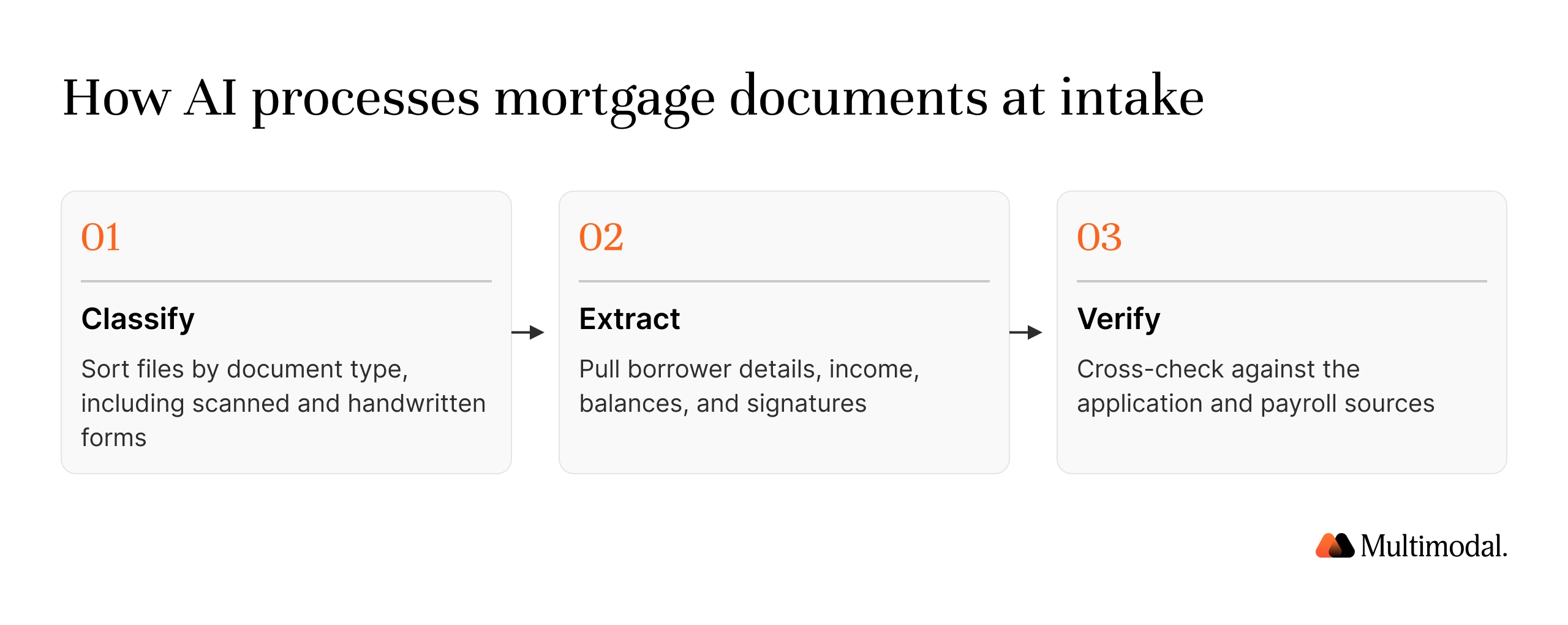
Mortgage document processing is where most lenders start: it is where the most time is lost, and every manual step introduces errors and delays. AI automates document collection and verification across intake:
Classification. AI models sort incoming files into the correct document types, including scanned and handwritten formats. Generative AI can analyze hundreds of pages in minutes rather than days.
Extraction. Agents pull borrower details, income figures, account balances, and signatures into structured data your loan origination system can use.
Verification. Extracted data is cross-checked against the application and third-party sources such as payroll systems, reducing human error in assessments.
TD Bank launched its first agentic AI model for mortgage and HELOC applications and reported that pre-adjudication processing dropped from roughly 15 hours to 3 minutes.
How Does AI Automate Mortgage Underwriting and Credit Decisions?
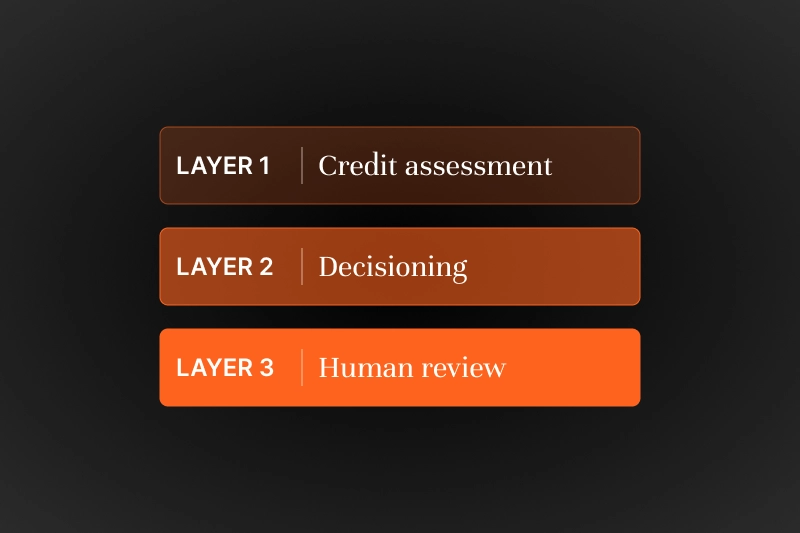
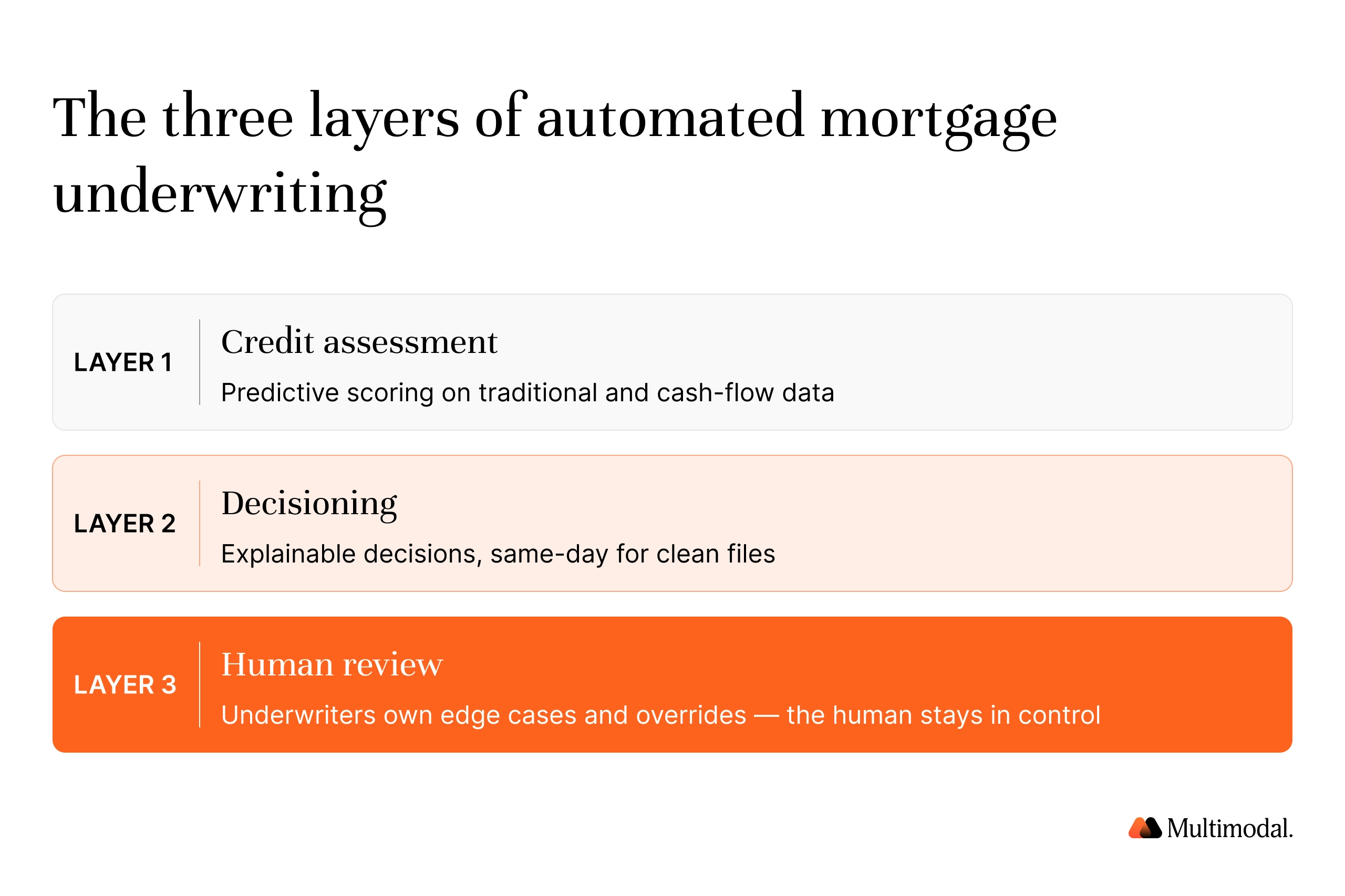
Underwriting is the decision-making engine of loan origination, where inconsistent credit evaluations increase default risk. AI models apply the same policy to every file, improving consistency and reducing compliance risk. Automated mortgage underwriting works in three layers:
Credit assessment. Predictive credit scoring models evaluate a borrower's ability to repay using traditional and, where policy allows, non-traditional data such as cash-flow patterns, which can expand access to homeownership for consumers with thin credit histories, provided models are validated for fairness.
Decisioning. AI agents calculate payout values, reserve amounts, and segmentation codes, then generate explainable loan decisions. For clean files, this enables same-day or real-time approvals.
Human review. Human professionals make or review final lending decisions. AI handles routine conditions; underwriters handle edge cases and overrides, and, with their processing colleagues, can meet peak volumes without overtime.
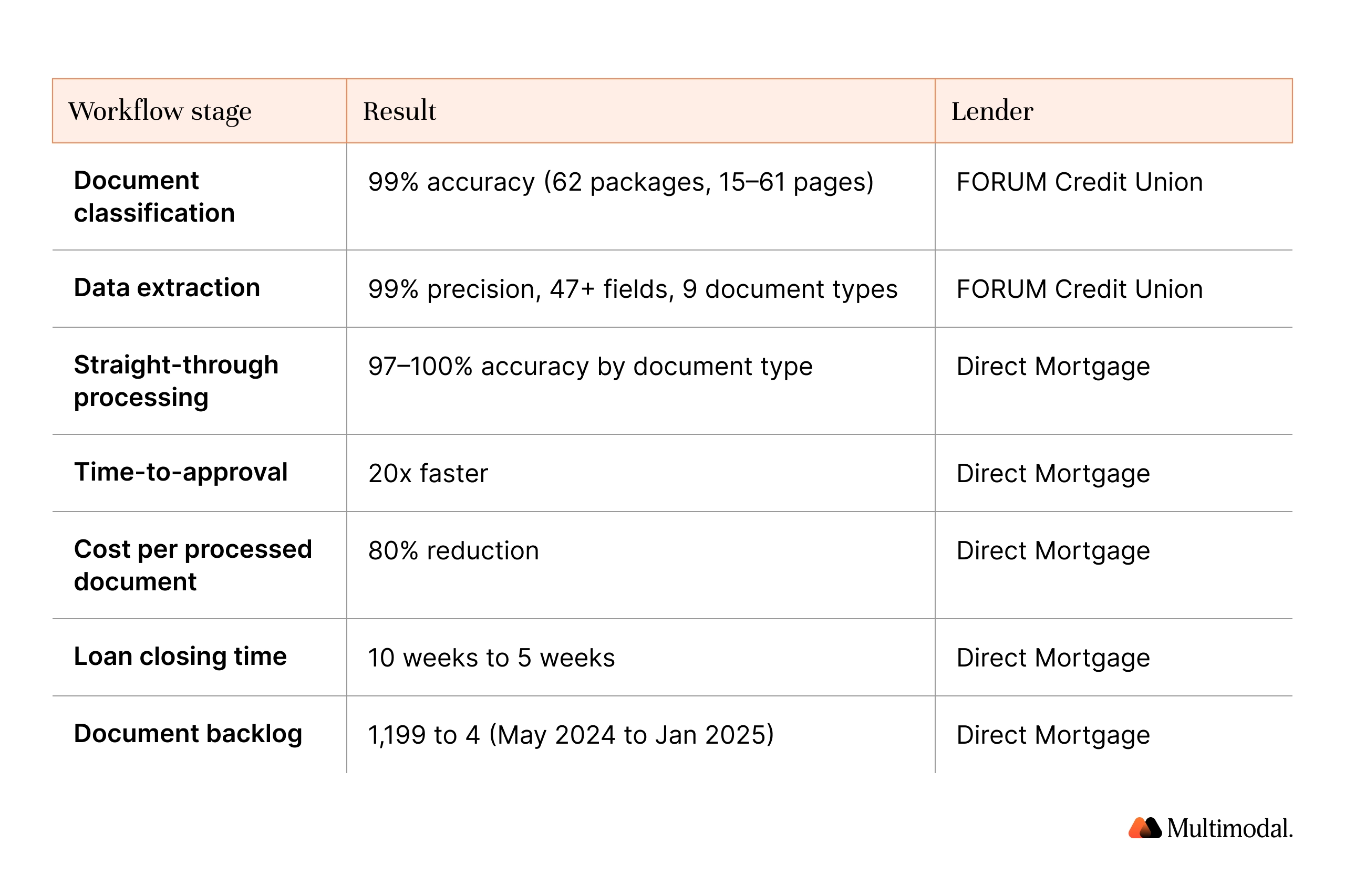
Faster decisions mean borrowers get answers in hours instead of weeks; the verified numbers are in the table below.
How Does AI Handle Mortgage Compliance and Fraud Detection?
Mortgage lenders must comply with federal and state regulations when using AI, including fair lending rules, anti-money laundering (AML) requirements, and know-your-customer (KYC) standards. Regulators expect the same thing from an AI agent that they expect from a human processor: show your work. Audit trails are the backbone of production-grade lending AI, and examiners are absolutely clear: a workflow is either explainable and compliant, or it should not be in production.
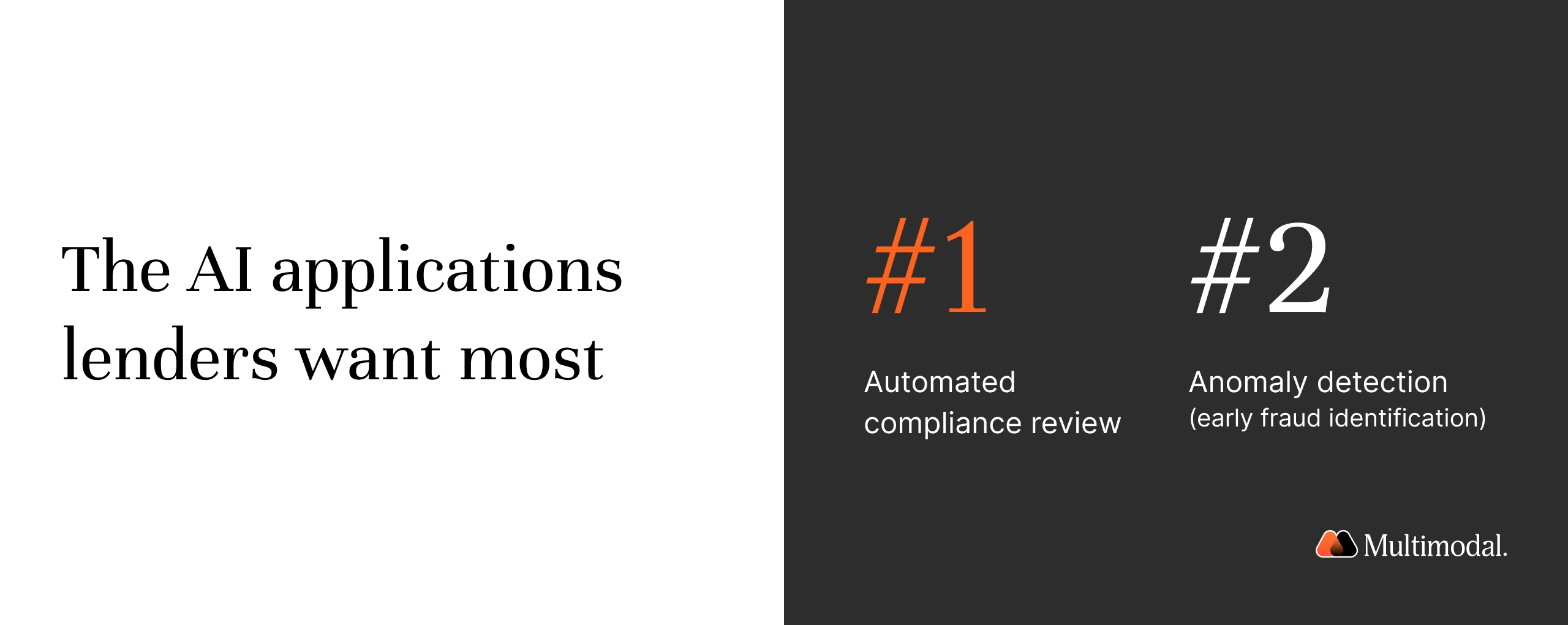
On the fraud side, AI can process large volumes of data to detect anomalies that manual review may miss: income discrepancies, unusual transaction patterns, and mismatched details across documents. In Fannie Mae's lender survey, anomaly detection was the second most appealing AI application idea lenders evaluated, right behind automated compliance review. Automated document verification strengthens compliance checks in loan origination while reducing the manual errors that create regulatory exposure.
What Happens After Closing? AI in Loan Servicing and Portfolio Management
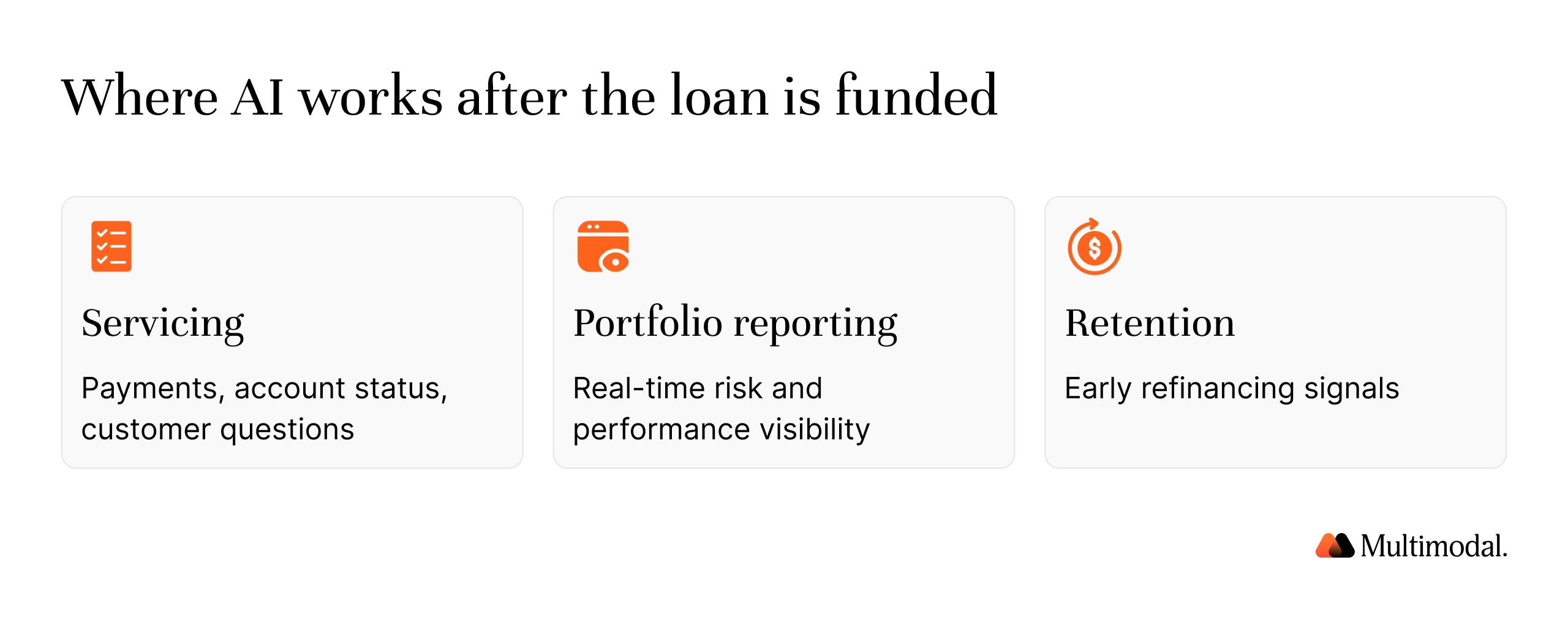
The loan file does not stop mattering at the closing table. After a mortgage is funded, AI keeps working in three areas:
Servicing. Automation streamlines payment processing, monitors account status, and tracks upcoming payments, reducing manual errors and operational costs. AI-driven support tools handle routine customer interactions around the clock, answering questions on balances and account details and sending the right payment reminder message at the right time. Still, the highest-value work in servicing remains in the back office, in the documents and data rather than the chat window.
Portfolio reporting. AI agents analyze loan volumes and repayment data in real time to track portfolio health, surface risk concentrations, and generate audit-ready reports, so leadership teams can make informed decisions instead of waiting for month-end.
Retention. Models detect early signals of refinancing intent or dissatisfaction, letting lenders reach out with relevant options before a customer leaves. Better communications at the right moment improve customer experience and retention without adding headcount.
What Are the Risks of AI in Mortgage Lending?
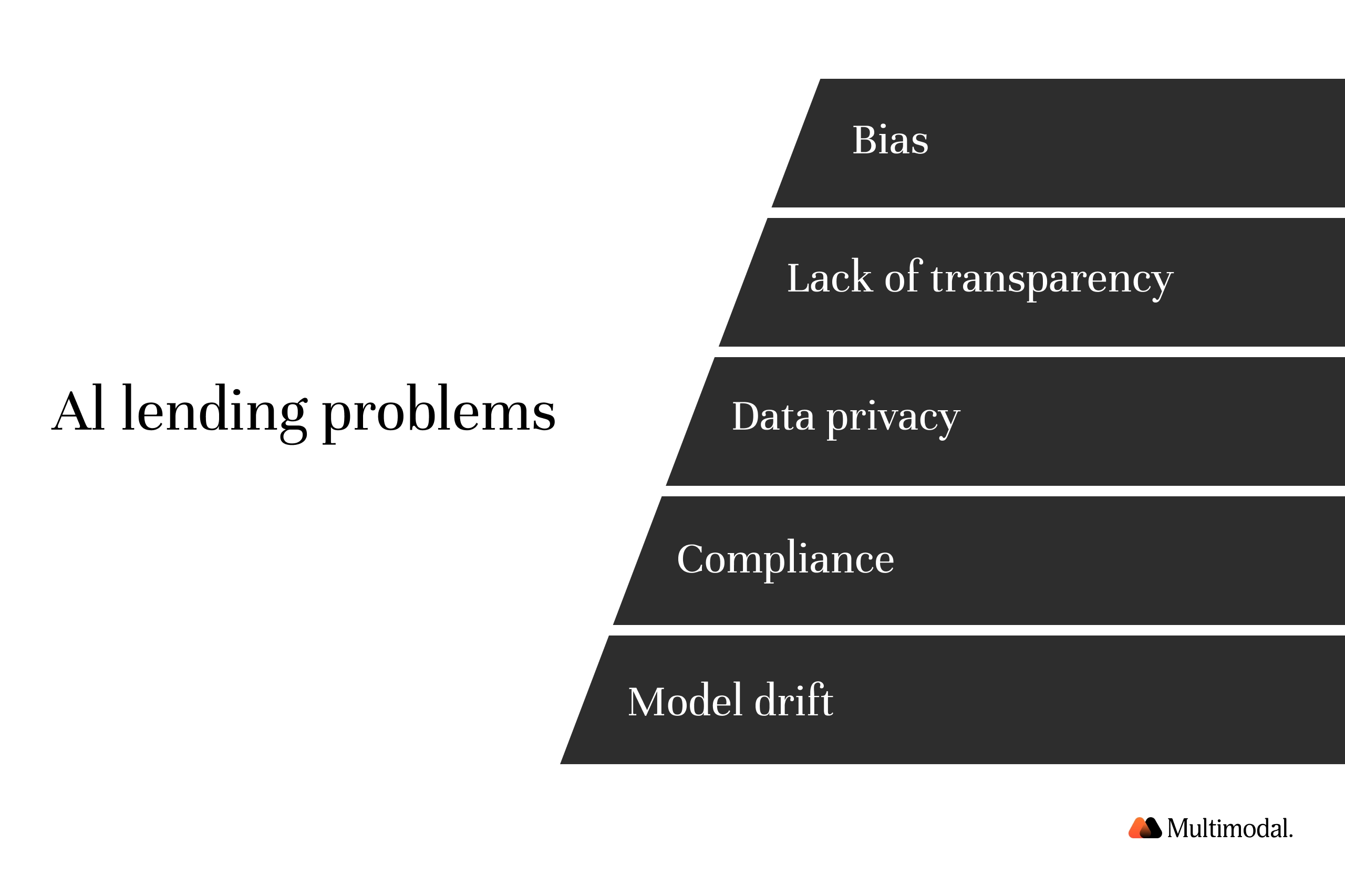
The promise of AI in mortgage lending is real. So are the risks, and executives evaluating AI mortgage lending technology should press vendors on all five:
Algorithmic bias. Models trained on historical data can inherit bias related to race, gender, or socioeconomic status, which is why fair lending testing and human oversight of final decisions are non-negotiable.
Transparency. Black-box models make it hard for lenders and regulators to understand decisions. Explainable decisioning with stored rationale is the requirement.
Data privacy. AI systems must protect sensitive financial data and comply with privacy regulations. Lender concerns about data security grew significantly between 2018 and 2023.
Model drift. Models drift over time; continuous monitoring and validation are necessary to ensure accuracy as borrower behavior and markets change.
Regulatory alignment. A model that does not align with lending laws creates legal exposure for the entire organization, not efficiency.
Across all five, AI in lending works when humans keep control of policy and exceptions while agents handle the volume.
Which Lenders Are Using AI in Mortgage and Consumer Lending Today?
Most content about AI mortgage lending stays theoretical. Two lenders have published verified numbers.
FORUM Credit Union, an Indiana-based credit union where auto lending is a core business line, runs an agentic automation solution on AgentFlow, integrated with its Temenos core, with every decision stored with a full audit rationale.
We've seen accuracy levels exceed 99% in both document classification and data extraction. This is the future of lending at FORUM Credit Union. — Chris Ferguson, SVP Consumer Lending, FORUM Credit Union
Direct Mortgage Corp., a 29-year residential mortgage lender, automated its application process with AI agents trained on its own document types and now serves more clients with the same team.
We gave [Multimodal] the most difficult form to process, a paystub. That was our test pilot. And in 30 days, they had it resolved. — Jim Beech, CEO, Direct Mortgage Corp.
Verified results from AI in the mortgage lending workflow
AgentFlow runs these same workflows for credit unions, banks, and private equity firms, from consumer lending to business loan underwriting and fund and portfolio operations.
Frequently Asked Questions
What is AI in mortgage lending?
AI in mortgage lending is the use of machine learning and agentic AI to automate document processing, underwriting evaluations, compliance checks, and fraud detection throughout the loan origination process, with human professionals making final decisions.
Can AI approve a mortgage loan?
AI can generate explainable loan decisions and, for clean files, enable same-day or real-time approvals. In regulated production deployments, human professionals make or review final lending decisions, and every automated step is stored with an audit trail.
How accurate is AI at processing mortgage documents?
Published results from production deployments show 99% document classification and data extraction accuracy at FORUM Credit Union, and 97%-100% straight-through processing accuracy across major document types at Direct Mortgage, including scanned and handwritten formats.
Will AI replace mortgage underwriters?
No. AI removes the repetitive document work, so underwriters focus on risk signals, compensating factors, and edge cases. As FORUM Credit Union's COO put it on Multimodal's Pioneers podcast, the job moves from data entry to decision supervision.
How do credit unions use AI in mortgage and consumer lending?
Credit unions use AI agents to classify loan documents, extract borrower data, automate credit decisioning, and remain audit-ready, typically integrated with core systems like Temenos. FORUM Credit Union processes auto loan packages with 99% accuracy. See our full guide to AI for credit unions.
What is an agentic mortgage workflow?
An agentic mortgage workflow is a sequence of AI agents that carry a loan file through intake, classification, extraction, verification, and decisioning with minimal human touch, escalating exceptions to staff. Agents complete the entire process step by step and log every action for compliance.
Bring AI Into Your Mortgage Lending Workflow
We are not a chatbot. We process the loan file.
See Your Loan Files Processed by AI
Bring a real loan package. Watch AgentFlow classify, extract, and make decisions in real time.
AgentFlow automates the mortgage lending process from document intake to audit-ready decision: the same platform behind FORUM Credit Union's 99% accuracy and Direct Mortgage's 80% cost reduction. Your team keeps control of policy and exceptions; the agents absorb the volume.
Schedule a 30-minute call with our experts to see how AI agents work on your actual loan files, or contact us with questions about your document stack. Teams launch fast here: Direct Mortgage had its first working prototype in under a month.

.svg)
.svg)

.avif)
.png)

.png)