What Community Banks Can Learn from Credit Union AI Adoption
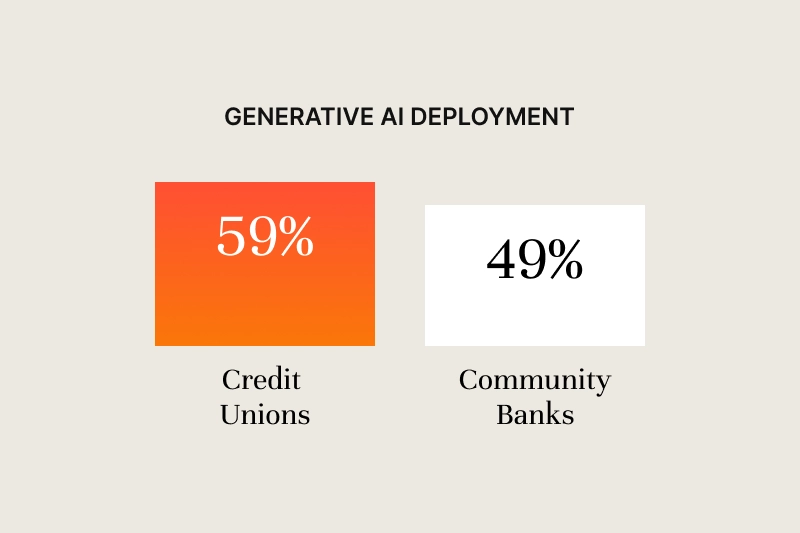
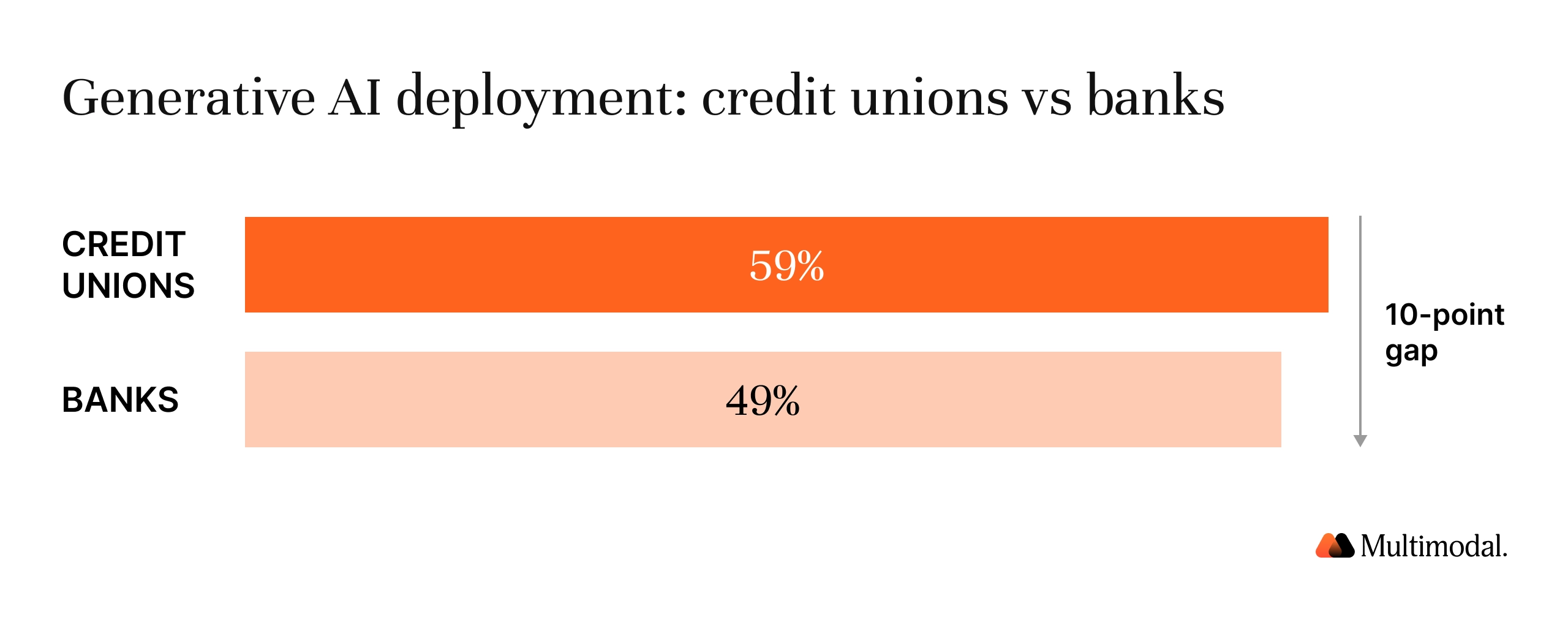
Credit unions deployed generative AI ahead of banks, 59% vs 49%. See the five lessons community banks can borrow, the regulatory reality, and where to start.
Credit unions reached production AI first: 59% deployed generative AI vs 49% of banks.
Regulation blocks less than boards assume; OCC scoped out agentic AI from model risk guidance.
The lessons are operational: one workflow, short contracts, governance written early.
Shared innovation vehicles replace the data science team banks cannot hire.
Document-first deployments produced the measurable wins.
Get 1% smarter about AI in financial services every week.
Receive weekly micro lessons on agentic AI, our company updates, and tips from our team right in your inbox. Unsubscribe anytime.
Thank you! Your submission has been received!
Oops! Something went wrong while submitting the form.
Community banks can close most of their AI gap by borrowing from what credit unions have already proven: the first step in adopting AI is a single document-heavy workflow on a short contract, with governance written early. The strongest evidence for AI in community banks sits one charter over: 59% of credit unions have deployed generative AI, compared with 49% of banks.
Both run the same core under examiners with similar expectations for operational risk, data security, and customer trust. When one vertical moves faster with new technology, the other inherits a proven roadmap.
Why Are Credit Unions Ahead of Community Banks on AI?
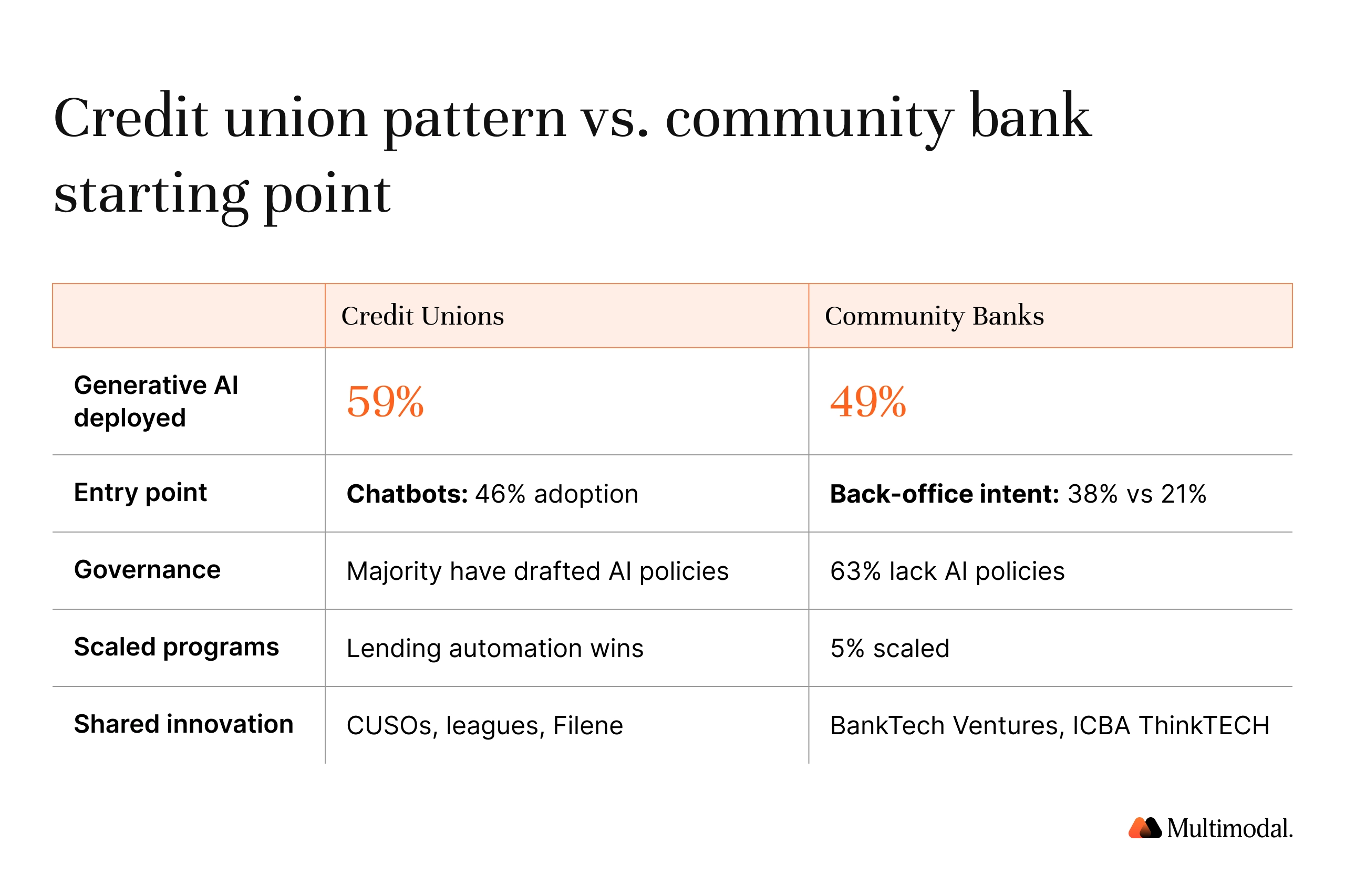
In Cornerstone Advisors' 2026 survey, 59% of credit unions had deployed generative AI, compared with 49% of banks; 46% now run chatbots, up from 3% in 2019.
Community banks look earlier-stage: every community bank in a Wolf & Company survey used artificial intelligence in some form, yet only 5% had a scaled, governed AI program, and 63% of institutions lack AI governance policies.
Customer experience pressure hit contact centers early; CUSOs and leagues spread the cost of evaluating AI tools; and decision distance is short. Community banks and regional institutions hold the same advantage.
Is Regulation Actually the Blocker for Community Banks?
Compliance tops the list of reasons why AI adoption stalls, yet the examiner's posture is more permissive than boards assume. NCUA states credit unions may use AI and has issued no AI-specific rules because existing regulations are technology-neutral. The bank charter has its own version: the revised interagency model risk guidance excludes generative and agentic AI and targets institutions with assets above $30 billion.
AI risk management runs through existing expectations: governance, vendor due diligence, fair lending, data privacy, explainability, human oversight. NCUA's resource hub points institutions to the NIST AI Risk Management Framework, and generative AI itself can support compliance teams by digesting and summarizing federal regulatory updates. A credit union CIO on the current exam conversation:
"If anybody's had an audit recently, I think the most you're gonna get from an NCUA auditor right now is, let me see your AI governance policy... you think that there's no tax there, that's a big tax." — Jeffrey Staw, Chief Information and Innovation Officer, Firefighters First Credit Union
Build the audit trail now; our guide to NCUA AI guidance breaks down what examiners ask.
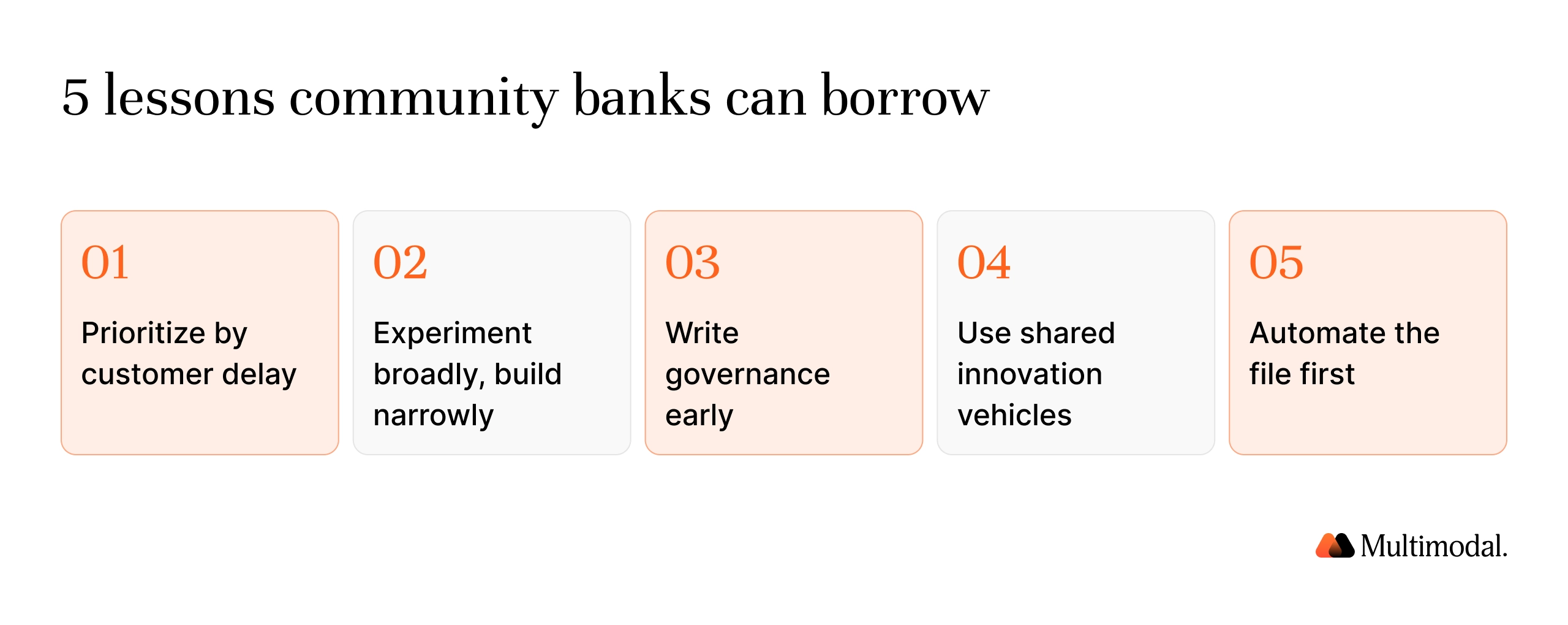
5 Lessons Community Banks Can Borrow from Credit Union AI Adoption
Lesson 1: Prioritize by where the customer feels the delay
LeAnn Case, Chief Strategy Officer at St. Cloud Financial Credit Union, asked her leadership team to identify where the institution was unintentionally sending members elsewhere. The answer: fifteen hours of staff time to build one business review file.
That question turns strategic planning into a ranked workflow list. The community bank equivalents: the CRE credit memo a lender waits a week for, the SBA packet in a queue, the delayed exception review. Slow files send customers to faster lenders. Automate certain tasks first, the high-impact ones.
Lesson 2: Experiment broadly, build narrowly, and skip the long contract
The failure pattern: a multi-year contract signed before the organization understands the technology. Integration with legacy systems complicates AI deployment in banks, another argument for a narrow start. Carey Ransom, who runs BankTech Ventures, an investment fund backed by more than 125 community banks, is blunt:
"You need to be experimenting. You need to be learning by doing... So get your hands dirty, experiment, don't sign long contracts, and really start to get to know what might be possible." — Carey Ransom, Managing Director, BankTech Ventures
Lesson 3: Write the governance policy before the examiner asks
Credit unions conducted governance in parallel with deployment: Filene found that the vast majority had drafted an AI policy, while adoption remained in its early stages.
Strong governance at this scale is one page: named accountability, an AI systems inventory, human oversight procedures for credit and compliance decisions, and a citation requirement so every AI-driven output traces to source documents.
Two risks make this critical: centralizing customer data for AI increases the potential for cyber threats, so extend encryption, role-based access, and explicit rules for personally identifiable information and other sensitive information; and AI models can unintentionally reflect biases in historical data, so credit decisioning needs fair lending review. Employees will use these tools either way; governance decides where that happens and how you manage risk.
Lesson 4: Use shared innovation vehicles instead of going alone
No community institution needs to hire a data science team. Credit unions pooled knowledge and resources through CUSOs, leagues, and Filene; St. Cloud Financial even bought ownership in a CUSO it credited with educating the industry. Community banks have parallel support in BankTech Ventures and ICBA's ThinkTECH Accelerator and AI Security Readiness Guide. Share the cost of learning, keep the value of deploying.
Lesson 5: Automate the file, and let the chatbot answer the phone
Conversational AI and chatbots provide 24/7 customer service for basic inquiries, and AI can personalize customer engagement across digital channels: financial wellness reminders and alerts drawn from customer behavior, tailored offers, and personalized financial advice and loan products built on transaction history.
AI-driven virtual assistants handle routine calls and reduce call times; internal knowledge assistants help service staff access internal resources quickly; and proactive engagement at every touchpoint can strengthen satisfaction and deepen relationships. JPMorgan Chase saw click-through rates increase by up to 450% with AI-personalized copy.
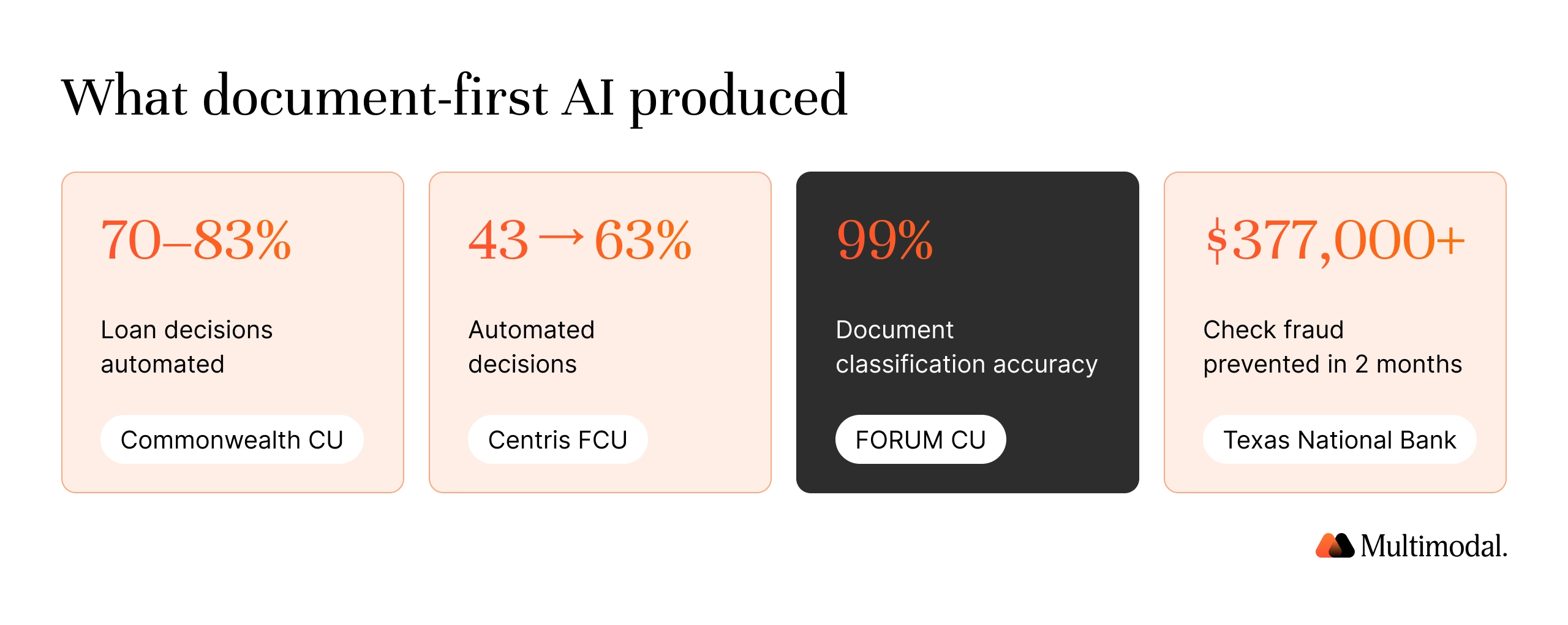
The results that changed lending economics, though, came from the files. Document automation extracts data from borrower documents using optical character recognition and natural language processing, then validates it against policy: 70% to 83% of consumer loan decisions automated at Commonwealth Credit Union, 43% to 63% at Centris, and 99% document classification accuracy at FORUM Credit Union with AgentFlow. AI can even expand credit scoring using alternative data for underbanked borrowers.
Community banks show the same pattern. Within two months of joining Abrigo's fraud detection program, for example, Texas National Bank prevented over $377,000 in fraudulent checks with AI that continuously analyzes transaction data and identifies suspicious patterns in real time. Bankers Trust cut its commercial loan processing time from two weeks to three to five days for certain loans, and 61% of financial institutions say AI has decreased annual costs by more than 5%. Fund the files first; that is where you improve efficiency measurably.
Where Does AI for Community Banks Land First?
In our conversations with community bank leaders, three pains recur: manual check and lockbox keying, ACH exception review, and CRE credit memo preparation, each document-heavy and measurable. One CSBS survey respondent estimated AI could handle 80% to 90% of annual commercial credit reviews, and banks applying AI across the KYC client-verification chain are targeting cost reductions of up to 50%.
In Multimodal's 2026 Field Report, drawn from 445 sales conversations, an EVP at a mid-size community bank captured shifting buyer expectations in four words: "Show me your sources." For the deploy-first workflow list, see how community banks are using AI agents to compete with megabanks.
What Should a Community Bank Do in the Next 90 Days?
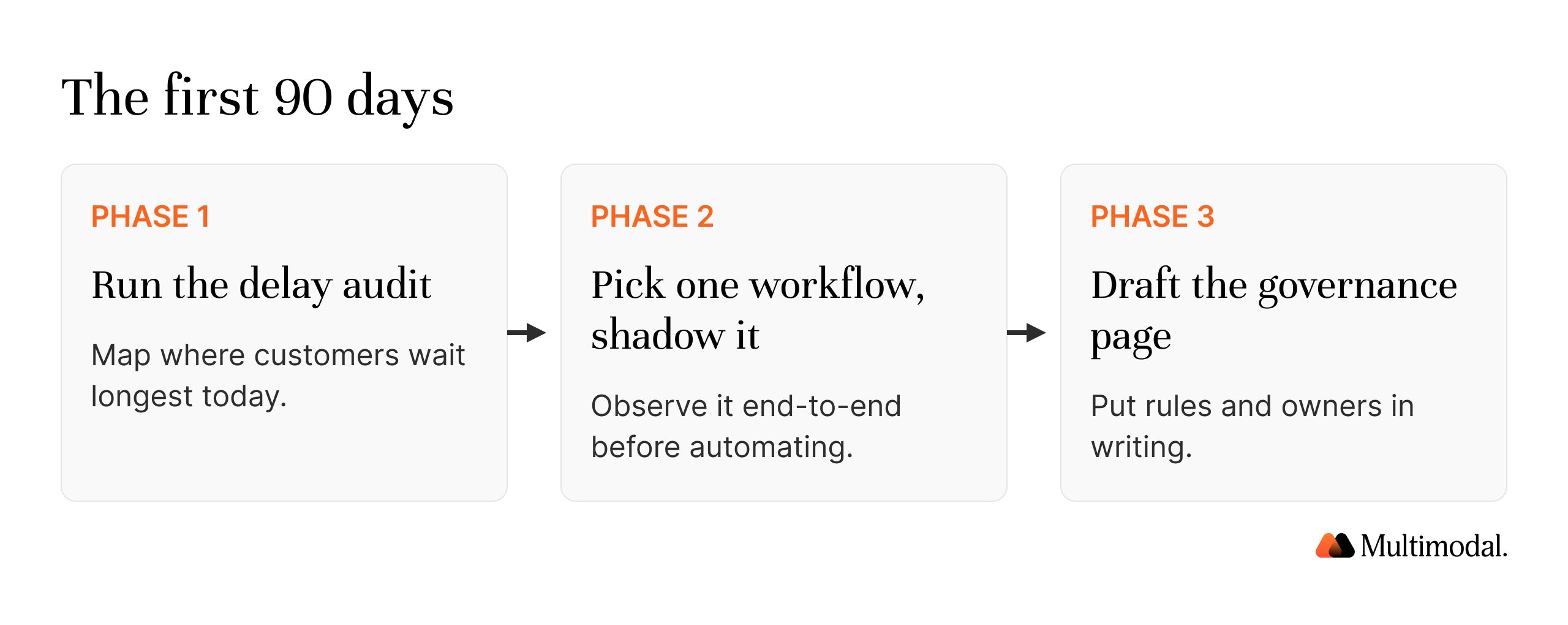
Run the delay audit. Ask department heads where customers wait on the bank, ranked by staff hours per file.
Pick one workflow and shadow it.Implement an AI solution against a file-heavy process on a short contract and track agreement rates. Decision-making stays with employees.
Draft the governance page before the pilot. Accountability, tool inventory, oversight rules, citation requirements, data privacy controls.
The end goal is operational efficiency you can measure, defend, and expand to drive growth. Budgets favor moving now: 45% of community bank executives expect technology budgets to rise at least 40% in 2026. Adoption does not happen without support; change management means talking to employees early, framing AI as a way to remove manual friction, and pausing after each rollout to ask what worked.
Frequently Asked Questions
What can community banks learn from credit union AI adoption?
Prioritize workflows by customer delay, experiment with short contracts, write governance early, use shared innovation vehicles, and fund document automation before chatbots.
Are credit unions really ahead of banks on AI?
Yes on deployment: 59% versus 49% for generative AI; on perceiving back-office value, banks actually lead, 38% versus 21%.
Do regulators allow community banks to use AI?
Yes, within existing risk management expectations. The revised model risk guidance scopes out generative and agentic AI, and no regulator has issued AI-specific rules.
What should a community bank's first AI workflow be?
A document-heavy back-office workflow with a measurable baseline: check or lockbox keying, ACH exception review, or CRE credit memo preparation.
What is the biggest AI mistake community banks can avoid?
Signing a long contract for a chatbot before automating the back office. Second: deploying AI without a governance policy and citation trail.
See an AI Agent Run on Your Bank's Documents
Pick the workflow that hurts most- check processing, ACH exception review, or CRE credit memos- and we will show you AgentFlow working through real files in 30 minutes: extraction, validation, citations, and the audit trail your examiner will ask about.
Credit Unions Ran the Experiment. Community Banks Get the Results.
Credit unions spent four years creating the adoption patterns that work at this scale. Community banks are uniquely positioned to use them: new opportunities to serve their communities and deepen relationships while maintaining customer trust. The banks that own the next five years will pick one workflow this quarter and prove it with evidence a board and an examiner can read.
To see an AI agent running on your bank's documents, book a demo on a check processing, ACH review, or credit memo workflow.

.svg)
.svg)

.avif)
.png)

.png)